
⬇ Download Markdown · ⬇ Download LaTeX · ⬇ original · view original
Lawrence C. Andrews a * and Herbert J. Bernstein b
a Ronin Institute for Independent Scholarship 2.0, USA, and b Fresh Pond Research Institute c/o National Light Source II, Brookhaven National Laboratory, Bldg 745, 11973-5000, Upton, NY, USA. *Correspondence e-mail: [email protected] Received 2 September 2025 Accepted 15 January 2026 Edited by M. I. Aroyo, Universidad del Paı́s Vasco, Spain Keywords: lattice; P 3 ; unit cell; polar coordinates.
The space P 3 is introduced, derived from unit-cell axial lengths and interaxial angles. P 3 enables linearization of unit-cell parameters using three polar coordinate bases. P 3 serves as a compact, interpretable alternative to more abstract spaces such as G 6 and S 6 .
In crystallography, unit-cell geometry is conventionally encoded in a six-dimensional parameter space H 6 = ða; b; c; �; �; �Þ. (‘H’ was chosen to honor the early French crystallographer René Just Haüy.) However, H 6 is not a metric space (where distances can be simply defined), nor is H 6 a vector space (where objects can be added and subtracted). In the same sense, symmetry operations have no simple representations in H 6 . In consequence, H 6 has no simple measure of the ‘difference’ between two lattices: how can one compare a difference of 1 ångström unit versus 1 angular degree?
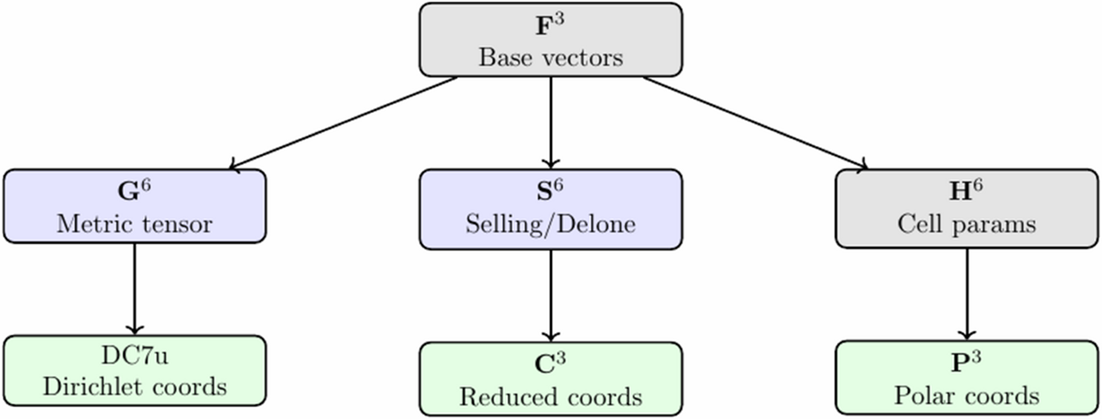
For the above reasons, other spaces are often used to describe lattices, often for specialized purposes (see Table 1). Fig. 1 shows relationships among several of these spaces. Although some of these spaces, such as H 6 and F 3 , are in almost daily use, they are not often referred to as ‘spaces’. In the case of F 3 , symmetry elements are linear operations in this space, and fractional coordinates of atomic positions are vectors expressed in this space.
We propose a ‘linearized’ space, P 3 , derived from H 6 , but having all measures in ångström units (or other chosen linear measures).
Delone et al. (1975) repeatedly pointed out the relationship of the ‘opposite’ scalars in the tetrahedron representations of the Selling scalars. Examining those relationships shows that the opposite terms are pairs where a term involving a is opposite a term involving � etc.
[Note: Boris Delaunay in his later publications chose to render his surname as ‘Delone’ (which is still pronounced the same as Delaunay).]
As described in Table 1, the Selling scalars are a vector: [s 1 ; s 2 ; s 3 ; s 4 ; s 5 ; s 6 ]. Delaunay (1933) represents their relationships as the edge components of a tetrahedron as shown in Fig. 2.
Extending the observation of Delone et al. (1975), the idea occurs to make a triple of those pairs. Since each pair has one length and one angle, we consider each pair as the definition of a polar coordinate. The result is P 3 , a space of three two-
128 https://doi.org/10.1107/S2053273326000410 Acta Cryst. (2026). A82, 128–131
Table 1 Crystallographic spaces with their scalar definitions and analytical purposes.
Space Scalars/coordinates Purpose
also known as ðp 1 ; p 2 ; p 3 Þ
where the parentheses denote a complex number d 1 ; d 2 ; d 3 – edge lengths d 4 ; d 5 ; d 6 – shortest face diagonals u – shortest body diagonal Composite geometric parameter space R 3 > 0 � ð0 � ; 180 � Þ 3 .
Lengths are unconstrained; angles are geometrically restricted. The angles must obey the spherical triangle inequalities (summing to less than 360 � , and the sum of any two must not exceed the third). H 6 is useful for conventional lattice descriptions, but limited in symmetry representation and metric-based classification Base vector space in R 3 . Coordinates are the three-space base
vectors of a unit cell. Lattices are defined using the components of F 3 , and translational symmetry is described in F 3 Base vector space in F 3 plus the negative sum of the three
base vectors. This set of vectors is used in the definition of S 6 , which is the space of Selling/Delone reduction Polar coordinate space defined in terms of unit-cell axial
lengths and their opposing angles (opposing, the angle between the other two unit-cell axes). It is a compact and smooth alternative to H 6 . Useful for comparing unit cells. (This work) Used for Selling/Delone reduction. The scalar components
are dot products between lattice vectors. S 6 supports Bravais lattice classification. 24 Bravais types were defined using the scalar components of S 6 by Delone et al. (1975), later revised using S 6 (Andrews & Bernstein, 2023b) G 6 is based on the metric tensor and used for Niggli reduction
and lattice distance computation (Andrews & Bernstein, 2014). The International Tables describe 44 Bravais types using scalar expressions derived from G 6 (Aroyo, 2016) C 3 associates scalar pairs identified by Delone as ‘opposites’.
Symmetry and Selling/Delone reduction simplify in this space (Andrews & Bernstein, 2023a) DC7u: unsorted Dirichlet cell space derived from Niggli-
reduced cells. Defined as a 7D vector of distances. Fully invertible and smooth; used for rapid lattice distance computation (Bernstein et al., 2023)
DC7u dimensional polar coordinates. See Table 1 for the formal description. Two uses immediately are obvious.
The first use applies the two-dimensional character of the coordinates of P 3 . They allow simple-to-plot representations of collections of unit cells. Plotting each of the coordinates of P 3 generates plots that are easily interpreted as crystallographic axial length/opposite angle pairs. The distance of a point from the origin has a length equal to the axial length, and the interaxial angle between the two other bases (plotted as the angle from the x axis) is illustrated on the plots. Basically, together the three plots of the three coordinates are simple projections of H 6 . See Section 4.
A second use is allowing the calculation of Euclidean distances between pairs of unit cells. Because P 3 can be represented as three xy planes, the Euclidean difference between any two unit cells described as P 3 can be easily computed. This use contrasts with H 6 , where incommensurate lengths and angles do not lend themselves to a distance calculation. See Section 5.
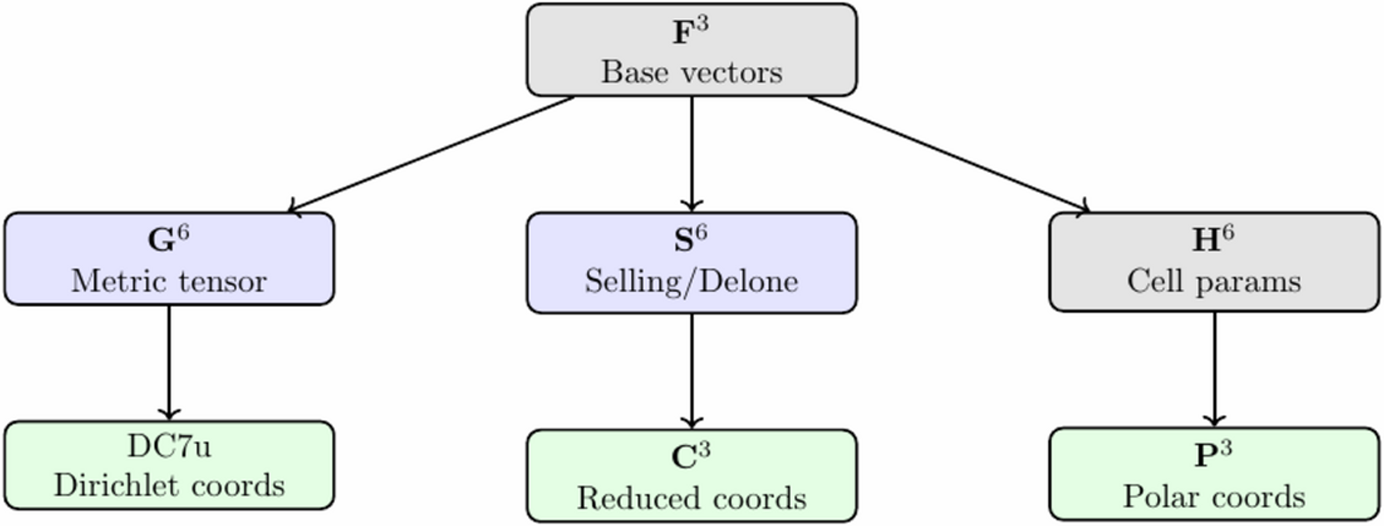
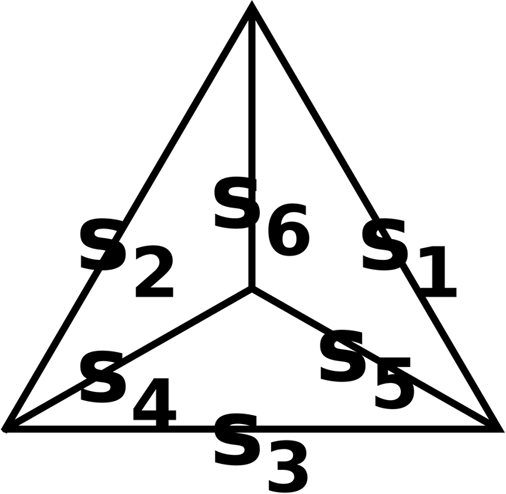
Figure 1 Figure 2 Schematic relationships among crystallographic spaces. The base vector space F 3 gives rise to three scalar spaces: metric tensor space G 6 , Selling/ Delone space S 6 and conventional cell parameter space H 6 . Each transforms into a reduced or classification space: DC7u from G 6 , C 3 from S 6 , and P 3 from H 6 .
The relationships of the Selling scalars as described by Delaunay (1933), but labeled using the vector components of S 6 (Andrews & Bernstein, 2023b). Visualized as a three-dimensional tetrahedron, scalar s 1 is opposite scalar s 4 etc. The number of each scalar is the position in the S 6 vector. See Table 1 for the definitions of the scalars in space S 6 .
Acta Cryst. (2026). A82, 128–131 Andrews and Bernstein � Properties of P 3 129
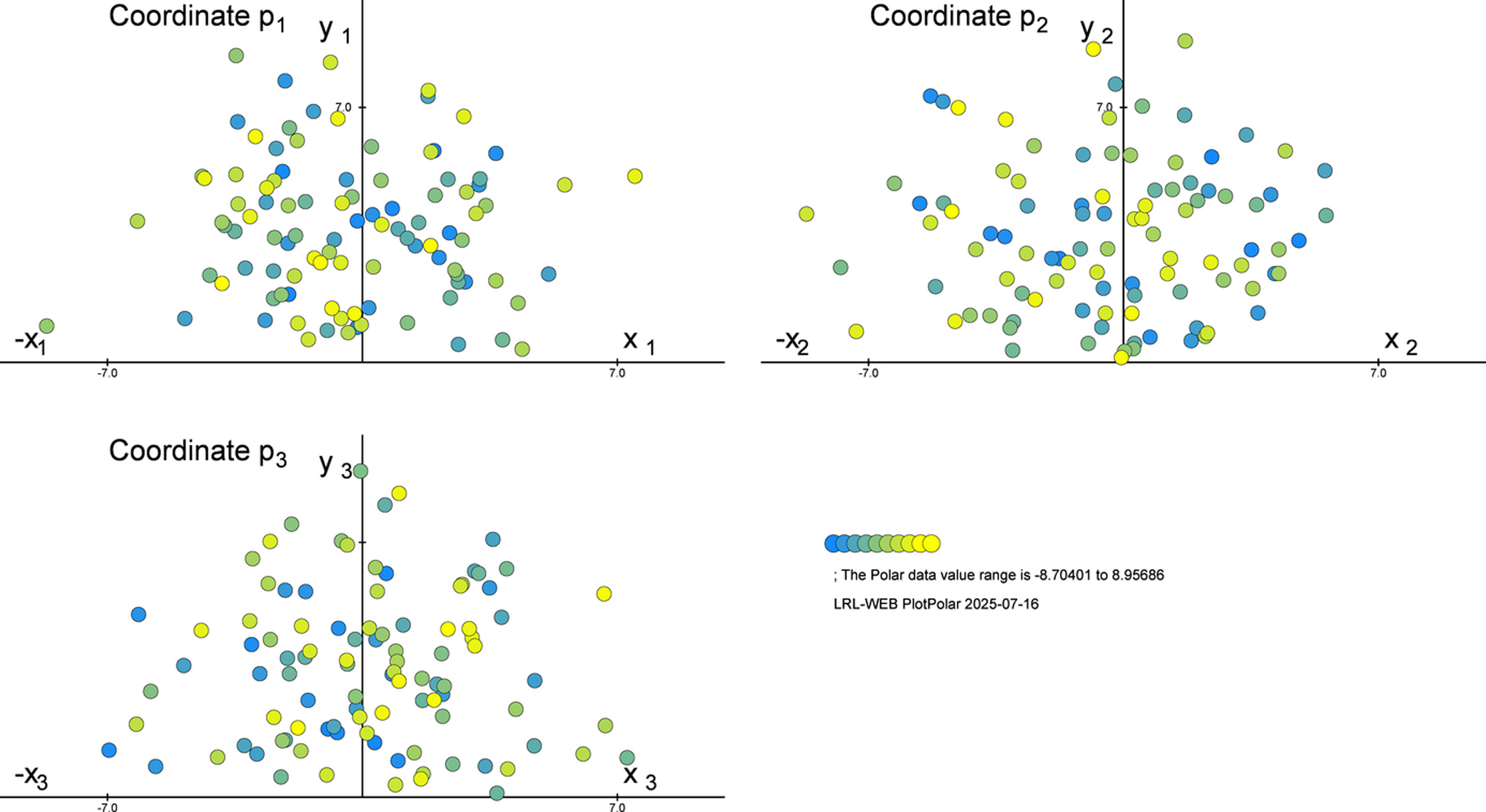
Figure 3 Scatter plots of 100 randomly selected primitive triclinic unit cells represented in P 3 . Each of the three components of P 3 is shown. (Colors reflect the
Figure 4 Scatter plots of the same 100 randomly selected primitive triclinic unit cells represented in P 3 as shown in Fig. 3, Niggli-reduced.
3 While P is derived from the same foundational cell parameters as H 6 , P 3 sidesteps issues of angular nonlinearity that arise in the conventional cell representation. Compared with C 3 (Andrews & Bernstein, 2023a), which derives coordinates from S 6 , the construction of P 3 is more geometric than algebraic. It provides a useful intermediary: more interpretable than metric tensors or other spaces, but less abstract than S 6 or G 6 .
P 3 allows simple-to-plot representations of collections of unit cells. See Figs. 3, 4 and 5, where 100 randomly chosen triclinic
130 Andrews and Bernstein � Properties of P 3 cells are plotted (Fig. 3), and the effects of unit-cell reduction are demonstrated (Fig. 4, Fig. 5).
In 3-space, measuring the Euclidean distance between two points is just computing the square root of the sum of the squares of the differences in the three coordinates. Similarly in P 3 , we compute distances from the square root of the sum of squared differences between the three polar coordinates. Polar coordinates have a Euclidean measure from their xy representation. So, taking the six scalar values of two unit cells presented in P 3 , we calculate a Euclidean distance by the ordinary method.
Acta Cryst. (2026). A82, 128–131
Let us compare two cells derived by modifying a primitive unit cell to form two slightly modified cells, one by changing � and one by changing c.
(1) P 10 10 10 90 90 90 (2) P 10 10 10 90 90 91 (3) P 10 10 10.1 90 90 90. The Euclidean distances between these cells are: 1–2: 0.175 1–3: 0.100 2–3: 0.202. In this example, a 1.0 � change in � yields a Euclidean distance comparable with a 0.1 Å change in the c-axis length.
Acknowledgements Careful copy-editing and corrections by Frances C. Bernstein are gratefully acknowledged.
Funding information Funding for this research was provided in part by: US Department of Energy Offices of Biological and Environmental Research and of Basic Energy Sciences (grant No. DEAC02-98CH10886; grant No. E-SC0012704); US National Institutes of Health (grant No. P41RR012408; grant No. P41GM103473; grant No. P41GM111244; grant No. R01GM117126, grant No. 1R21GM129570); Dectris, Ltd.
The space P 3 is introduced. Less abstract than spaces based on dot products and metric tensors, it provides a simple way to understand the method for comparing unit cells and a convenient method of displaying unit cells.
CmdToP3 and PlotPolar are available in GitHub (https:// github.com/duck10/LatticeRepLib.git).
Acta Cryst. (2026). A82, 128–131 References Andrews, L. C. & Bernstein, H. J. (2014). J. Appl. Cryst. 47, 346–359. Andrews, L. C. & Bernstein, H. J. (2023a). Acta Cryst. A79, 499–503. Andrews, L. C. & Bernstein, H. J. (2023b). Acta Cryst. A79, 485–498. Aroyo, M. I. (2016). Editor. International tables for crystallography,
Vol. A, Space-group symmetry, 2nd ed. International Union of Crystallography. Bernstein, H. J., Andrews, L. C. & Xerri, M. (2023). Acta Cryst. A79,
369–380. Delaunay, B. N. (1933). Z. Kristallogr. 84, 109–149. Delone, B. N., Galiulin, R. V. & Shtogrin, M. I. (1975). J. Math. Sci. 4,
79–156.
Andrews and Bernstein � Properties of P 3 131