
⬇ Download Markdown · ⬇ Download LaTeX · ⬇ original · view original · CSV: table 1, table 2

ISSN 2053-2733
Michael O’Keeffe a and Michael M. J. Treacy b * a School of Molecular Sciences, Arizona State University, Tempe, Arizona 85287, USA, and b Department of Physics, Arizona State University, Tempe, Arizona 85287, USA. *Correspondence e-mail: [email protected] Received 27 February 2026 Accepted 5 June 2026 Edited by P. M. Dominiak, University of Warsaw, Poland Keywords: nets; graphs; tessellate; decussate; symmetric nets.
Vertex- and edge-transitive graphs that admit tilings (tessellate graphs) have been known for 20 years. In this paper, we identify additional families of vertexand edge-transitive graphs with symmetric embeddings, for which the order of the point symmetry at a vertex equals the vertex’s coordination number. Remarkably, symmetric tessellate graphs appear over 150 000 times in crystal structures, while there is only one reported occurrence of a symmetric decussate (untessellable) graph.
In our previous work, we examined woven, knotted, catenated and tangled structures from a crystallographic chemistry perspective. Structures are first described as abstract graphs and then embedded in Cartesian space to identify the topologies they generate. We have observed that the simplest graphs tend to appear in actual crystals – those with the fewest crystallographically distinct vertices and edges. This is known as the principle of minimum transitivity (Li et al., 2014), a variation of Pauling’s rule of parsimony: ‘the number of essentially different kinds of constituents in a crystal tends to be small’ (Pauling, 1929). Of particular interest are topologies with symmetric graphs, which not only exhibit minimum transitivity but also have the order of the vertex site symmetry equal to or greater than the coordination of the vertex (Li et al., 2025; Zhou, 2026). Here, we systematically explore all possible 3-periodic symmetric graphs to assess their relevance to crystal chemistry.
We start with some definitions. An abstract graph, G ð V; E Þ, is a set of vertices, V, some of which are connected by edges – the edge set, E. A spatial graph is an embedding of the abstract graph into three-dimensional Euclidean space. A net is a rectilinear spatial graph with straight non-intersecting edges. Furthermore, a net is connected (there exists a path between every pair of edges) and simple (there are no multiple links between vertices or loops connecting a vertex to itself). If all vertices and edges are related by symmetry, we say the graph is vertex- and edge-transitive, denoted by ½ 1 1 �. For such a net, we define a symmetry number s ¼ o=n, where o is the order of the point symmetry at the vertex site and n is the coordination number of the vertex. Finally, if s > 1 we say the net is supersymmetric, if s ¼ 1 the net is symmetric, and if s ¼ 1=2 the net is semisymmetric.
We find it useful to calculate the girth of rectilinear struc-
tures, which we define as the shortest distance between nonadjacent edges, divided by the length of the longest edge; thus, 0 � girth � 1. In this study of transitivity ½ 1 1 � graphs, all edges have equal length. The girth cannot exceed 1 because, at that
Acta Cryst. (2026). A82 https://doi.org/10.1107/S2053273326005991 1 of 5
Table 1 Symmetric (s � 1) and semisymmetric (s = 1/2) vertex- and edge-transitive tessellate nets with edges corresponding to the shortest distances between vertices.
n is the coordination number and s the symmetry number. Coordinates refer to the ‘1st origin choice’ when applicable. c and a are unit-cell edge lengths. ‘Occ’ is the number of occurrences of that graph as a crystal structure, as reported by TopCryst.
n s RCSR Symmetry From To c/a Occ 3 4 4 4 4 4 4 4 4 4 6 6 6 6 6 6 8 8 8 8 12 12 2 6 4 2 1 1 1 1 1 1/2 8 2 2 2 1 1 6 1 2 1/2 4 1/2 srs dia nbo sod lcs lcv lvt qtz rhr ana pcu crs hxg acs lcy bcs bcu lcx reo thp fcu ibb I4 1 32 � Fd 3m � Im 3m Im � 3m Ia � 3d I4 1 32 I4 1 /amd P6 2 22 Im � 3m � Ia 3d � Pm 3m Fd � 3m Pn � 3m P6 3 /mmc P4 1 32 Ia � 3d Im 3 � m � Pm 3n � Pm 3m Ia � 3d Fm � 3m � Ia 3d 1/8, 1/8, 1/8 0, 0, 0 0, 0, 1/2 1/4, 0, 1/2 3/8, 0, 1/4 1/8, 0, 1/4 0, 1/4, 1/8 1/2, 0, 0 0.3333, x, 0 1/8, 0.3333, 1/4 0, 0, 0 1/8, 1/8, 1/8 1/4, 1/4, 1/4 1/3, 2/3, 1/4 3/8, 3/8, 3/8 0, 0, 0 0, 0, 0 0, 1/2, 1/4 1/2, 0, 0 3/8, 0, 1/4 0, 0, 0 1/8, 1/8, 1/8 3/8, 1/8, 1/8 1/4, 1/4, 1/4 0, 1/2, 1/2 1/2, 0, 1/4 1/2, 1/4, 1/8 0, 1/4, 1/8 1/4, 1/2, 3/8 1/2, 1/2, 1/3 1/2 x, 1/2 x, 1/2 1/4 y, 3/8, y 1/2 1, 0, 0 3/8, 3/8, 1/8 3/4, 1/4, 1/4 2/3, 1/3, 3/4 3/8, 1/8, 5/8 1/4, 1/4, 1/4 1/2, 1/2, 1/2 1/4, 0, 1/2 0, 1/2, 0 0, 1/4, 3/8 1/2, 1/2, 0 3/8, 5/8, 1/8 1 1 1 1 1 1 1.000 1.092 1 1 1 1 1 0.817 1 1 1 0.833 1 1 1 1 956 40213 718 643 63 30 513 682 7 68 38844 62 17 13376 3214 23 8001 0 82 18 49922 0 limit, vertices on the second-nearest-neighbor edges are one edge-length away. The girth values we report are usually the maximum values found for each spatial graph (ambient isotopy), without allowing edges to cross. The concept of girth is useful for rectilinear nets and is related to ropelength (Cantarella et al., 2002) and thickness (Litherland et al., 1999), which are better suited for structures with smoothly curved edges. We note that the term ‘girth’ is also used in graph theory for the number of edges of the smallest ring. ‘Girth’ in that context is an integer �3 and is an invariant property of the graph. ‘Girth’ in our context is a property of a particular rectilinear embedding within each ambient isotopy.
It has also been found useful (O’Keeffe & Treacy, 2024) to describe graphs as tessellate (admitting a tiling) or decussate (not admitting a tiling). Generally, decussate nets contain linked rings or tangles, which interfere with the net’s ability to fill space with closed-volume tiles with no edges piercing the faces. However, such self-intersections are not the defining feature of decussate graphs. Some graphs are untessellable, but do not contain any linked rings or tangles. Other graphs are tessellate, but generate nets (topologies) that cannot be tiled: these cases are of particular interest. Tessellate graphs can be systematically enumerated using the methods developed by Dress, Huson and Delgado-Friedrichs (Delgado-Friedrichs et al., 1999). Using this approach, all tessellate ½ 1 1 � graphs and their corresponding nets were identified (Delgado-Friedrichs & O’Keeffe, 2007); the structural data for these are given in Table 1. For all these nets in full-symmetry embeddings, edge lengths correspond to the shortest distances between vertices. They are often the largest-girth members of families of structures that share the same graph but differ in ambient isotopy class – that is, they have different topologies.
yMany of the nets described here are also listed in the Reticular Chemistry Structure Resource (RCSR) database, available at http://rcsr.net/. They are identified by a threeletter (lower-case, bold) symbol such as dia.
It has been shown (Li et al., 2025) that there are only 11 supersymmetric 3-periodic nets. They are listed in Table 1. The table also includes eight nets with s = 1, and three semisymmetric nets (including the zeolite framework ana). In this paper, we focus particularly on identifying and describing semisymmetric (s ¼ 1=2) nets. These were obtained through a systematic search, as explained next.
We first note that srs is the only possible transitivity ½ 1 1 � net with 3-coordination (Delgado-Friedrichs & O’Keeffe, 2003). Therefore, new symmetric graphs must have coordination numbers of 4, 6, 8 or 12 – the possible orders of site symmetry of the invariant lattice complexes. With one exception, structures in which the vertex site symmetry matches the vertex coordination number are invariant lattice complexes; that is, the vertex coordinates are fixed on special sites. The exception, discussed further below, involves sites with coordinates x; 0; 0 or 0; 0; z with symmetry 4. Generally, for rectilinear spatial graphs without edge intersections, the space group must lack mirror planes. Symmetric graphs with mirrors (Table 1) have edges that are the shortest distances between vertices.
Much of our work has focused on tessellate and tangled/ self-linked decussate nets, but it is clearly of interest to identify the symmetric untessellable types, and assess their significance in crystal chemistry. This motivates this work.
O’Keeffe and Treacy � Symmetric vertex- and edge-transitive 3-periodic nets Acta Cryst. (2026). A82
Table 2 Symmetric vertex- and edge-transitive net data.
Apart from lcs, lcv and lcy, all structures are decussate. Under ‘Symm’ are the space groups and the point groups at the vertex positions. n is the coordination number. ‘LC’ lists the symbol for the lattice complex. Under ‘vertex’ is the point symbol for the vertex, giving the size and number of the shortest cycles at each angle. The RCSR symbol for the net is in the last column.
Symm n LC From To Girth � 32 R 3c R � 3c 32 6 6 R c R c 0, 0, 1/4 0, 0, 1/4 4/3, 5/3, 5/12 1/3, 8/3, 5/12 0.1429 6 15 0.0526 6 15 – –
Pn 3 � 32 Pn 3 � 32 6 6 F F 1/4, 1/4, 1/4 1/4, 3/4, 7/4 1/4, 1/4, 1/4 1/4, 11/4, 1/4 0.0663 6 12 .8 3 0.0154 6 12 .8 3 – –
Fd � 3 � 3 Fd � 3 � 3 6 6 T T 1/8, 1/8, 1/8 1/8, 1/8, 7/8 1/8, 1/8, 1/8 3/8, 1/8, 11/8 0.1326 6 12 .8 3 0.0307 6 12 .8 3 fdt – P432 422 P432 422 8 8 J* J* 1/2, 1/2, 0 1/2, 1/2, 0 0.1380 3 4 .6 24 0.0282 6 20 .8 8 – – F4 1 32 32 F4 1 32 32 6 6 T T 1/8, 1/8, 1/8 1/8, 1/8, 1/8, 1/8 1/8, 0.1326 6 9 .8 6 0.0225 6 9 .8 6 foo – I432 222 I432 222 4 4 W* 1/4, 1/2, 0 W* 1/4, 1/2, 0 1/2, 3/4, 1 1, 3/2, 3/4 0.0524 10 6 0.0419 10 6 – –
I432 4 4 – 0, 0, 0.7071 0.2071, 0.5, 0.5 0.5051 8 6 qld P4 3 32 32 P4 3 32 32 6 6 Y Y 1/8, 1/8, 1/8 3/8, 1/8, 1/8, 1/8 7/8, 1 3 3 .5 12 0.0850 6 15 lcy qok P4 3 32 3 3 – 0.3394, x, x x + 1/4, x
7/4 x 1/4, 0.1819 10 3 srs-z I4 1 32 32 6 Y* 1/8, 1/8, 1/8 1/8, 7/8, 3/8 0.1907 6 15 pok
| I41 32 222 4 V | 1/8, 0, 1/4 | 0, 1/4, 1/8 | 1 32 .104 | lcv |
|---|---|---|---|---|
| I41 32 222 4 V | 1/8, 0, 1/4 | 0, 3/4, 3/8 | 0.2134 106 | okt |
| I41 32 222 4 V | 1/8, 0, 1/4 | 3/4, 5/8, 1/2 | 0.1641 106 | lok |
| I41 32 222 4 V | 1/8, 0, 1/4 | 1/2, 1/4, 1/8 | 0.1306 96 | tok |
� 4 � Pn 3n Pn � 3n � 4 4 4 W* 1/4, 0, 1/2 W* 1/4, 0, 1/2 1/2, 1, 3/4 1, 3/4, 3/2 0.0525 6 4 .10 2 0.0419 6 4 .10 2 – –
Ia � 3d � 4 � 4 � Ia 3d 4 4 S* S* 1/2, 1/4, 1/8 3/4, 3/8, 1/2 1 6 4 .10 2 0.1956 6 4 .10 2 lcs idd 3/8, 0, 1/4 3/8, 0, 1/4 3/2, 0, 1/2 0, 3/2, 1/2 1/8, 7/8 9/8, 7/8 1/8, 5/8 3/8, 5/8 Vertex RCSR 3 2 .10 4 10 6 10 6 9 6 lcv okt lok tok Accordingly, to identify new transitive symmetric graphs, we examined the invariant sites of all space-group symmetries without mirrors. We generated structures where edges connect the canonical special site [the first listed in the International Tables for Crystallography (Aroyo, 2016)] to all symmetryrelated images of that site, with coordinates bounded by 3 � x; y; z � 3, i.e. connections to all image sites within a block of 7 3 ¼ 343 unit cells. We feel this range is adequate, as in every case but one where more than one graph emerges, at least two have 2 < x; y; z < 2. Of course, this has no bearing on the problem of whether a family is finite or infinite. The � where the second graph only exception was for symmetry Pn 3, had one coordinate > 2 (see Table 2).
The identities of the resulting graphs were then determined using the program Systre (Delgado-Friedrichs & O’Keeffe, 2003). For a given symmetry and Wyckoff position, we often found that several graphs could be constructed, each generating a family of topologies with different girths. These could be symmetric (s ¼ 1) or semisymmetric (s ¼ 1=2, n = 8 or 12). Table 2 provides data for the two largest-girth symmetric graphs. There is only one entry for a symmetric graph with vertex symmetry 4: qld, symmetry I432. This graph has the unusual property that, in barycentric coordinates, all edges are equal, yet pairs of edges overlap to form a ‘folding ladder’. This topic has been discussed in detail by Delgado-Friedrichs et al. (2025). In that paper, it was noted that the net served as the underlying structure of a metal–organic framework, GUHMIH (Wang et al., 2015). The abundance of knotted rings in the structure appears to eliminate the possibility of a tiling.
Also listed in Table 2 are data for srs-z with symmetry P4 3 32. This is a tangled embedding of the srs graph. It is the largest-girth member of a possibly infinite family of such embeddings, all with s ¼ 1. They are all the same graph but represent different ambient isotopy classes, so they are different nets.
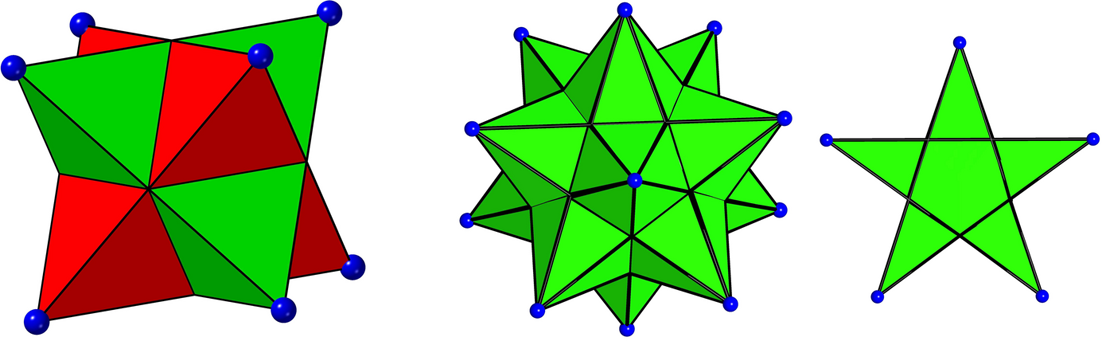
Since our main focus is on chemical structures, our earlier research limited the discussion to spatial graphs with nonintersecting edges. However, this restriction does not apply to abstract graph theory, and mathematicians usually also consider finite spatial graphs with intersecting edges, such as stellated polyhedra. In Fig. 1, we present two examples. The first is Kepler’s stella octangula, which is derived from an octahedron by stellation – adding a trigonal pyramid to each
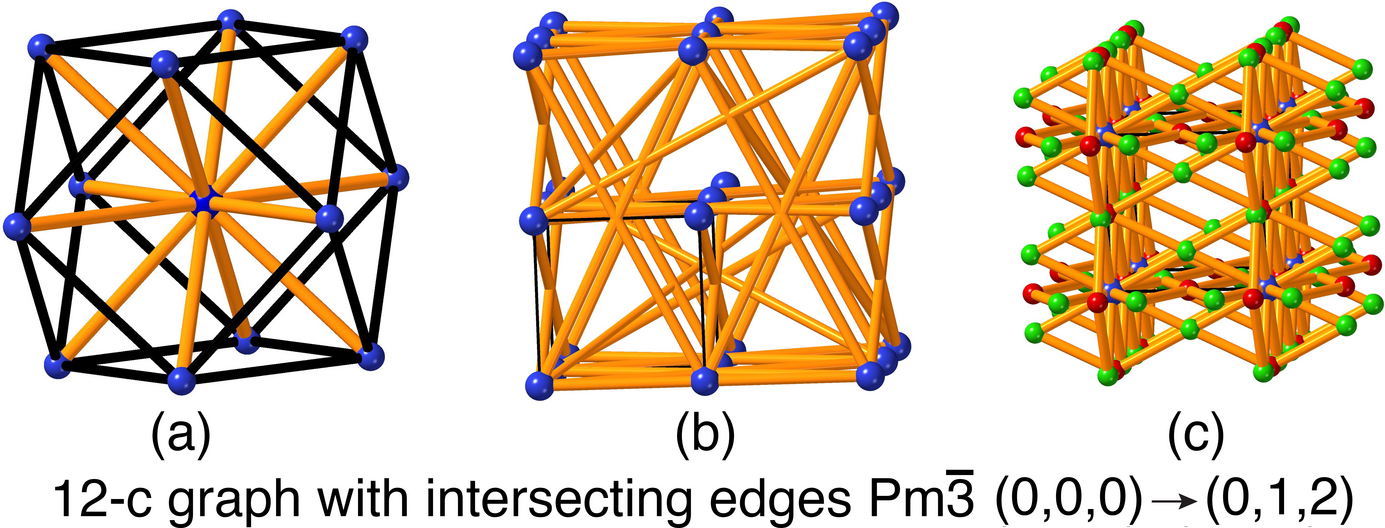
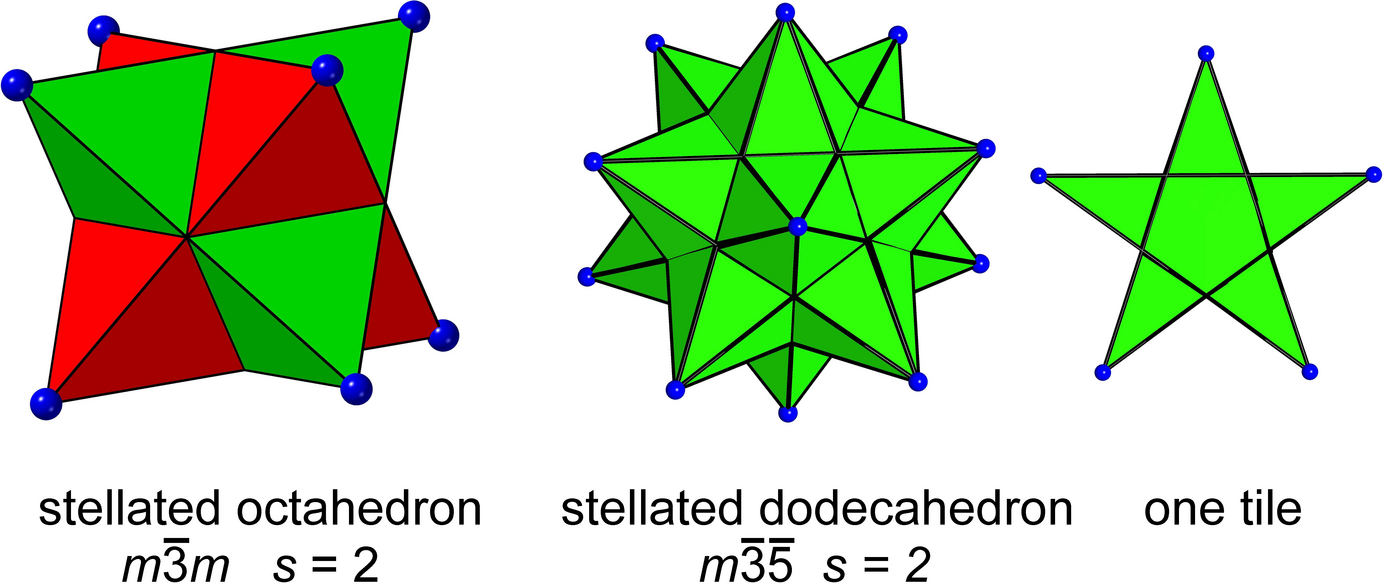
Figure 2 Figure 1 Examples of stellated polyhedra: embeddings of graphs with intersecting edges.
Acta Cryst. (2026). A82 A supersymmetric spatial graph (s ¼ 2) with intersecting edges. (a) The coordination figure. (b) A fragment of the periodic structure showing the intersecting edges; (c) by placing new vertices at the edge intersections, we obtain a (4-4-12)-coordinated graph with transitivity ½ 3 2 �, and no edge intersections. The different types of vertex are colored red, green and blue (the original vertices).
O’Keeffe and Treacy � Symmetric vertex- and edge-transitive 3-periodic nets 3 of 5
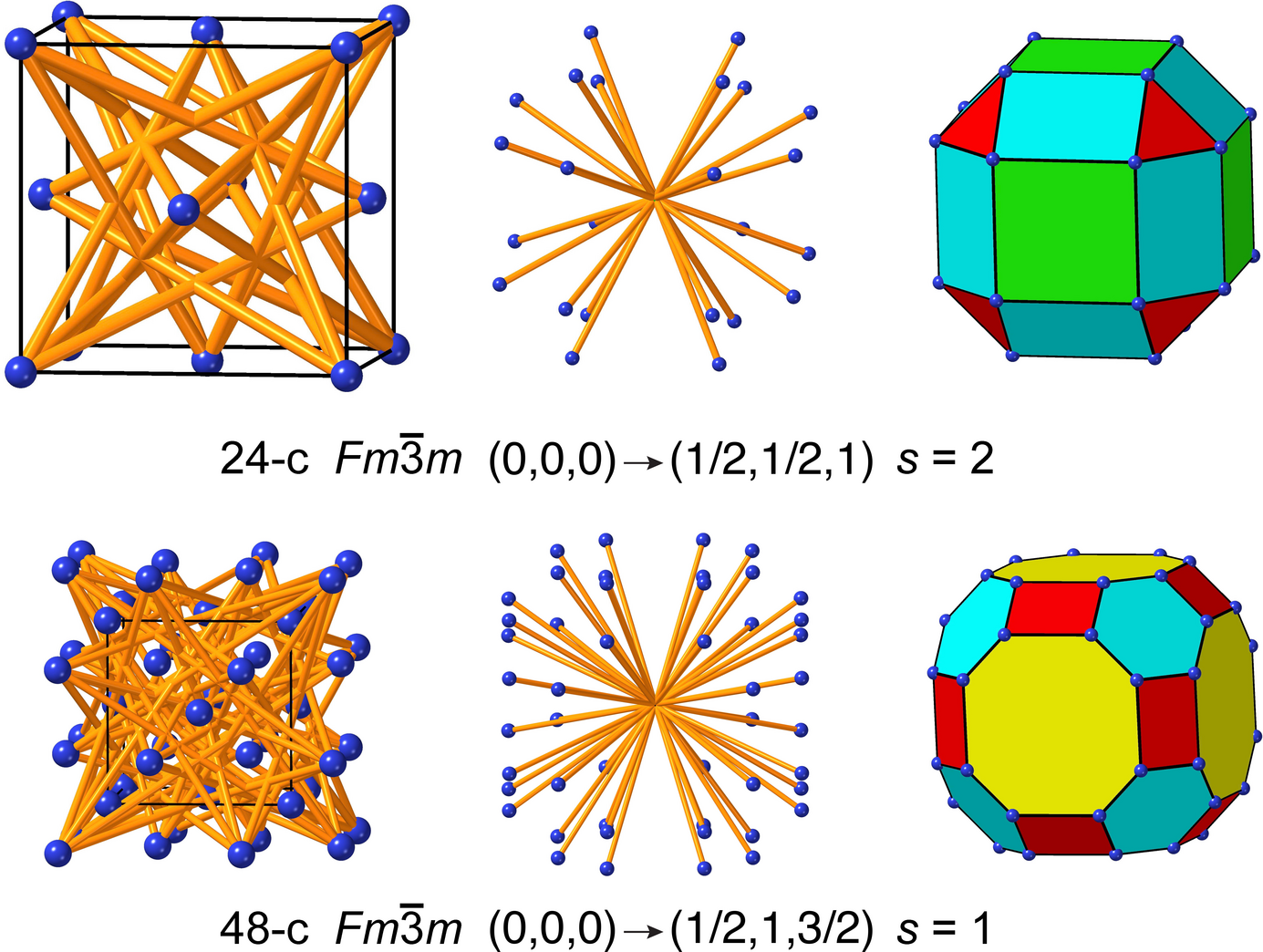
Figure 3 Examples of symmetric 24- and 48-coordinated periodic graphs with intersecting edges in a rectilinear embedding (left). The coordinating edges from a single vertex are shown in the center, and the corresponding coordination polyhedra are shown on the right.
face. The resulting structure can be viewed as two interpenetrating regular tetrahedra, focusing only on the eight outer vertices. The second example we show is a dodecahedron stellated with pentagonal pyramids. This structure consists of 12 stellate vertices forming a dodecahedron with pentagram faces (5-pointed stars), as illustrated in the figure.
Delgado-Friedrichs & O’Keeffe (2009) described periodic lattice nets. These are vertex- and edge-transitive periodic spatial graphs with only one vertex per primitive unit cell. In particular, especially relevant to this work, we find infinite families of 3-periodic structures with cubic symmetry. In Fig. 2, we show a simple example of a 12-coordinated supersymmetric (s ¼ 2) spatial graph with intersecting edges. Interestingly, if vertices are placed at the edge intersections, a (4, 4, 12)-connected net with transitivity ½ 3 2 � is obtained. Such minimal-transitivity nets are of significant interest in reticular chemistry and have been systematically derived (Chen et al., 2020). In Fig. 3, we present two simple examples: a 24-coordinated graph with s ¼ 2 (supersymmetric) and a 48-coordinated graph with s ¼ 1 (symmetric); again, there are intersecting edges. We emphasize that in a net, ‘intersecting’ edges actually correspond to edges from a vertex located at the intersection point.
Wells (1977) paid special attention to spatial graphs in which the shortest ring at each angle was the same size. These were called uniform nets. We briefly mention nets in which all the shortest rings are related by symmetry.
The number of angles at a vertex with a coordination number n is m ¼ n ð n 1 Þ=2. If all the shortest rings have the same number of edges r, then the point symbol is compact, r m . Several nets in Table 2 have this type of point symbol. We ask: ‘For which of these are all the shortest rings related by
symmetry?’ (i.e. which are ‘shortest-ring-transitive’?). The only nets in which the angles are related by symmetry are srs and dia. For these, the vertex symbols are 10 5 :10 5 :10 5 � ð 10 5 Þ 3 and 6 2 :6 2 :6 2 :6 2 :6 2 :6 2 � ð 6 2 Þ 6 , respectively. For the nets of Table 2, we find that the following have all their shortest rings symmetry-related:
(a) 4-coordinated. The net qld has 8-rings as the shortest ring at each angle, symbol 8 6 . The extended symbol is ð 8 6 Þ 2 : ð 8 7 Þ 4 , for a total of 40 8-rings at each vertex.
The net tok has the symbol 9 6 . The number of shortest rings is the same at each angle, so the extended symbol is ð 9 4 Þ 6 .
Two 10 6 families in Table 2 have the same extended vertex symbol. These are the I432 family (vertices at 1=4; 1=2; 0), where the largest girth is 0.0524, and for the I4 1 32 family, for which okt has the largest girth of 0.2134. For these, the extended vertex symbol is ð 10 2 Þ 2 : ð 10 4 Þ 4 .
(b) 6-coordinated. We find just qok, with a girth of 0.0850 and a vertex symbol 6 15 , which is ð 6 2 Þ 12 : ð 6 4 Þ 3 in extended format. The pok net, girth 0.1907, also 6 15 , has an extended symbol ð 6 2 Þ 9 : ð 6 3 Þ 6 . In both cases, there is a total of 36 6-rings. � girth 0.1429 and 0.0526, the For the graphs with symmetry R 3c, 15 extended symbol is (6
4 ) for a total of 60 6-rings at each vertex.
(c) 12-coordinated. We mention here one semisymmetric (s ¼ 1=2) 12-coordinated net in the RCSR, ibb, with symbol 4 66 and girth 0.0106. The extended symbol is 4 33 : ð 4 2 Þ 12 : ð 4 3 Þ 12 : ð 4 5 Þ 9 , for a total of 138 rings at each vertex. Being semisymmetric decussate, it is not listed in Table 2.
We highlight a family of symmetric graphs of particular interest. The symmetry is I4 1 32 with vertices at Wyckoff site 12c, 1=8; 0; 1=4. The net with edges corresponding to the p ffiffi shortest possible distance between vertices, 6 a=8, where a is the cubic unit-cell edge is lcv. The net with the next- p ffi length, ffiffiffiffi shortest edge length is 14 a=8. After that comes a sequence of 14 nets with connecting coordinates in the range 2 � x; y; z � 2, each with p the ffiffiffiffiffi same vertex symbol (starting with okt) and edge length 38 a=8.
The presence of a graph as the underlying net of a crystal structure is readily determined using the program TopCryst (Shevchenko et al., 2022). This tool is accessible directly from the RCSR database for the nets listed in Table 1. Notably, all of these nets, except for lcx and semisymmetric ibb, appear in crystal structures: the number of occurrences for each is recorded in the table. Each net occurs multiple times, especially the supersymmetric (s > 1) nets, with over 150 000 total occurrences. In contrast, for the structures in Table 2, except for lcs, lcv and lcy, which, being the tessellate ‘heads of families’ with decussate ‘offspring’, are also listed in Table 1, there is only one occurrence of qld, which is found in a synthetic metal–organic framework structure with long ligands connecting vertices that are not nearest neighbors (Wang et al., O’Keeffe and Treacy � Symmetric vertex- and edge-transitive 3-periodic nets Acta Cryst. (2026). A82
2015). We find this result remarkable: with just this one exception, the only symmetric graphs relevant to crystal chemistry are tessellate.
In this work, we have shown that vertex- and edge-transitive nets fall into two distinct groups. One group consists of 20 nets that can be carried by tilings of tessellate graphs. These nets serve as the underlying topology of numerous crystalline materials. The second group includes large, possibly infinite, families of graphs. We believe all of these are decussate (do not admit tilings), although we recognize that it is often very difficult to rigorously prove the absence of a tiling. However, in this case, none appear in a systematic enumeration of vertex- and edge-transitive tilings.
Having said this, we also recognize that, from a purely mathematical perspective, the lack of relevance of decussate structures to real-world materials is not particularly significant.
Acknowledgements We are grateful to Professor Davide M. Proserpio for valuable discussions and for confirming with TopCryst that structures based on symmetric, low-transitivity decussate graphs do not arise in real materials, except for the special case of qld.
Acta Cryst. (2026). A82 References Aroyo, M. I. (2016). International Tables for Crystallography, Vol. A,
Space-Group Symmetry. Wiley. Cantarella, J., Kusner, R. B. & Sullivan, J. M. (2002). Invent. Math.
150, 257–286. Chen, Z., Jiang, H., Li, M., O’Keeffe, M. & Eddaoudi, M. (2020).
Chem. Rev. 120, 8039–8065. Delgado-Friedrichs, O. & O’Keeffe, M. (2003). Acta Cryst. A59, 351–
Delgado-Friedrichs, O. & O’Keeffe, M. (2007). Acta Cryst. A63, 344–
Delgado-Friedrichs, O. & O’Keeffe, M. (2009). Acta Cryst. A65, 360–
Delgado-Friedrichs, O., O’Keeffe, M. & Treacy, M. M. J. (2025). Acta
Cryst. A81, 49–56. Friedrichs, O. D., Dress, A. W. M., Huson, D. H., Klinowski, J. &
Mackay, A. L. (1999). Nature 400, 644–647. Li, M., Li, D., O’Keeffe, M. & Yaghi, O. M. (2014). Chem. Rev. 114,
1343–1370. Li, M., O’Keeffe, M. & Treacy, M. M. J. (2025). Acta Cryst. A81, 419–
Topol. Its Appl. 91, 233–244. O’Keeffe, M. & Treacy, M. M. J. (2024). Int. J. Topol. 1, 1–10. Pauling, L. (1929). J. Am. Chem. Soc. 51, 1010–1026. Shevchenko, A. P., Shabalin, A. A., Karpukhin, I. Y. & Blatov, V. A.
(2022). Sci. Technol. Adv. Mater. Methods 2, 250–265. Wang, X., Chang, Z., Lin, H., Xu, C., Luan, J., Liu, G. & Tian, A.
(2015). RSC Adv. 5, 35535–35540. Wells, A. F. (1977). Three Dimensional Nets and Polyhedra. New
York: Wiley. Zhou, W. (2026). Acta Cryst. A82, 1–3.
O’Keeffe and Treacy � Symmetric vertex- and edge-transitive 3-periodic nets 5 of 5