⬇ Download Markdown · ⬇ Download LaTeX · ⬇ original · view original · CSV: table 1
nature reviews materials https://doi.org/10.1038/s41578-025-00779-1 Perspective Check for updates
Introduction 5 , Spectroscopic characterization of altermagnetic spin splitting
Spin phenomena induced by the spin-split band in altermagnets
Perspectives Key Laboratory of Advanced Materials (MOE), School of Materials Science and Engineering, Tsinghua University, Beijing, China. 2 Institute of Physics ASCR, v. v. i., Prague, Czech Republic. 3 Center for Photon Science, Paul Scherrer Institut, Villigen, Switzerland. 4 Institut de Physique, École Polytechnique Fédérale de Lausanne, Lausanne, Switzerland. 5 Department of Physics, The Hong Kong University of Science and Technology, Hong Kong, China. 6 These authors contributed equally: Cheng Song, Hua Bai. e-mail: [email protected]; [email protected]; [email protected]; [email protected] 1 Nature Reviews Materials | Volume 10 | June 2025 | 473–485 473
Altermagnetism 1 , a novel type of magnetism beyond traditional ferromagnetism and antiferromagnetism, has recently attracted considerable attention 2,3 in terms of both fundamental physics and potential device applications. Distinguished by their non-relativistic spin splitting in the electronic band structure despite their compensated collinear magnetic configurations 1–11 , altermagnets can produce time-reversal symmetry-breaking magneto responses akin to ferromagnets. Moreover, they display negligible stray fields, immunity to external disturbances and terahertz dynamic frequency, which are typically associated with antiferromagnets 12,13 . These distinctive features stem from specific crystal and spin symmetries inherent to altermagnets, which endow them with non-relativistic and alternating spin splitting 1,2 .
Traditionally, the spin splitting of electronic bands can arise from either relativistic spin–orbit coupling (SOC) (such as Rashba-type 14 and Dresselhaus-type 15 spin splitting) or non-relativistic exchange coupling (such as Zeeman splitting in ferromagnets) (Fig. 1a). In conventional collinear antiferromagnets, opposite magnetic sublattices are linked by combinations of time-reversal symmetry (T) and spatial operations including inversion (P) or translation (t) symmetries, which lead to spin degeneracy in the whole Brillouin zone (Fig. 1b) in the limit of zero SOC. Note that the spin degeneracy is only valid for P∙T symmetry when considering finite SOC. By contrast, owing to the specific crystal environment, opposite sublattices in altermagnets can be connected by symmetry (C) operations that are not inversion or translation 1,2,16 , including rotations, mirrors, glides and screws. This results in C-compensated alternating spin density in real space and C-paired spin-momentum/valley locking in reciprocal space 1,2,5,9,17,18 (Fig. 1c). This spin splitting arises from exchange coupling rather than SOC; hence, the band splitting energy can be comparable to that of ferromagnets 1,2,5 (approximately electronvolt). Similar spin configurations in the momentum-space electronic structure could also stem from the Pomeranchuk instability 6,19 . As in collinear antiferromagnets, the magnetic states of altermagnets can be described by the Néel vector n, representing the difference between the moments (m 1 − m 2 ) in the opposite sublattices.
a Ferromagnet
k y Nature Reviews Materials | Volume 10 | June 2025 | 473–485
474
which are based on momentum-selective conduction channels rather than momentum-averaging conductivity, can occur in altermagnets with higher even-parity. Additionally, odd-parity wave magnets, typically p-wave magnets, show unique non-relativistic antisymmetric spin splitting and great potential for spin current generation 36,37 . However, besides collinear order, p-wave magnets can also exhibit non-collinear magnetic structures 36 and are beyond the scope of this Perspective. Overall, altermagnets represent a broad category within well-known magnetic materials and do not rely on rare or toxic elements, yet they can exhibit exotic magneto responses and possess tremendous potential for device applications.
In this Perspective, we primarily summarize recent experimental progress in altermagnetism. The first part discusses direct observations of altermagnetic spin-split bands through spectroscopic techniques. The second part introduces magneto-transport phenomena in altermagnets, including the anomalous Hall and Nernst effects, as well as the non-relativistic charge–spin interconversion. We also discuss ideas for manipulating the magnetic and crystal orders of altermagnets via spin torques or strain, facilitating tunable altermagnet-based spintronic devices. Looking ahead, we outline concrete experimental tasks in altermagnetic spintronics and explore potential applications within diverse research fields, including magnonics, ultrafast photonics, phononics and properties such as superconductivity, topology and multiferroicity. Several recent review papers summarize the theoretical and experimental progress of altermagnets in spintronics 38–40 . Our Perspective expands on this work and surveys the potential of altermagnets in fields beyond spintronics.
Before focusing on specific experiments involving altermagnets, we discuss some conflicting results that will need to be reconciled to advance the field. First, RuO 2 was once characterized as a magnetically ordered material with compensated antiparallel ordering of magnetic moments on Ru atoms 41,42 , whereas recent experiments reported the absence of magnetic ordering 43–45 . Meanwhile, both the absence and the existence of spin splitting in momentum space were suggested through angle-resolved photoemission spectroscopy (ARPES) measurements 46–48 . Non-stoichiometry 49 and strain 50,51 (for thin films) could be possible reasons for the different results, and more work is needed to resolve this controversy. Second, according to neutron diffraction data 52 , bulk Mn 5 Si 3 is not an altermagnet and cannot show non-relativistic spin splitting. However, systematic characterization of the lattice parameters of Mn 5 Si 3 thin films 53,54 has indicated an unusual transition of the magnetic structure owing to strain, which breaks P∙T and t∙T symmetries, such that strained Mn 5 Si 3 thin films are likely to be altermagnets. Other techniques, such as neutron scattering, Lorentz transmission electron microscopy and ARPES, are expected to more directly characterize the magnetic structure and spin-split bands of strained Mn 5 Si 3 films. Third, although the anomalous Hall effect (AHE) in altermagnets is always accompanied by a net magnetization 55 , its magnitude is typically weak and cannot explain the sizable AHE observed in these systems 5 . The net magnetization can arise from spin canting induced by the Dzyaloshinskii–Moriya (DM) interaction 56 and can be excluded for certain Néel vector orientations 23 . It acts as a ‘handle’ to enable the manipulation of the altermagnetic Néel vector by the magnetic field. In addition, self-doping in some cases can also induce weak magnetization and affect the electronic structure 57 . The stoichiometric ratios of altermagnetic samples are critical for their performance. Fourth, a putative collinear altermagnetic order was proposed in Co 1/3 NbS 2 as a possible explanation for the experimentally observed sizable AHE 58,59 . However, the AHE in Co 1/3 NbS 2 was recently Nature Reviews Materials | Volume 10 | June 2025 | 473–485 attributed to a non-collinear magnetic structure, demonstrating that Co 1/3 NbS 2 is not an altermagnet 60,61 . By contrast, Co 1/4 NbSe 2 and Fe 1/4 NbS 2 , which belong to the same material family, are predicted to be promising candidates for quasi-2D layered altermagnets 62,63 . Overall, the issues mentioned earlier cannot undermine the significance of this field. Notably, altermagnetism has been well established theoretically and experimentally in several materials 64,65 and it is worthwhile to further study altermagnets both in theory and in experiments.
The non-relativistic alternating lifting of spin degeneracy is a pivotal aspect of altermagnets. Substantial efforts have been dedicated to directly probe the spin splitting with altermagnetic symmetry in reciprocal space. In this section, we summarize observations of altermagnetic spin splitting through spectroscopic techniques.
ARPES is a powerful technique for investigating the electronic energy bands of materials 66 and is well suited for probing spin splitting in altermagnets. The breaking of inversion symmetry at the surface can induce relativistic spin splitting, but this spin splitting has a different symmetry from that caused by altermagnetism, allowing the two effects to be distinguished. Besides, the use of high photon energies in soft X-ray ARPES (SX-ARPES) enables the penetration through possible ambiguous surface structures, minimizing contributions from relativistic spin splitting. Moreover, it enhances momentum resolution along the out-of-plane momentum axis.
In a pioneering measurement 64 on the altermagnet candidate α-MnTe, experimental SX-ARPES maps (Fig. 2a) revealed clear band splitting along different momentum axes, which is consistent with ab initio band structure calculations, confirming the lifting of spin degeneracy 64 . As temperature rose, the magnitude of the band splitting gradually diminished and finally vanished above the Néel temperature, linking the broken spin degeneracy to altermagnetic ordering 67–69 .
Similarly, SX-ARPES was used to measure the electronic band structures of other altermagnet candidates 47,65 . Particularly, SX-ARPES measurements of CrSb revealed a sizable band splitting (~0.6 eV) just below the Fermi energy 65 , which was further corroborated by subsequent measurements based on high-resolution ARPES 70–74 . These experiments revealed a giant spin-splitting energy and possibly a Weyl semimetal state, implying that CrSb will likely exhibit significant time-reversal symmetry-breaking and topological responses.
Spin-resolved ARPES (SARPES) can directly distinguish spin-up and spin-down bands at relatively low photon energies 75 . This technique is crucial for probing spin textures and can differentiate altermagnetic spin splitting from ferromagnetic or relativistic spin splitting by symmetry. Figure 2b displays representative SARPES data for α-MnTe, demonstrating an evident asymmetry of spin polarization, which suggests opposite spin polarization for the band pair (B 1 and B 2 ) 64 . Systematic measurements along different momentum directions, combined with calculations, can further resolve the spin texture in reciprocal space 47,70,73,76,77 . For example, SARPES measurements on CrSb suggest a g-wave spin texture 70,73 . Besides 3D materials, C-paired spin-momentum locking was also observed in 2D altermagnetic candidates, such as Rb-doped V 2 Te 2 O (ref. 76) and K-doped V 2 Se 2 O (ref. 77). Remarkably, ARPES experimental results for both these systems are consistent with 475
Spin currents
0 –2 –4 B 1 –6
Positive k MΓM Negative k MΓM –8 –10
| 6 | hv = 37 eV | ||||
|---|---|---|---|---|---|
| 4(%) 2 | hv = 24 eV | B2 | (a.u.) | ||
| polarization –4 –2 0 | B1 | currents Spin | Spin Spin up down | ||
| Spin –6–8 | Positive kMΓM | (%) 0 5 | Spin polarization | ||
| –10 | Negative kMΓM | PΓ–M –5 | |||
–0.5 –1.0 –1.5 P Γ–X (%)
PΓ–M (%) Spin polarization (%)
4 Spin currents (a.u.)
0 10 0 –10 0.5 –0.5 k MΓM (Å –1 ) E–E
F (eV)
0 0.5 k MΓM (Å –1 )
c Dichroic ARPES
476
Fig. 2 | Direct observation of lifted spin degeneracy in altermagnets via spectroscopic techniques. a, Measurements using angle-resolved photoemission spectroscopy (ARPES) in the soft X-ray range in α-MnTe. The left and middle panels depict an experimental soft X-ray ARPES map and the corresponding calculation, respectively, for the energy band along the k −KΓK axis (the inset on the map shows a refinement of the measured data by curve mapping). The right panel shows experimental data along the k −MΓM axis 64 . The left and right ARPES maps exhibit weak and strong lift of spin degeneracy, respectively. B 1 and B 2 mark the spin-split bands along the k −MΓM axis. b, Measurements performed using spin-resolved ARPES (SARPES) on α-MnTe. The left panel displays SARPES signals for positive and negative values of the momentum component along the Γ − Μ path, showing an asymmetry in the spin polarization, suggesting opposite spin polarization for the B 1 and B 2 bands. The spin polarization component is detected along the Γ − Μ axis. The right panels show SARPES data as momentum distribution curves, with spin polarization detected along the Γ − Μ and Γ − X axes, respectively 64 . A clear spin signal is observed (grey), matching the calculated dispersion of B 1 and B 2 bands when taking into account altermagnetic spin splitting. c, Measured (top) and calculated (bottom) dichroic ARPES maps for RuO 2 (ref. 48). The intensity maps reveal the energy dispersion of bands along the line M − Γ − Μ (left colour scale bar). The asymmetry maps reveal the asymmetry for circular right and left polarization of the incident light (right colour scale bar). The magnetic circular dichroism (MCD) and circular dichroism in the angular distribution (CDAD) maps are extracted from the asymmetry maps. E F , Fermi energy. Panels a and b adapted from ref. 64, CC BY 4.0. Panel c adapted from ref. 48, CC BY 4.0.
are essential for the identification of altermagnetic order, are very challenging and intrinsically show a lower degree of spin polarization than their surface counterpart 80,81 . This is probably related to the shorter lifetime of bulk states and the resulting dephasing in the photoemission process. It will be of prime interest to explore these photoemission-induced effects for altermagnets, similar to what has been done for spin–orbit-driven spin textures 82 .
Identifying the lifting of spin degeneracy in altermagnets is only the first step, and subsequent measurements can provide further insights. For instance, ARPES mapping as a function of applied strain is helpful in characterizing transitions between the altermagnetic phase and other magnetic orders, as well as the preferential formation of domains 78 . Additionally, altermagnetic domains can be modulated by a magnetic field 78 , electric field or current, with SARPES enabling the detection of the resulting changes in the band splitting. Transitioning to laser-based drives in the picosecond or femtosecond range, time-resolved ARPES 83 facilitates tracking spin dynamics and variations in band splitting. Overall, their rich electronic structure and intriguing responses to various stimuli make altermagnets a fertile field for exploration using the diverse array of ARPES-based tools currently available and in development.
capability 78 . By employing simultaneous XMCD-PEEM and XMLD-PEEM measurements, it is possible to image not only the spatially varying Néel vector axis but also its sign. This setup enables the microscopic observation of the evolution of domains, domain walls and other magnetic textures in altermagnets under external stimuli, such as a magnetic field 78 or current pulses.
Furthermore, XMCD can be detected in angle-resolved photoemission spectra, offering a direct way to observe time-reversal symmetry breaking in the band structure 48 . Even when the integrated XMCD signal is zero for a particular high-symmetry orientation of the Néel vector in altermagnets, a momentum-resolved ARPES setup enables the observation of the XMCD signal: left-polarized and right-polarized incident light induces a photoemission intensity difference that can be observed in asymmetry maps (Fig. 2c) and that indicates the presence of time-reversal symmetry breaking.
Another crucial technique in element-specific spectroscopy and microscopy is X-ray absorption spectroscopy, which comprises two primary modes for magnetic detection. One mode is X-ray magnetic linear dichroism (XMLD), which is sensitive to the Néel vector axis but cannot distinguish its opposite signs. The other mode is X-ray magnetic circular dichroism (XMCD), which relies on time-reversal symmetry breaking and can determine the sign of the Néel vector in altermagnets.
Characteristic XMCD signatures of altermagnets have been theoretically calculated 84,85 and experimentally explored 78,84 . Although band splitting cannot be directly resolved by this method, the broken time-reversal symmetry and the presence of alternating spin polarization can be indirectly inferred in conjunction with theoretical models. For instance, XMCD signals measured in α-MnTe exhibit distinct lineshapes depending on whether they arise from the Néel vector or from the field-induced net magnetization. The sign of the former contribution was shown to flip after field-cooling the sample in opposite magnetic fields, which causes a reversal of the sign of the Néel vector in remanence 84 .
These XMCD results sparked a natural interest in combining this technique with photoelectron emission microscopy (PEEM) to move from spatially averaged measurements to direct imaging of altermagnetic domains. Recent experiments on α-MnTe suggest this Nature Reviews Materials | Volume 10 | June 2025 | 473–485
Functionalizing the interaction between spin and charge constitutes a core focus of spintronics. This interaction can be manipulated through various external stimuli including magnetic or electric fields, optical or thermal excitation and strain. The spin-split band structure of altermagnets enables time-reversal symmetry-breaking responses, such as the anomalous Hall and Nernst effects 5,53,54,57,86–96 , the magneto-optical Kerr effect 82,97,98 , giant or tunnelling magnetoresistance 35,99–103 , non-relativistic charge–spin conversion 4,9,17,104–111 and unconventional piezomagnetism 9,112–115 . These anomalous magneto-transport responses, in particular, are relevant for practical applications, as they enable the detection of the Néel vector and data readout. Moreover, altermagnetism can be modulated by multiple methods, such as electric currents 54,116 and strain 78,116,117 , offering potential avenues for data writing.
The breaking of time-reversal symmetry in the electronic band structure is crucial for inducing non-zero anomalous magneto-transport phenomena. These phenomena are absent in collinear antiferromagnets with P·T or t·T symmetry, thereby serving as initial experiments for identifying altermagnetism in collinear compensated magnets.
Owing to its relative simplicity, requiring only a single layer of altermagnet, the AHE received initial attention 5 and was experimentally investigated in various materials 53,54,57,86–93 . Notably, unlike in ferromagnets, the AHE in altermagnets strongly depends on the crystal orientation of the Néel vector 5,23 , which provides an opportunity to further uncover the physics underlying the AHE in systems with magnetic 477
compensation. We take α-MnTe as an example. Symmetry analysis shows that the pseudovector, such as the anomalous Hall vector (h), is prohibited when the Néel vector is along the <2110> or <0001> axes and allowed when the Néel vector is along any other axes 87 . Considering that the magnetic easy axis of α-MnTe is along the <1100> axes, the spontaneous AHE can be observed in this material, as shown by experimental data for both α-MnTe films 57,87,92 (Fig. 3a) and bulk samples 55 .
a Anomalous Hall effect b Anomalous Nernst effect
α–MnTe Anomalous Hall conductivity (S cm –1 )
Owing to the presence of a weak net moment induced by the DM interaction 56 , an external magnetic field can modify the magnetic configuration and reorient h, resulting in a Hall voltage difference that is retained at zero magnetic field.
Similarly, a spontaneous AHE was observed in Mn 5 Si 3 films 53,54,90,91,118 and CrSb films 116 , suggesting the presence of time-reversal symmetry breaking. Note that the intrinsic AHE is forbidden for bulk Mn 5 Si 3 T = 175 K c Magneto-optical Kerr effect
0.05 0 –0.03 Kerr angle (mrad)
Voltage (µV)
0.03 0.1 0 0 –0.05 –0.1
–0.1 0 30 60 –15 –10 –5 0 H (kOe)
5 10 j c
m AM Anomalous Hall resistance (Ω)
Anomalous Hall voltage (µV)
n + 0 n – +0.2 kOe –60 –40 –20 0 20 σ j c n –0.2 kOe 40 60 0 5 10 m FM AM –5 –5 15 f Spin–charge conversion FM AM Pt/Mn 5 Si 3 –10
H (kOe)
e Spin-splitting torque NM –15 H (kOe)
d Néel vector switching 5 15 0.8 m
–30 ∆ –60 0
m – –0.05 0.4 0 –0.4
RuO 2 /Ru/Co/Pt
–4 –2 I (mA)
Fig. 3 | Spin transport behaviours in AMs. a, Electrical anomalous Hall effect in an α-MnTe film 87 . In the anomalous Hall effect, a longitudinal electric current induces transverse electron transport under time-reversal symmetry breaking. A magnetic field, H, can control the orientation of the Néel vector of altermagnets (AMs) and hence alter the spin-split bands, resulting in an anomalous Hall effect hysteresis loop as the field is cycled. b, Thermal anomalous Nernst effect in an Mn 5 Si 3 film. The thermal gradient drives transverse electron transport in AMs with non-zero Berry curvature at the Fermi level. The sign of the thermal voltage relates to the Néel vector orientation. c, Magneto-optical Kerr effect in Mn 5 Si 3 (ref. 54). Incident linearly polarized light is reflected from AMs with a tilt in the polarization that depends on the Néel vector orientation. d, Electrical 180° switching of the Néel vector in Pt/Mn 5 Si 3 (ref. 54). A current-induced spin current from the Pt layer exerts a spin–orbit torque and induces Néel vector switching between the n + and n − states of Mn 5 Si 3 . n + and n − represent the 180° flip Nature Reviews Materials | Volume 10 | June 2025 | 473–485 σ – 0 Oe
–0.8 0 J RuO2 (10 11 A m –2 )
2 4 –1.0 –0.5 0 0.5 1.0
H (kOe)
of the Néel vector n. e, Field-free switching of perpendicular magnetization induced by spin-splitting torque in RuO 2 /Ru/Co/Pt (ref. 106). AMs can generate a z-polarized spin current via the altermagnetic spin-splitting effect, facilitating efficient switching of an adjacent ferromagnetic layer between the m + and m − states. f, Spin-to-charge conversion via the altermagnetic spin-splitting effect in RuO 2 /[Co/Pt] (ref. 107). Out-of-plane spins injected through a thermal gradient, ∇T, can be converted into a charge current and result in voltage signals, V, which flow along a specific crystal axis. The magnetic field is used to flip the magnetization of Co/Pt multilayers and reverse the sign of the injected spins. FM, ferromagnet; NM, nonmagnet. Panel a adapted with permission from ref. 87, APS. Panels c and d adapted with permission from ref. 54, © The Authors, some rights reserved; exclusive licensee AAAS. Distributed under a CC BY-NC 4.0 License. Panel e adapted with permission from ref. 106, APS. Panel f adapted with permission from ref. 107, APS.
478
and CrSb. In bulk Mn 5 Si 3 , the collinear magnetic phase is not altermagnetic owing to the presence of t∙T symmetry, excluding the AHE for any Néel vector orientation. Bulk CrSb is considered to have altermagnetic ordering, but the easy axis is along the <0001> axes, which, similar to α-MnTe, excludes the AHE by symmetry for this Néel vector orientation. For the film samples, the strain introduced by the substrate can change the magnetic space group or magnetic easy axis, leading to finite anomalous Hall conductivities for these two materials 54,116 .
Efficient thermoelectric conversion through the anomalous Nernst effect is also anticipated in altermagnets, because they exhibit alternating spin-split bands that break time-reversal symmetry and are compatible with semimetals. Initial experiments have been reported for Mn 5 Si 3 films 95,96 (Fig. 3b), in which positive and negative thermal voltages correspond to opposite Néel vector orientation and associated Berry curvature 119 . Moving forward, altermagnets with high Néel temperature and significant band crossing near the Fermi level, such as strained CrSb films 116 , hold promise for exhibiting giant anomalous Nernst effect signals at room temperature.
The magneto-optic Kerr effect (MOKE) provides an effective approach to investigate time-reversal symmetry breaking 82,97,98 in insulating altermagnetic candidates, such as organic κ-Cl (ref. 120). It also enables the detection of the Néel vector of altermagnets. An example is the MOKE loop 54 observed in Mn 5 Si 3 (Fig. 3c), in which the Kerr angle variation reflects the flip of the Néel vector. Looking ahead, combining pump-probe setups 121 and MOKE microscopy would help to elucidate the magnetic dynamics behaviours and microscopic domain topography of altermagnets. Other transverse spin transport phenomena, such as the thermal Hall and spin Nernst effects, were also proposed for altermagnets 119,122,123 .
The anomalous magneto-transport responses discussed earlier enable the detection of the Néel vector, which is essential for data readout. Equally significant are manipulation tools for data writing and processing. Current-induced spin–orbit torque has emerged as a promising method for magnetization control 124–126 , which can drive altermagnetic dynamics 127 , akin to what happens in antiferromagnets. Realizing 180° switching of the Néel vector is essential for high-density two-terminal memories but remains a critical challenge for altermagnets 54 . One approach is applying a small magnetic field concurrently with current pulses to break the symmetry of the energy barriers for 180° switching. When the spin torque drives the Néel vector precession, it can overcome the low energy barrier but halts at the high energy barrier, resulting in deterministic switching 54 . This idea has been experimentally demonstrated in Pt/Mn 5 Si 3 bilayers, where the spin current generated by the heavy metal Pt can induce 180° switching of the Néel vector of Mn 5 Si 3 , with the AHE voltage serving as a detection tool (Fig. 3d). To further understand the microscopic process, visualization techniques such as PEEM 78 or MOKE microscopies will be important for probing the domain variation induced by current pulses.
Because altermagnetic spin splitting arises from the combined spin and crystal symmetry, changes in the crystal environment can strongly affect the spin-split bands. External stimuli such as strain can effectively modulate altermagnetism 50,51,78,116,117 . A typical example is the tuning of the altermagnetic order via strain in CrSb films 116 . Bulk CrSb exhibits high magnetic symmetry and no intrinsic AHE. The crystal distortion induced by the substrate reduces the magnetic symmetry of the films, allowing for the observation of a spontaneous AHE 116 . Furthermore, a strain-induced tilting of the DM vector Nature Reviews Materials | Volume 10 | June 2025 | 473–485 enables field-free switching of the Néel vector 115 . The strain modulation of altermagnetism or altermagnetic domains was also proposed for α-MnTe (ref. 78) and ReO 2 (ref. 117). In situ electric field manipulation by piezoelectric substrates 128 will be among the next targets for future work.
The alternating spin-split band structure of altermagnets enables the generation of non-relativistic and conserved spin currents 4,9,17 . This behaviour was demonstrated by spin-torque ferromagnetic resonance and harmonic Hall measurements 104–106,109,110 . The alternating crystal environment of opposite sublattices enables the generation of an anisotropic spin current that depends on the crystal orientation, with a spin polarization that depends on the Néel vector orientation 17 . By selecting the direction of the charge current, spin currents polarized along the x-axis, y-axis or z-axis can be generated 104 (the x-axis is along the charge current), consistent with theoretical predictions 17 . Furthermore, the magnitude of the spin current increases as temperature decreases, consistent with its non-relativistic origin 104 . The spin-splitting torque generated by the z-polarized spin current enables field-free switching of the perpendicular magnetization 106,129–131 (Fig. 3e), showing the potential of altermagnets for the efficient and controllable generation of spin currents 132 . Besides, orbital ordering could help to form robust altermagnetism 133 and induce altermagnetic order-dependent orbital currents 134 .
Besides spin current generation, the spin-split band structure also enables non-relativistic spin-to-charge conversion, as shown by experiments involving electrical spin pumping 109,110 , thermal spin transport 107,111 and optical terahertz emission 108 . These studies illustrate the conversion of x-spin, y-spin and z-spin polarizations to charge currents in altermagnets (Fig. 3f), highlighting their multifunctionality compared with relativistic effects in heavy metals, in which the conversion of x-spin and z-spin is typically forbidden. The inverse spin Hall effect driven by the presence of nodal lines in the band structure was also proposed to induce anisotropic spin-to-charge conversion 135 . Additionally, ultrafast spin-to-charge conversion facilitates the construction of tunable terahertz emitters. For instance, using circularly polarized lasers to inject out-of-plane spins could generate terahertz waves in altermagnets, with the sign of the terahertz signal modulated by the helicity of the pump laser.
Exploring altermagnetism in various candidate systems is important 136–146 , as it opens up new horizons in various fields, including spintronics, magnonics, ultrafast photonics and phononics, and has implications for superconductivity, topology and multiferroicity (Fig. 4).
Constructing multifunctional devices is the ultimate goal of spintronics, with high-performance magnetic random-access memories (MRAMs) being a primary objective. Currently, ferromagnetic MRAMs are limited by low storage density and operation speed, which can be overcome by antiferromagnetic MRAMs. However, the spin degeneracy in antiferromagnets makes it challenging to generate spin-polarized currents and to achieve giant magnetoresistance or TMR, thus complicating data readout. Altermagnets offer promise in addressing these issues by combining spin splitting in momentum space and magnetization compensation in real space. The concept of the altermagnetic tunnel junction, a critical device unit of altermagnet-based MRAMs, 479
Spintronics
has been theoretically proposed 35,99 , although its experimental exploration is still in its early stages. Preliminary results suggest that RuO 2 could be an electrode candidate 147 , pending clarification of its altermagnetic nature. Considerable effort is needed to investigate more materials with large TMR ratios. Subsequently, integrating electrical manipulation into an altermagnetic tunnel junction and achieving room-temperature electrical reading and writing capabilities would be a milestone achievement.
Altermagnets are proposed to generate efficient out-of-plane spins 104,106,109 . They can in principle maintain a high switching efficiency of the perpendicular magnetization even in the single-domain limit, which would enable high-density magnetic memories with low power consumption. However, experimental validation of this idea is still lacking. A possible approach involves replacing the traditional heavy metal with an altermagnet as a writing channel and constructing a CoFeB/MgO/ CoFeB magnetic tunnel junction on it 148 . Whether data can indeed be written under zero magnetic field should be tested with priority, alongside investigating how the critical current density varies with the junction area. Besides as electrodes and as a spin source, altermagnets were also proposed as materials for the tunnel barrier to induce TMR 149–151 .
Notably, altermagnet-based MRAMs face some technical challenges. The major issue is that altermagnetism relies on specific crystal and spin symmetries, which are often disrupted in the polycrystalline samples typically used in commercial spintronic devices. Addressing this issue is crucial, particularly regarding the role of texturing and the degree of crystallinity required to achieve robust responses. Similarly, the presence of multidomains can weaken the altermagnetism-induced macroscopic responses, emphasizing the need to fabricate altermagnetic samples with large domains.
Data processing and storage are two building blocks of the information industry. The long pursuit of spintronic logic devices, such as the spin field-effect transistor 152 , is crucial for integrating storage and computing. Earlier research on dilute magnetic semiconductors led to the discovery of new spin-dependent effects and functionalities for spintronic devices 28,29 . However, this field faces a fundamental challenge: the Curie temperature of ferromagnetic semiconductors remains well below room temperature. By contrast, altermagnetism can coexist with intrinsic semiconducting properties and exhibit a magnetic ordering temperature above room temperature (for example, in α-MnTe) 153 , offering new opportunities for gate-tunable spintronic devices. Besides, altermagnets are expected to be compatible with neuromorphic computing, similar to antiferromagnets 154,155 , owing to their ability to enable multilevel memory effects 156 . More importantly, altermagnets can overcome the challenge of tiny readout signals faced by antiferromagnets owing to their compatibility with substantial TMR signals 35,99 .
Regarding information transmission, ferromagnetic nanooscillators have a crucial role, having demonstrated microwave output induced by direct current input 157 , with the benefits of easy integration and a wide adjustment range. To enhance the radiation frequency towards terahertz, an antiferromagnetic oscillator has been proposed 158 but faces the challenge of tiny readout signals. By contrast, altermagnets combine high frequency and a sizable TMR effect, holding great potential for terahertz nano-oscillators. The exploration of spin dynamics and self-oscillation behaviours in altermagnets with low damping 159 is an essential step in this direction.
Nature Reviews Materials | Volume 10 | June 2025 | 473–485
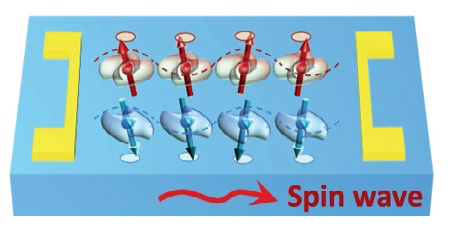
Magnons are the quanta of collective spin excitations in a magnetic material. The intrinsic collinear compensated moments endow altermagnetic magnons with both left-handed and right-handed chirality and ultrafast propagation 30 , akin to their antiferromagnetic counterparts. The degeneracy of the two chiral magnon bands can also be lifted, enabling altermagnets to carry spin currents such as ferromagnets.
480
Moreover, the spin-split electronic structure is anticipated to suppress Landau damping 30 and exhibit anisotropic magnon lifetimes 160 , offering a unique opportunity for designing ultrafast magnonic devices with low power consumption.
Experimental investigations of magnon spin current and transport have been reported for some altermagnetic candidates, although not interpreted in the context of altermagnets. For example, the efficient generation of magnon spin currents was illustrated through sub-terahertz spin pumping 161 and thermal spin Seebeck effects 162,163 in rutile MnF 2 and FeF 2 . A coherent spin wave 159,164–166 and incoherent non-local magnon transport 167–172 were also observed in α-Fe 2 O 3 and orthoferrites, exhibiting anisotropic 172 , non-reciprocal 165,171 and non-degenerated 165 spin wave characteristics. In these studies, an external magnetic field was typically applied to lift the degeneracy of opposite-chirality modes 163 .
Very recently, the chiral splitting of magnon bands under zero magnetic field was verified using inelastic neutron scattering 173 . Alternatively, thermal spin transport such as the spin Seebeck effect 119 would be another way to demonstrate the alternating splitting of magnon bands. The reversal of the Néel vector can change the sign of the magnon band splitting and the energetically favourable chirality of magnon branches, leading to spontaneous voltage differences under zero magnetic field.
The frequency of spin waves in altermagnets, especially those with easy-axis anisotropy, can reach the terahertz range, posing challenges for the electrical excitation of coherent magnons. Ultrafast photonics provides a powerful method to stimulate and modulate altermagnetic magnons 174 . A pioneering study using time-resolved magneto-optical techniques 159 has successfully observed coherent spin waves in the altermagnetic candidate DyFeO 3 , opening a door for the precise detection of high-frequency magnons. Intense terahertz transients can effectively modulate ultrafast spin waves owing to their adjacent frequency 175 , enabling the switching on and off of magnon transport 176 . Besides, nonlinear magnon–magnon coupling and magnon upconversion were preliminarily reported in altermagnetic candidates orthoferrites 177–179 . These advancements pave the way for efficient magnon-based processing devices.
Another important topic involves using optical techniques to modulate the altermagnetism 174,180 or excite the spin polarization 51,181,182 . The modulation process can be unveiled via time-resolved MOKE 121 or terahertz emission 183 . Conversely, collinear compensated magnets can act as terahertz sources owing to their high magnon frequency 184 , highlighting the potential of altermagnetic materials to advance terahertz emitters 185 .
Investigating the intersection between altermagnets and phonons, quasiparticles associated with vibrational motion in the crystal lattice, promises an exciting prospect. The band splitting in altermagnets originates from the specific crystal structure, which is highly sensitive to the crystal lattice 1,2 . Static strain can affect altermagnetic spin splitting 112,116,186 and control the ferroically ordered magnetic octupoles 187 , potentially modulating physical effects such as the AHE 188 . Moreover, dynamic strain from surface acoustic waves provides a new way to tailor spin dynamics in altermagnets: for example, the acoustic-wave-assisted Néel vector switching and domain evolution 189 . In turn, altering the spin-split bands could modify the phonon frequency via magnon–phonon coupling.
Altermagnets encompass a broad range of materials properties; for instance, they are compatible with superconductivity, topological phases Nature Reviews Materials | Volume 10 | June 2025 | 473–485 and ferroelectricity 1,2 , which offer a unique opportunity to connect magnetism with other fields in condensed matter physics.
Superconducting spintronics 190 is an emerging field integrating superconductors and magnets to enhance the performance of devices. Altermagnets offer a new platform for this field. Andreev reflection was theoretically investigated in altermagnets, showing a strong orientation dependence 191–194 . On the basis of this observation, a direct-current Josephson junction with finite-momentum Cooper pairing was theoretically proposed 195,196 , which exhibits controllable 0-π oscillation in the Josephson supercurrent and shows promise for applications in superconducting circuits and qubits.
Altermagnetism can directly coexist with superconductivity. For example, the d-wave altermagnet candidate La 2 CuO 4 is a typical parent compound of superconductors 197 . This combination offers a unique platform to study the interaction between magnetism and unconventional superconductivity, which could lead to a field-free Josephson diode effect 198,199 . Moreover, altermagnets can support spin-triplet Cooper pairs 31 , which possess non-zero total spin angular momentum and enable spin transmission. Besides, they provide material platforms to search for Majorana bound states with zero magnetization 200 .
Topologically protected quantum states, a focal point in condensed matter physics, exhibit unique advantages for applications in dissipationless and robust electronic devices 201 . Introducing ferromagnetism to break time-reversal symmetry leads to exotic topological magneto-responses 202 , such as the quantum AHE (QAHE). The QAHE, a building block of quantum computing, has been reported in magnetically doped and intrinsic magnetic topological insulators, as well as in moiré materials 203 . For instance, odd-layer MnBi 2 Te 4 , which has non-zero macroscopic magnetization, shows the QAHE 204 , whereas even-layer MnBi 2 Te 4 acts as an axion insulator at zero magnetic field 205 . This raises the question of whether the QAHE can exist in the magnetically compensated phase, which is crucial for constructing high-density quantum devices with a negligible stray field.
Altermagnets hold great promise in addressing this challenge. The compatibility of altermagnets with 2D van der Waals systems facilitates quantized spin transport. For example, twisting the stacking of two MnBi 2 Te 4 monolayers was theoretically proposed to combine spin splitting and topological nontriviality in the band structure, leading to the QAHE 206 . The easy stacking of van der Waals systems makes experimental realization feasible. Besides, the QAHE was also proposed in other collinear magnetically compensated phases, such as monolayer CrO (ref. 207), MnO (ref. 208) and RbCr 4 S 8 (ref. 209). Like the AHE 87 , the QAHE in altermagnets may exhibit orientation dependence, unlike in traditional magnetic topological insulators, in which the QAHE is influenced mainly by layer number 204,205,210 . Exploring high-temperature and high-Chern-number QAHE in altermagnets will be an important focus for future research.
Apart from gapped topological nontrivial phases, the symmetry of altermagnetism also allows for another class of topological matter known as Weyl semimetals. The experimental observation of the Fermi arc that characterizes these materials using ARPES has been reported in CrSb (refs. 73,74) and GdAlSi (ref. 211), suggesting that altermagnets provide a broad material platform for investigating Weyl fermions. Notably, Weyl nodes act as monopole sources and drains of Berry curvature flux 202 , typically leading to anomalous magneto-transport phenomena. Thus, altermagnets hold potential for realizing large anomalous Hall conductivity and Nernst coefficient.
Multiferroic materials that combine ferroelectricity and antiferromagnetism are an active area of research in functional materials.
481
However, the combination of ferroelectricity and ferromagnetism in a single material with coupled electric and spin polarization is challenging. Altermagnets offer opportunities for the coexistence of ferroelectric and spin polarization, enabling efficient gate control of spin transport. In terms of the experimental realization of this concept, materials in the phase diagram of (Ge,Mn)Te between ferroelectric GeTe and altermagnetic MnTe are expected to be promising candidates 212 .
The key to fabricating multiferroic altermagnets lies in integrating the polar space group with the altermagnetic space group. Many common multiferroic materials can be classified as altermagnets, including those with the Ruddlesden–Popper and perovskite phases 213 . These materials exhibit active ion migration, enabling gate-controllable ferroelectricity and altermagnetism. A more exotic realization would be the coexistence of multiferroicity and altermagnetism in the 2D limit 214,215 , facilitated by emerging techniques such as moiré engineering, which can generate novel ferroelectric states 216 . One natural avenue for fabricating multiferroic altermagnets is through the twisted stacking of van der Waals antiferromagnetic insulators.
Despite being a young research field, altermagnetism holds immense promise for both fundamental physics and practical applications. In the near future, theoretical and experimental endeavours will deepen our understanding of these promising materials and drive advancements in functional devices.
Published online: 14 February 2025 References 1. Šmejkal, L., Sinova, J. & Jungwirth, T. Beyond conventional ferromagnetism and
antiferromagnetism: a phase with nonrelativistic spin and crystal rotation symmetry. Phys. Rev. X 12, 031042 (2022). 2. Šmejkal, L., Sinova, J. & Jungwirth, T. Emerging research landscape of altermagnetism.
Phys. Rev. X 12, 040501 (2022).
Phys. Rev. X 12, 040002 (2022).
4305 (2019). 5. Šmejkal, L., González-Hernández, R., Jungwirth, T. & Sinova, J. Crystal time-reversal
symmetry breaking and spontaneous Hall effect in collinear antiferromagnets. Sci. Adv. 6, eaaz8809 (2020).
Pomeranchuk instability. Phys. Rev. B 99, 184432 (2019).
spin splitting in centrosymmetric low-Z antiferromagnets. Phys. Rev. B 102, 014422 (2020).
electronic band structures in antiferromagnets without spin–orbit coupling: procedure on the basis of augmented multipoles. Phys. Rev. B 102, 144441 (2020).
and noncollinear spin current. Nat. Commun. 12, 2846 (2021).
Prediction of unconventional magnetism in doped FeSb 2 . Proc. Natl Acad. Sci. USA 118, e2108924118 (2021). 11. Liu, P., Li, J., Han, J., Wan, X. & Liu, Q. Spin-group symmetry in magnetic materials with
negligible spin–orbit coupling. Phys. Rev. X 12, 021016 (2022).
Nat. Nanotechnol. 11, 231–241 (2016).
degeneracy. JETP Lett. 39, 78–81 (1984). 15. Dresselhaus, G. Spin–orbit coupling effects in zinc blende structures. Phys. Rev. 100, 580
(1955).
collinear antiferromagnetism. Phys. Rev. Lett. 126, 127701 (2021).
antiferromagnetic systems. Preprint at https://arxiv.org/abs/2407.02319 (2024). 19. Wu, C., Sun, K., Fradkin, E. & Zhang, S. C. Fermi liquid instabilities in the spin channel.
Phys. Rev. B 75, 115103 (2007). 20. Zhu, Y.-P. et al. Observation of nonrelativistic plaid-like spin splitting in a noncoplanar
antiferromagnet. Nature 626, 523–528 (2024). 21. Cheong, S. W. & Huang, F. T. Altermagnetism with non-collinear spins. npj Quantum Mater.
9, 13 (2024).
Nature Reviews Materials | Volume 10 | June 2025 | 473–485 22.
Cheong, S.-W. & Huang, F.-T. Altermagnetism classification. Preprint at https://arxiv.org/ abs/2409.20456 (2024). Šmejkal, L., MacDonald, A. H., Sinova, J., Nakatsuji, S. & Jungwirth, T. Anomalous Hall antiferromagnets. Nat. Rev. Mater. 7, 482–496 (2022). Rimmler, B. H., Pal, B. & Parkin, S. S. P. Non-collinear antiferromagnetic spintronics. Nat. Rev. Mater. 10, 109–127 (2025). Yin, J., Lian, B. & Hasan, M. Z. Topological kagome magnets and superconductors. Nature 612, 647–657 (2022).
antiferromagnetic MnTe. Nat. Commun. 7, 1038 (2016). Dietl, T. & Ohno, H. Dilute ferromagnetic semiconductors: physics and spintronic structures. Rev. Mod. Phys. 86, 187–251 (2014). Jungwirth, T. et al. Spin-dependent phenomena and device concepts explored in (Ga,Mn)As. Rev. Mod. Phys. 86, 855–896 (2014). Šmejkal, L. et al. Chiral magnons in altermagnetic RuO 2 . Phys. Rev. Lett. 131, 256703 (2023). Mazin, I. I. Notes on altermagnetism and superconductivity. Preprint at https://arxiv.org/ abs/2203.05000 (2022). Mazin, I., González-Hernández, R. & Šmejkal, L. Induced monolayer altermagnetism in MnP(S,Se)3 and FeSe. Preprint at https://arxiv.org/abs/2309.02355 (2023). He, R. et al. Nonrelativistic spin–momentum coupling in antiferromagnetic twisted bilayers. Phys. Rev. Lett. 130, 046401 (2023). Sheoran, S. & Bhattacharya, S. Nonrelativistic spin splittings and altermagnetism in twisted bilayers of centrosymmetric antiferromagnets. Phys. Rev. Mater. 8, L051401 (2024). Šmejkal, L., Hellenes, A. B., González-Hernández, R., Sinova, J. & Jungwirth, T. Giant and tunneling magnetoresistance in unconventional collinear antiferromagnets with nonrelativistic spin–momentum coupling. Phys. Rev. X 12, 011028 (2022). Hellenes, A. B. et al. P-wave magnets. Preprint at https://arxiv.org/abs/2309.01607 (2023). Brekke, B., Sukhachov, P., Giil, H. G., Brataas, A. & Linder, J. Minimal models and transport properties of unconventional p-wave magnets. Phys. Rev. Lett. 133, 236703 (2024). Chen, H. et al. Emerging antiferromagnets for spintronics. Adv. Mater. 36, 2310379 (2024). Bai, L. et al. Altermagnetism: exploring new frontiers in magnetism and spintronics. Adv. Funct. Mater. 34, 2409327 (2024). Shim, S. et al. Spin-polarized antiferromagnetic metals. Annu. Rev. Condens. Matter Phys. 16, 103–120 (2025). Berlijn, T. et al. Itinerant antiferromagnetism in RuO 2 . Phys. Rev. Lett. 118, 077201 (2017). Zhu, Z. H. et al. Anomalous antiferromagnetism in metallic RuO 2 determined by resonant X-ray scattering. Phys. Rev. Lett. 122, 017202 (2019). Hiraishi, M. et al. Nonmagnetic ground state in RuO 2 revealed by muon spin rotation. Phys. Rev. Lett. 132, 166702 (2024). Keßler, P. et al. Absence of magnetic order in RuO 2 : insights from µSR spectroscopy and neutron diffraction. npj Spintron. 2, 50 (2024). Kiefer, L. et al. Crystal structure and absence of magnetic order in single crystalline RuO 2 . Preprint at https://arxiv.org/abs/2410.05850 (2024). Liu, J. et al. Absence of altermagnetic spin splitting character in rutile oxide RuO 2 . Phys. Rev. Lett. 133, 176401 (2024). Lin, Z. et al. Observation of giant spin splitting and d-wave spin texture in room temperature altermagnet RuO 2 . Preprint at https://arxiv.org/abs/2402.04995 (2024). Fedchenko, O. et al. Observation of time-reversal symmetry breaking in the band structure of altermagnetic RuO 2 . Sci. Adv. 10, eadj4883 (2024). Smolyanyuk, A., Mazin, I. I., Garcia-Gassull, L. & Valentí, R. Fragility of the magnetic order in the prototypical altermagnet RuO 2 . Phys. Rev. B 109, 134424 (2024). Jeong, S. G. et al. Altermagnetic polar metallic phase in ultra-thin epitaxially-strained RuO 2 films. Preprint at https://arxiv.org/abs/2405.05838 (2024). Weber, M. et al. All optical excitation of spin polarization in d-wave altermagnets. Preprint at https://arxiv.org/abs/2408.05187 (2024). Brown, P. J. & Forsyth, J. B. Antiferromagnetism in Mn 5 Si 3 : the magnetic structure of the AF2 phase at 70 K. J. Phys. Condens. Matter 7, 7619–7628 (1995). Reichlova, H. et al. Observation of a spontaneous anomalous Hall response in the Mn 5 Si 3 d-wave altermagnet candidate. Nat. Commun. 15, 4961 (2024). Han, L. et al. Electrical 180° switching of Néel vector in spin-splitting antiferromagnet. Sci. Adv. 10, eadn0479 (2024). Kluczyk, K. P. et al. Coexistence of anomalous Hall effect and weak magnetization in a nominally collinear antiferromagnet MnTe. Phys. Rev. B 110, 155201 (2024). Mazin, I. I. & Belashchenko, K. D. Origin of the gossamer ferromagnetism in MnTe. Preprint at https://arxiv.org/abs/2407.14389 (2024). Chilcote, M. et al. Stoichiometry-induced ferromagnetism in altermagnetic candidate MnTe. Adv. Funct. Mater. 34, 2405829 (2024). Ghimire, N. J. et al. Large anomalous Hall effect in the chiral-lattice antiferromagnet CoNb 3 S 6 . Nat. Commun. 9, 3280 (2018). Tenasini, G. et al. Giant anomalous Hall effect in quasi-two-dimensional layered antiferromagnet Co 1/3 NbS 2 . Phys. Rev. Res. 2, 023051 (2020). Zager, B., Fan, R., Steadman, P. & Plumb, K. W. Double-Q spin chirality stripes in the anomalous Hall antiferromagnet CoNb 3 S 6 . Preprint at https://arxiv.org/abs/2307.03776 (2023).
482
Lu, K. et al. Understanding the anomalous Hall effect in Co 1/3 Nb 2 from crystal and magnetic structures. Preprint at https://arxiv.org/abs/2212.14762 (2022). Lawrence, E. A. et al. Fe site order and magnetic properties of Fe 1/4 NbS 2 . Inorg. Chem. 62, 18179–18188 (2023). Regmi, R. B. et al. Altermagnetism in the layered intercalated transition metal dichalcogenide CoNb4Se8. Preprint at https://arxiv.org/abs/2408.08835 (2024). Krempaský, J. et al. Altermagnetic lifting of Kramers spin degeneracy. Nature 626, 517–522 (2024). Reimers, S. et al. Direct observation of altermagnetic band splitting in CrSb thin films. Nat. Commun. 15, 2116 (2024). Lv, B., Qian, T. & Ding, H. Angle-resolved photoemission spectroscopy and its application to topological materials. Nat. Rev. Phys. 1, 609–626 (2019). Lee, S. et al. Broken Kramers degeneracy in altermagnetic MnTe. Phys. Rev. Lett. 132, 036702 (2024). Osumi, T. et al. Observation of giant band splitting in altermagnetic MnTe. Phys. Rev. B 109, 115102 (2024). Hajlaoui, M. et al. Temperature dependence of relativistic valence band splitting induced by an altermagnetic phase transition. Adv. Mater. 36, 2314076 (2024). Yang, G. et al. Three-dimensional mapping and electronic origin of large altermagnetic splitting near Fermi level in CrSb. Preprint at https://arxiv.org/abs/2405.12575 (2024). Zeng, M. et al. Observation of spin splitting in room-temperature metallic antiferromagnet CrSb. Adv. Sci. 11, e2406529 (2024). Ding, J. et al. Large band-splitting in g-wave type altermagnet CrSb. Phys. Rev. Lett. 133, 206401 (2024). Li, C. et al. Topological Weyl altermagnetism in CrSb. Preprint at https://arxiv.org/abs/ 2405.14777 (2024). Lu, W. et al. Observation of surface Fermi arcs in altermagnetic Weyl semimetal CrSb. Preprint at https://arxiv.org/abs/2407.13497 (2024). Dil, J. H. Spin and angle resolved photoemission on non-magnetic low-dimensional systems. J. Phys. Condens. Matter 21, 403001 (2009). Zhang, F. et al. Crystal-symmetry-paired spin-valley locking in a layered room-temperature antiferromagnet. Preprint at https://arxiv.org/abs/2407.19555 (2024). Jiang, B. et al. Discovery of a metallic room-temperature d-wave altermagnet KV 2 Se 2 O. Preprint at https://arxiv.org/abs/2408.00320 (2024). Amin, O. J. et al. Nanoscale imaging and control of altermagnetism in MnTe. Nature 636, 348–353 (2024). Mazin, I. I. Altermagnetism in MnTe: origin, predicted manifestations, and routes to detwinning. Phys. Rev. B 107, L100418 (2023). Landolt, G. et al. Direct measurement of the bulk spin structure of noncentrosymmetric BiTeCl. Phys. Rev. B 91, 081201(R) (2015). Krempaský, J. et al. Disentangling bulk and surface Rashba effects in ferroelectric α-GeTe. Phys. Rev. B 94, 205111 (2016). Hugo Dil, J. Spin- and angle-resolved photoemission on topological materials. Electron. Struct. 1, 023001 (2019). Boschini, F., Zonno, M. & Damascelli, A. Time-resolved ARPES studies of quantum materials. Rev. Mod. Phys. 96, 015003 (2024). Hariki, A. et al. X-ray magnetic circular dichroism in altermagnetic α-MnTe. Phys. Rev. Lett. 132, 176701 (2024). Hariki, A., Takahashi, Y. & Kuneš, J. X-ray magnetic circular dichroism in RuO 2 . Phys. Rev. B 109, 094413 (2024). Feng, Z. et al. An anomalous Hall effect in altermagnetic ruthenium dioxide. Nat. Electron. 5, 735–743 (2022). Gonzalez Betancourt, R. D. et al. Spontaneous anomalous Hall effect arising from an unconventional compensated magnetic phase in a semiconductor. Phys. Rev. Lett. 130, 036702 (2023). Wang, M. et al. Emergent zero-field anomalous Hall effect in a reconstructed rutile antiferromagnetic metal. Nat. Commun. 14, 8240 (2023). Tschirner, T. et al. Saturation of the anomalous Hall effect at high magnetic fields in altermagnetic RuO 2 . APL Mater. 11, 101103 (2023). Kounta, I. et al. Competitive actions of MnSi in the epitaxial growth of Mn 5 Si 3 thin films on Si(111). Phys. Rev. Mater. 7, 024416 (2023). Leiviskä, M. et al. Anisotropy of the anomalous Hall effect in thin films of the altermagnet candidate Mn 5 Si 3 . Phys. Rev. B 109, 224430 (2024). Bey, S. et al. Unexpected tuning of the anomalous Hall effect in altermagnetic MnTe thin films. Preprint at https://arxiv.org/abs/2409.04567 (2024). Galindez-Ruales, E. F. et al. Altermagnetism in the hopping regime. Preprint at https://arxiv.org/abs/2310.16907 (2023). Sato, T., Haddad, S., Fulga, I. C., Assaad, F. F. & Van Den Brink, J. Altermagnetic anomalous Hall effect emerging from electronic correlations. Phys. Rev. Lett. 133, 086503 (2024). Badura, A. et al. Observation of the anomalous Nernst effect in altermagnetic candidate Mn 5 Si 3 . Preprint at https://arxiv.org/abs/2403.12929 (2024). Han, L. et al. Observation of non-volatile anomalous Nernst effect in altermagnet with collinear Néel vector. Preprint at https://arxiv.org/abs/2403.13427 (2024). Samanta, K. et al. Crystal Hall and crystal magneto-optical effect in thin films of SrRuO 3 . J. Appl. Phys. 127, 213904 (2020). Zhou, X., Feng, W., Yang, X., Guo, G. Y. & Yao, Y. Crystal chirality magneto-optical effects in collinear antiferromagnets. Phys. Rev. B 104, 024401 (2021).
Nature Reviews Materials | Volume 10 | June 2025 | 473–485 99. Shao, D. F., Zhang, S. H., Li, M., Eom, C. B. & Tsymbal, E. Y. Spin-neutral currents for
spintronics. Nat. Commun. 12, 7061 (2021). 100. Shao, D.-F. & Tsymbal, E. Y. Antiferromagnetic tunnel junctions for spintronics. npj Spintron.
2, 13 (2024). 101. Jiang, Y. Y. et al. Prediction of giant tunneling magnetoresistance in RuO 2 /TiO 2 /RuO 2 (110)
antiferromagnetic tunnel junctions. Phys. Rev. B 108, 174439 (2023). 102. Samanta, K., Jiang, Y. Y., Paudel, T. R., Shao, D. F. & Tsymbal, E. Y. Tunneling
magnetoresistance in magnetic tunnel junctions with a single ferromagnetic electrode. Phys. Rev. B 109, 174407 (2024). 103. Chi, B. et al. Crystal-facet-oriented altermagnets for detecting ferromagnetic and
antiferromagnetic states by giant tunneling magnetoresistance. Phys. Rev. Appl. 21, 034038 (2024). 104. Bose, A. et al. Tilted spin current generated by the collinear antiferromagnet ruthenium
dioxide. Nat. Electron. 5, 267–274 (2022). 105. Bai, H. et al. Observation of spin splitting torque in a collinear antiferromagnet RuO 2 .
Phys. Rev. Lett. 128, 197202 (2022). 106. Karube, S. et al. Observation of spin-splitter torque in collinear antiferromagnetic RuO 2 .
Phys. Rev. Lett. 129, 137201 (2022). 107. Bai, H. et al. Efficient spin-to-charge conversion via altermagnetic spin splitting effect
in antiferromagnet RuO 2 . Phys. Rev. Lett. 130, 216701 (2023). 108. Liu, Y. et al. Inverse altermagnetic spin splitting effect-induced terahertz emission in
RuO 2 . Adv. Opt. Mater. 11, 2300177 (2023). 109. Zhang, Y. et al. Simultaneous high charge-spin conversion efficiency and large spin
diffusion length in altermagnetic RuO 2 . Adv. Funct. Mater. 34, 2313332 (2024). 110. Guo, Y. et al. Direct and inverse spin splitting effects in altermagnetic RuO 2 . Adv. Sci. 11,
2400967 (2024). 111. Te. Liao, C., Wang, Y. C., Tien, Y. C., Huang, S. Y. & Qu, D. Separation of inverse
altermagnetic spin-splitting effect from inverse spin Hall effect in RuO 2 . Phys. Rev. Lett. 133, 056701 (2024). 112. Aoyama, T. & Ohgushi, K. Piezomagnetic properties in altermagnetic MnTe. Phys. Rev. Mater.
8, L041402 (2024). 113. Wu, Y. et al. Valley-related multipiezo effect and noncollinear spin current in an
altermagnet Fe 2 Se 2 O monolayer. Nano Lett. 24, 10534–10539 (2024). 114. Zhu, Y. et al. Multipiezo effect in altermagnetic V 2 SeTeO monolayer. Nano Lett. 24,
472–478 (2024). 115. Devaraj, N., Bose, A. & Narayan, A. Interplay of altermagnetism and pressure in hexagonal
and orthorhombic MnTe. Phys. Rev. Mater. 8, 104407 (2024). 116. Zhou, Z. et al. Manipulation of the altermagnetic order in CrSb via crystal symmetry.
Nature https://doi.org/10.1038/s41586-024-08436-3 (2024). 117. Chakraborty, A., González Hernández, R., Šmejkal, L. & Sinova, J. Strain-induced phase
transition from antiferromagnet to altermagnet. Phys. Rev. B 109, 144421 (2024). 118. Rial, J. et al. Altermagnetic variants in thin films of Mn 5 Si 3 . Phys. Rev. B110, L220411
(2024). 119. Zhou, X. et al. Crystal thermal transport in altermagnetic RuO 2 . Phys. Rev. Lett. 132,
056701 (2024). 120. Iguchi, S. et al. Magneto-optical detection of altermagnetism in organic antiferromagnet.
Preprint at https://arxiv.org/abs/2409.15696 (2024). 121. Gray, I. et al. Time-resolved magneto-optical Kerr effect in the altermagnet candidate
MnTe. Appl. Phys. Lett. 125, 212404 (2024). 122. Cui, Q., Zeng, B., Cui, P., Yu, T. & Yang, H. Efficient spin Seebeck and spin Nernst effects
of magnons in altermagnets. Phys. Rev. B 108, L180401 (2023).
moving towards device applications. Appl. Phys. Rev. 5, 031107 (2018). 125. Manchon, A. et al. Current-induced spin–orbit torques in ferromagnetic and
antiferromagnetic systems. Rev. Mod. Phys. 91, 035004 (2019). 126. Song, C. et al. Spin–orbit torques: materials, mechanisms, performances, and potential
applications. Prog. Mater. Sci. 118, 100761 (2021). 127. Gomonay, O. et al. Structure, control, and dynamics of altermagnetic textures. npj Spintron.
2, 35 (2024). 128. Chen, X. et al. Electric field control of Néel spin–orbit torque in an antiferromagnet.
Nat. Mater. 18, 931–935 (2019). 129. Fan, Y. et al. Robust magnetic-field-free perpendicular magnetization switching by
manipulating spin polarization direction in RuO 2 /[Pt/Co/Pt] heterojunctions. ACS Nano 18, 26350–26358 (2024). 130. Li, Z., Zhang, Z., Lu, X. & Xu, Y. Spin splitting in altermagnetic RuO 2 enables field-free
spin–orbit torque switching via dominant out-of-plane spin polarization. Preprint at https://arxiv.org/abs/2407.07447 (2024). 131. Wu, Y. et al. Field-free spin-orbit switching of canted magnetization in Pt/Co/
Ru/RuO 2 (101) multilayers. Appl. Phys. Lett. 126, 012401(2024). 132. Bai, H. et al. Antiferromagnetism: an efficient and controllable spin source. Appl. Phys. Rev.
9, 041316 (2022). 133. Leeb, V., Mook, A., Šmejkal, L. & Knolle, J. Spontaneous formation of altermagnetism
from orbital ordering. Phys. Rev. Lett. 132, 236701 (2024). 134. Yahagi, Y. Néel vector dependent orbital Hall effect in altermagnetic RuO 2 . Preprint at
https://arxiv.org/abs/2410.01689 (2024). 135. Wang, Z. Q. et al. Inverse spin Hall effect dominated spin-charge conversion in (101)
and (110)-oriented RuO 2 films. Phys. Rev. Lett. 133, 046701 (2024).
483
https://arxiv.org/abs/2311.04418 (2023). 137. Smolyanyuk, A., Šmejkal, L. & Mazin, I. I. A tool to check whether a symmetry-
compensated collinear magnetic material is antiferro- or altermagnetic. SciPost Phys. Codebases https://doi.org/10.21468/SciPostPhysCodeb.30 (2024). 138. Pan, B. et al. General stacking theory for altermagnetism in bilayer systems. Phys. Rev. Lett.
133, 166701 (2024). 139. Jaeschke-Ubiergo, R., Bharadwaj, V. K., Jungwirth, T., Šmejkal, L. & Sinova, J. Supercell
altermagnets. Phys. Rev. B 109, 094425 (2024). 140. Das, P., Leeb, V., Knolle, J. & Knap, M. Realizing altermagnetism in Fermi–Hubbard models
with ultracold atoms. Phys. Rev. Lett. 132, 263402 (2024). 141. Cuono, G., Sattigeri, R. M., Skolimowski, J. & Autieri, C. Orbital-selective altermagnetism
and correlation-enhanced spin-splitting in strongly-correlated transition metal oxides. J. Magn. Magn. Mater. 586, 171163 (2023). 142. Hodt, E. W. & Linder, J. Spin pumping in an altermagnet/normal-metal bilayer. Phys. Rev. B
109, 174438 (2024). 143. Verbeek, X. H. et al. Non-relativistic ferromagnetotriakontadipolar order and spin
splitting in hematite. Phys. Rev. Res. 6, 043157 (2024). 144. Kashikar, R. et al. Coupling of the structure and magnetism to spin splitting in hybrid
organic–inorganic perovskites. J. Am. Chem. Soc. 146, 13105–13112 (2024). 145. Liu, Y., Yu, J. & Liu, C.-C. Twisted magnetic van der Waals bilayers: an ideal platform
for altermagnetism. Phys. Rev. Lett. 133, 206702 (2024). 146. Ma, H. Y. & Jia, J. F. Altermagnetic topological insulator and the selection rules. Phys. Rev. B
110, 064426 (2024). 147. Xu, S. et al. Spin-flop magnetoresistance in a collinear antiferromagnetic tunnel junction.
Preprint at https://arxiv.org/abs/2311.02458 (2023). 148. Liang, S. et al. Field-free perpendicular magnetic memory driven by out-of-plane
spin-orbit torques. Adv. Funct. Mater. https://doi.org/10.1002/adfm.202417731 (2024). 149. Liu, F. et al. Giant tunneling magnetoresistance in insulated altermagnet/ferromagnet
junctions induced by spin-dependent tunneling effect. Phys. Rev. B 110, 134437 (2024). 150. Samanta, K., Shao, D.-F. & Tsymbal, E. Y. Spin filtering with insulating altermagnets.
Preprint at https://arxiv.org/abs/2409.00195 (2024). 151. Chi, B. et al. Anisotropic spin filtering by an altermagnetic barrier in magnetic tunnel
junctions. Phys. Rev. Appl. 23, 014013 (2024). 152. Datta, S. & Das, B. Electric analog of the electro-optic modulator. Appl. Phys. Lett. 56,
665–667 (1990). 153. Uchida, E., Kondoh, H. & Fukuoka, N. Magnetic and electrical properties of manganese
telluride. J. Phys. Soc. Jpn 11, 27–32 (1956). 154. Olejník, K. et al. Antiferromagnetic CuMnAs multi-level memory cell with microelectronic
compatibility. Nat. Commun. 8, 15434 (2017). 155. Kurenkov, A., Fukami, S. & Ohno, H. Neuromorphic computing with antiferromagnetic
spintronics. J. Appl. Phys. 128, 010902 (2020). 156. Dai, J. K. et al. Thermal-modulation spin–orbit torque for 180° Néel vector switching.
Phys. Rev. Mater. 8, 074406 (2024). 157. Klselev, S. I. et al. Microwave oscillations of a nanomagnet driven by a spin-polarized
current. Nature 425, 380–383 (2003). 158. Cheng, R., Xiao, D. & Brataas, A. Terahertz antiferromagnetic spin Hall nano-oscillator.
Phys. Rev. Lett. 116, 206703 (2016). 159. Hortensius, J. R. et al. Coherent spin-wave transport in an antiferromagnet. Nat. Phys. 17,
1001–1006 (2021). 160. Costa, A. T., Henriques, J. C. G. & Fernández-Rossier, J. Giant spatial anisotropy of
magnon lifetime in altermagnets. Preprint at https://arxiv.org/abs/2405.12896 (2024). 161. Vaidya, P. et al. Subterahertz spin pumping from an insulating antiferromagnet. Science
368, 160–165 (2020). 162. Wu, S. M. et al. Antiferromagnetic spin Seebeck effect. Phys. Rev. Lett. 116, 097204 (2016). 163. Li, J. et al. Spin Seebeck effect from antiferromagnetic magnons and critical spin
fluctuations in epitaxial FeF 2 Films. Phys. Rev. Lett. 122, 217204 (2019). 164. Wang, H. et al. Long-distance coherent propagation of high-velocity antiferromagnetic
spin waves. Phys. Rev. Lett. 130, 096701 (2023). 165. El Kanj, A. et al. Antiferromagnetic magnon spintronic based on nonreciprocal and
nondegenerated ultra-fast spin-waves in the canted antiferromagnet α-Fe 2 O 3 . Sci. Adv. 9, eadh1601 (2023). 166. Yang, D. et al. Spin–orbit torque manipulation of sub-terahertz magnons in
antiferromagnetic α-Fe 2 O 3 . Nat. Commun. 15, 4046 (2024). 167. Lebrun, R. et al. Tunable long-distance spin transport in a crystalline antiferromagnetic
iron oxide. Nature 561, 222–225 (2018). 168. Han, J. et al. Birefringence-like spin transport via linearly polarized antiferromagnetic
magnons. Nat. Nanotechnol. 15, 563–567 (2020). 169. Lebrun, R. et al. Long-distance spin-transport across the Morin phase transition up to
room temperature in ultra-low damping single crystals of the antiferromagnet α-Fe 2 O 3 . Nat. Commun. 11, 6332 (2020). 170. Wimmer, T. et al. Observation of antiferromagnetic magnon pseudospin dynamics and
the Hanle effect. Phys. Rev. Lett. 125, 247204 (2020). 171. Gückelhorn, J. et al. Observation of the nonreciprocal magnon Hanle effect. Phys. Rev. Lett.
130, 216703 (2023). 172. Das, S. et al. Anisotropic long-range spin transport in canted antiferromagnetic
orthoferrite YFeO 3 . Nat. Commun. 13, 6140 (2022). 173. Liu, Z., Ozeki, M., Asai, S., Itoh, S. & Masuda, T. Chiral-split magnon in altermagnetic
MnTe. Phys. Rev. Lett. 133, 156702 (2024).
Nature Reviews Materials | Volume 10 | June 2025 | 473–485 174. Kimel, A. V., Rasing, T. & Ivanov, B. A. Optical read-out and control of antiferromagnetic
Néel vector in altermagnets and beyond. J. Magn. Magn. Mater. 598, 172039 (2024). 175. Kampfrath, T., Tanaka, K. & Nelson, K. A. Resonant and nonresonant control over matter
and light by intense terahertz transients. Nat. Photon. 7, 680–690 (2013). 176. Kampfrath, T. et al. Coherent terahertz control of antiferromagnetic spin waves. Nat. Photon.
5, 31–34 (2011). 177. Leenders, R. A., Afanasiev, D., Kimel, A. V. & Mikhaylovskiy, R. V. Canted spin order
as a platform for ultrafast conversion of magnons. Nature 630, 335–339 (2024). 178. Zhang, Z. et al. Terahertz field-induced nonlinear coupling of two magnon modes
in an antiferromagnet. Nat. Phys. 20, 801–806 (2024). 179. Zhang, Z. et al. Terahertz-field-driven magnon upconversion in an antiferromagnet.
Nat. Phys. 20, 788–793 (2024). 180. Rajpurohit, S. et al. Optical control of spin-splitting in an altermagnet. Preprint at
https://arxiv.org/abs/2409.17718 (2024). 181. Farajollahpour, T., Ganesh, R. & Samokhin, K. Light-induced Hall currents in
altermagnets. Preprint at https://arxiv.org/abs/2405.03779 (2024). 182. Adamantopoulos, T. et al. Spin and orbital magnetism by light in rutile altermagnets.
npj Spintron. 2, 46 (2024). 183. Huang, L. et al. Terahertz oscillation driven by optical spin–orbit torque. Nat. Commun.
15, 7227 (2024). 184. Huang, L. et al. Antiferromagnetic magnonic charge current generation via ultrafast
optical excitation. Nat. Commun. 15, 4270 (2024). 185. Qiu, H. et al. Terahertz spin current dynamics in antiferromagnetic hematite. Adv. Sci. 10,
2300512 (2023). 186. Belashchenko, K. D. Giant strain-induced spin splitting effect in MnTe, a g-wave
altermagnetic semiconductor. Preprint at https://arxiv.org/abs/2407.20440 (2024). 187. Bhowal, S. & Spaldin, N. A. Ferroically ordered magnetic octupoles in d-wave
altermagnets. Phys. Rev. X 14, 011019 (2024). 188. Ikhlas, M. et al. Piezomagnetic switching of the anomalous Hall effect in an
antiferromagnet at room temperature. Nat. Phys. 18, 1086–1093 (2022). 189. Yang, W. G. & Schmidt, H. Acoustic control of magnetism toward energy-efficient
applications. Appl. Phys. Rev. 8, 021304 (2021). 190. Linder, J. & Robinson, J. W. A. Superconducting spintronics. Nat. Phys. 11, 307–315
(2015). 191. Sun, C., Brataas, A. & Linder, J. Andreev reflection in altermagnets. Phys. Rev. B 108,
054511 (2023). 192. Papaj, M. Andreev reflection at the altermagnet–superconductor interface. Phys. Rev. B
108, L060508 (2023). 193. Das, S. & Soori, A. Crossed Andreev reflection in altermagnets. Phys. Rev. B 109, 245424
(2024). 194. Niu, Z. P. & Yang, Z. Orientation-dependent Andreev reflection in an altermagnet/
altermagnet/superconductor junction. J. Phys. D Appl. Phys. 57, 395301 (2024). 195. Ouassou, J. A., Brataas, A. & Linder, J. dc Josephson effect in altermagnets. Phys. Rev. Lett.
131, 076003 (2023). 196. Zhang, S.-B., Hu, L.-H. & Neupert, T. Finite-momentum Cooper pairing in proximitized
altermagnets. Nat. Commun. 15, 1801 (2024). 197. Song, J. & Annett, J. F. Electron–phonon coupling and d-wave superconductivity
in the cuprates. Phys. Rev. B 51, 3840 (1995). 198. Cheng, Q., Mao, Y. & Sun, Q. F. Field-free Josephson diode effect in altermagnet/normal
metal/altermagnet junctions. Phys. Rev. B 110, 014518 (2024). 199. Banerjee, S. & Scheurer, M. S. Altermagnetic superconducting diode effect. Phys. Rev. B
110, 024503 (2024). 200. Ghorashi, S. A. A., Hughes, T. L. & Cano, J. Altermagnetic routes to Majorana modes
in zero net magnetization. Phys. Rev. Lett. 133, 106601 (2024). 201. Haldane, F. & Duncan, M. Nobel lecture: topological quantum matter. Rev. Mod. Phys. 89,
040502 (2017). 202. Bernevig, B. A., Felser, C. & Beidenkopf, H. Progress and prospects in magnetic
topological materials. Nature 603, 41–51 (2022). 203. Chang, C. Z., Liu, C. X. & Macdonald, A. H. Colloquium: quantum anomalous Hall effect.
Rev. Mod. Phys. 95, 011002 (2023). 204. Deng, Y. et al. Quantum anomalous Hall effect in intrinsic magnetic topological insulator
MnBi 2 Te 4 . Science 367, 895–900 (2020). 205. Liu, C. et al. Robust axion insulator and Chern insulator phases in a two-dimensional
antiferromagnetic topological insulator. Nat. Mater. 19, 522–527 (2020). 206. Zhu, W., Bai, H., Han, L., Pan, F. & Song, C. Tunable quantum anomalous Hall effect via
crystal order in spin-splitting antiferromagnets. Preprint at https://arxiv.org/abs/ 2410.16587 (2024). 207. Guo, P. J., Liu, Z. X. & Lu, Z. Y. Quantum anomalous Hall effect in collinear
antiferromagnetism. npj Comput. Mater. 9, 70 (2023). 208. Wu, B. et al. Quantum anomalous Hall effect in an antiferromagnetic monolayer of MoO.
Phys. Rev. B 107, 214419 (2023). 209. Liu, Y., Li, J. & Liu, Q. Chern-insulator phase in antiferromagnets. Nano Lett. 23,
8650–8656 (2023). 210. Ge, J. et al. High-Chern-number and high-temperature quantum Hall effect without
Landau levels. Natl Sci. Rev. 7, nwaa089 (2020). 211. Nag, J. et al. GdAlSi: an antiferromagnetic topological Weyl semimetal with
non-relativistic spin splitting. Phys. Rev. B 110, 224436 (2023).
484
14, 6127 (2023). 213. Bernardini, F., Fiebig, M. & Cano, A. Ruddlesden–Popper and perovskite phases as a
material platform for altermagnetism. Preprint at https://arxiv.org/abs/2401.12910 (2024). 214. Song, Q. et al. Evidence for a single-layer van der Waals multiferroic. Nature 602,
601–605 (2022). 215. Sun, W. et al. Stacking-dependent ferroicity of a reversed bilayer: altermagnetism or
ferroelectricity. Phys. Rev. B 110, 224418 (2024). 216. Zheng, Z. et al. Unconventional ferroelectricity in moiré heterostructures. Nature 588,
71–76 (2020). Acknowledgements The authors appreciate the fruitful discussions with and helpful suggestions from T. Jungwirth. C.S. was supported by the National Key Research and Development Program of China (Grant No. 2022YFA1402603), the National Natural Science Foundation of China (Grant Nos 52225106, 12241404 and T2394471), the Open Fund of the State Key Laboratory of Spintronics Devices and Technologies (Grant No. SPL-2401) and the Open Fund of Key Laboratory of Advanced Materials (Advmat-2410). H.R. is supported by the Grant Agency of the Czech Republic Grant No. 22-17899K, TERAFIT-CZ.02.01.01/00/22_008/0004594 and the Dioscuri Program LV23025. J.L. is supported by National Key R&D Program of China (Grant No. 2021YFA1401500) and the Hong Kong Research Grants Council (16303821, 16306722 and 16304523).
Nature Reviews Materials | Volume 10 | June 2025 | 473–485 Author contributions C.S., H.B. and L.H. researched data for the article. All authors contributed substantially to discussion of the content. C.S., H.B., Z.Z., L.H., H.R., J.H.D and J.L. wrote the article. All authors reviewed and/or edited the manuscript before submission. Competing interests The authors declare no competing interests. Additional information Peer review information Nature Reviews Materials thanks the anonymous reviewers for their contribution to the peer review of this work.
Publisher’s note Springer Nature remains neutral with regard to jurisdictional claims in published maps and institutional affiliations.
Springer Nature or its licensor (e.g. a society or other partner) holds exclusive rights to this article under a publishing agreement with the author(s) or other rightsholder(s); author self-archiving of the accepted manuscript version of this article is solely governed by the terms of such publishing agreement and applicable law.
© Springer Nature Limited 2025 485