⬇ Download Markdown · ⬇ Download LaTeX · ⬇ original · view original · CSV: table 1
Quenching of Nonrelativistic p-Wave Spin Splitting by Reduced c-f Coupling in CeNiAsO
Xinnuo Zhang, 1 , ∗ Zhicheng Jiang, 1 , ∗ Shibo Shen, 2 , ∗ Jian Yuan, 3 , ∗ Junseo Yoo, 4 Xun Ma, 1 Mao Ye, 5 , 6 Jishan Liu, 5 , 6 Zhengtai Liu, 5 , 6, † Changyoung Kim, 4 Yanfeng Guo, 3 , 7, ‡ Yilin Wang, 2 , 8, § and Dawei Shen 1 , ¶
arXiv:2606.02420v2 [cond-mat.str-el] 12 Jun 2026
1 National Synchrotron Radiation Laboratory and School of Nuclear Science and Technology,
University of Science and Technology of China, Hefei, 230026, China 2 School of Emerging Technology, University of Science and Technology of China, Hefei 230026, China
3 State Key Laboratory of Quantum Functional Materials, School of Physical Science and Technology, ShanghaiTech University, Shanghai 201210, China 4 Department of Physics and Astronomy, Seoul National University, Seoul 08826, Republic of Korea
5 Shanghai Synchrotron Radiation Facility, Shanghai Advanced Research Institute,
Chinese Academy of Sciences, Shanghai 201210, China 6 National Key Laboratory of Materials for Integrated Circuits, Shanghai Institute of Microsystem and Information Technology,
Chinese Academy of Sciences, Shanghai 200050, China
7 ShanghaiTech Laboratory for Topological Physics, ShanghaiTech University, Shanghai 201210, China 8 Hefei National Laboratory, Hefei 230088, China
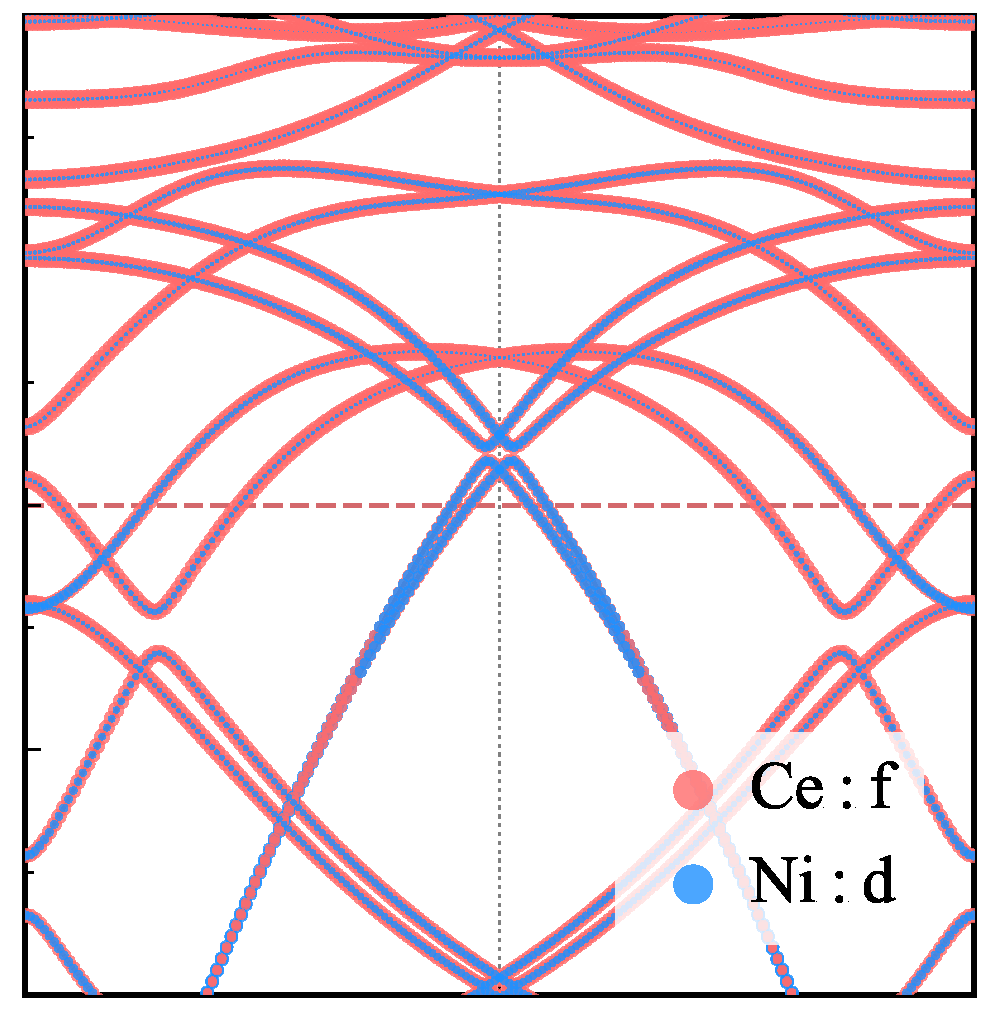
The application of spin-space group symmetries to noncollinear antiferromagnets has led to the prediction of odd-parity, nonrelativistic spin splittings, making the physical realization of a practical p -wave magnet a central pursuit in spintronics. The layered heavy-fermion oxypnictide CeNiAsO has been widely regarded as a prototypical platform to verify this paradigm. Here, we investigate the electronic structure of single-crystal CeNiAsO using high-resolution, ultra-low-temperature and resonant angle-resolved photoemission spectroscopy (ARPES), and ab − initio calculations. Across the consecutive magnetic transitions into the ordered phases, our spectroscopic data reveal neither the expected band folding associated with a spin density wave nor any observable p -wave spin split- ting, demonstrating that the conduction bands retain full degeneracy. By tracking the temperature dependence of the Ce 4 f spectral weight via resonant ARPES, we find negligible c - f hybridiza- tion near the Fermi level within magnetically ordered states, confirming that the Ce 4 f electrons reside close to the localized limit. Our findings establish a clear many-body constraint on the pro- jection of real-space magnetic symmetries onto momentum-space electronic bands, demonstrating that symmetry classifications constitute a necessary framework but are not a sufficient condition for nonrelativistic spin splittings in the presence of strong electronic correlations. The realization of nonrelativistic spin splittings inde- pendent of spin-orbit coupling (SOC) has emerged as a central frontier in quantum magnetism and spintron- ics [ 1 – 6 ]. This paradigm was initiated by altermagnets, where collinear antiferromagnetic (AFM) structures un- lock an even-parity ( d - or g -wave) spin splitting at the electron-volt scale for high-efficiency spin currents [ 5 , 7 – 16 ]. Stimulated by this, spin-space group (SSG) [ 17 – 23 ] based classifications have generalized this phenomenon to noncollinear (NCL) magnetic structures that break spatial inversion symmetry while preserving a general- ized time-reversal symmetry, predicting odd-parity p - wave magnets [ 24 – 32 ]. It shifts the spin-polarized Fermi surfaces asymmetrically in momentum space, satisfying E ( k , σ ⊥ ) = E ( − k , −σ ⊥ ) and generating a unique p -wave spin texture with opposite polarizations on opposing sides of the Fermi surface [Fig. 1 (a)]. Acting as a nonrel- ativistic counterpart to relativistic Rashba/Dresselhaus SOC, these profiles are governed by strong exchange en- ergy scales and highly attractive for nonrelativistic Edel- stein responses and for engineering unconventional triplet pairing toward topological superconductivity [ 33 – 48 ]. The heavy-fermion oxypnictide CeNiAsO has been proposed as a promising platform to host p -wave spin splitting driven by its coplanar NCL AFM order on Ce- sites [ 24 , 32 – 36 , 49 – 54 ]. To date, however, a direct momentum-resolved spectroscopic verification of such odd-parity spin splitting remains entirely elusive across all candidate materials. Although SSG symmetry classi- fications establish the necessary condition for odd-parity magnets, the spin-splitting in actual materials strongly depends on the assumed well-defined single-particle band structures in momentum space. In strongly corre- lated heavy-fermion f -electron materials, this single- particle framework must confront the intrinsic many- body competition between the local-moment behavior of f -electrons and the phase-coherent hybridization with the conduction c -electrons. To enable the momentum- space spin splitting, the correlated 4 f electrons must ei- ther form coherent, dispersive bands that split directly, or develop a sufficiently strong c - f exchange coupling to transfer the odd-parity magnetic potentials to the itin- erant conduction bands. Both scenarios dictate a phase- coherent c - f entanglement, leaving the validity of static symmetry predictions in the presence of strong electronic correlations an open but crucial question.
2
0 5 10 15 0.010 0.011 0.012 χ
(
e
m
u
/
m
o
l
/
O
e
)
0 100 2 00 300 0.004 0.008 0.012 0.016 χ
(
e
m
u
/
m
o
l
/
O
e
)
T ( K) B = 1 T (f) Ce O As Ni (a) (b) (c) (d) k x k y [C 2 ⊥ | τ] (e) d
R
/
d
T
(
µ
Ω
·
K
-
1
)
0 5 10 15 20 0 .0 1 .0 2 .0 T N 1 T N 2 0 50 100 150 200 250 300 1.0 2.0 3.0 T (K) 0 5 10 15 20 25 30 35 7.0 7.5 8.0 8.5 9.0 9.5 B ( T) −7 0 7 −0.006 0 .000 0.006 M
(
e
m
u
)
Temp=2K (g) R
(
μ
Ω
)
R
(
μ
Ω
)
E ( k , σ ⊥ ) = E (- k , - σ ⊥ ) FIG. 1. Basic properties and transport measurements. (a) Spin-polarized Fermi surfaces of a p -wave magnet with the dispersion satisfying E ( k , σ ⊥ ) = E ( − k , −σ ⊥ ) . (b) Tetrago- nal crystal structure of CeNiAsO showing alternating stacked layers. (c) Incommensurate SDW below T N 1 : a magnetic cycloid approximately treated as a longitudinal spin-density wave. (d) Commensurate coplanar order below T N 2 : a copla- nar helical spin structure. (e) Resistivity R ( T ) of CeNiAsO; inset shows dR/dT to resolve the two-step transitions, where T N 1 = 8.66K, T N 2 = 6.23K. (f) Susceptibility χ ( T ) measured at B = 1 T along the c axis; inset magnifies the low- T region. (g) Magnetoresistance R ( B ) up to 35 T at 2 K temperature; inset shows M ( B ) from -7 T to 7 T. In this Letter, we address this issue by tracking the low-energy electronic structure of single-crystal CeNiAsO using high-resolution angle-resolved photoemission spec- troscopy (ARPES). Across the magnetic transitions into the coplanar NCL AFM state, our momentum-resolved spectra reveal strict, unlifted electronic degeneracy with no detectable p -wave band splitting at zero magnetic field. Furthermore, resonant ARPES (rARPES) mea- surements detect no spectral signatures of coherent Ce 4 f hybridization with the conduction bands near the Fermi level ( E F ) within the magnetically ordered state. This strongly suppressed hybridization confirms that the f electrons remain nearly fully localized, thereby isolating the conduction electrons from the expected odd-parity magnetic background such that there is no spin split- ting. Our results demonstrate that while SSG provides a necessary framework for identifying the symmetry of al- termagnets and odd-parity magnets, it is not a sufficient condition for the expected spin splitting in the systems with strong electronic correlations. Details of our experiments and ab − initio calculations can be found in Section 1 of the Supplemental Material (SM). CeNiAsO crystallizes in a tetragonal ZrCuSiAs- type structure with space group P 4 /nmm (No. 129) [Fig. 1 (b)] [ 55 – 57 ]. Prior neutron scattering and trans- port studies resolve two successive magnetic transitions upon cooling from the paramagnetic state: a spin- density-wave (SDW) phase below T N 1 ≈ 9 K [Fig. 1 (c)], and then a coplanar NCL AFM state below T N 2 ≈ 6 K [Fig. 1 (d)] [ 52 , 53 ]. Governed by the non-trivial SSG op- eration [ C 2 ⊥ | t ], where t is a fractional spatial translation, this state was predicted to exhibit an asymmetric p -wave spin splitting [ E ( k , σ ⊥ ) = E ( − k , −σ ⊥ ) ] with nonzero spin textures along the C 2 ⊥ rotation axis [Fig. 1 (a)]. To benchmark our samples against established struc- tural and magnetic properties, single-crystal X-ray diffraction (XRD) was performed [Fig. S1, TABLE I and II in SM], revealing sharp Bragg reflections with no de- tectable impurity phases. The temperature-dependent resistivity R ( T ) [Fig. 1 (e)] exhibits clear anomalies, with the derivative dR/dT resolving magnetic transitions at 8.66 K and 6.23 K, respectively, in good agreement with literature [ 52 , 53 ]. The magnetic susceptibility χ ( T ) [Fig. 1 (f)], measured under B = 1 T along the c -axis, displays a pronounced peak at T N 1 and a subtle shoul- der around T N 2 under both zero-field/field cooling con- ditions, substantiating the two-step magnetic ordering. Moreover, high-field magnetotransport measurements re- veal a hysteretic magnetoresistance between 15 and 25 T [Fig. 1 (g)], indicative of magnetic frustration within the ordered Ce layers. As shown in the inset of Fig. 1 (g), the magnetization increases monotonically up to 7 T, while the negative magnetoresistance emerging beyond B > 25 T indicates that the system approaches a field- induced polarized magnetic state. The bulk Brillouin zone (BZ) of CeNiAsO and its pro- jection onto the (001) surface BZ are schematically illus- trated in Fig. 2 (a). Because CeNiAsO naturally cleaves along polar planes to yield either [CeO] + - or [NiAs] − - terminated surfaces, we characterized these cleavage pro- files using micro-focused ARPES. Figure 2 (b) displays representative As 3 d core-level spectra from two distinct domains. Specifically, domain 1 exhibits a pronounced satellite splitting within the As 3 d 3 / 2 and 3 d 5 / 2 spin- orbit doublets, whereas this feature is substantially sup- pressed in domain 2. This distinct line-shape disparity allows us to assign domain 1 to the [NiAs] − -terminated surface layer. Paramagnetic state ARPES cuts along Γ- X [Fig. 2 (c), with second-order derivatives on the right halves] confirm that both domains possess highly similar bulk bands. However, because domain 2 hosts additional folding replicas driven by cleavage-induced surface recon-
3
Γ X M E
-
E
F
(
e
V
)
SS -1.0 -0.5 0 E
-
E
F
(
e
V
)
-1.0 0 1.0 k / / (Å - 1 ) Γ X X Domain 1 SS k z k y k x Γ Z M X Γ M X -1.0 0 1.0 k / / (Å - 1 ) Γ X X Domain 2 -1.0 -0.5 0 E
-
E
F
(
e
V
)
(a) (e) I
n
t
e
n
s
i
t
y
(
a
r
b
.
u
n
i
t
s
)
-42 -41 -40 E - E F (eV) As 3 d 3 /2 Domain1 As 3 d 5 /2 Domain2 (b) (c) MAX MIN (d) k
z
(
2
π
/
c
)
5 6 7 Γ M M FIG. 2. Paramagnetic-state ARPES results. (a) 3D Bril- louin zone of CeNiAsO and its projection onto the (001) sur- face Brillouin zone. (b) Cleaved CeNiAsO surface with pos- sible terminations; spatially resolved As 3 d core-level spectra for two surface domains (gray curves: Lorentzian fits). (c) ARPES intensity and second-derivative images along Γ- X for the two domains; arrow: an extra surface-related band in do- main 1. (d) Photon-energy-dependent ARPES intensity along M -Γ- M as a function of k z ; dashed line guides the eye for pe- riodic k z dispersion, the inner potential is 10 eV . (e) 3D ARPES intensity on the Γ- X - M plane, including the Fermi- surface map and band dispersions; white curves: renormal- ized bulk-band calculations; black arrows: additional surface states. structions, we focus our subsequent systematic analysis on the domain 1 (datasets of domain 2 are compiled in Fig. S3). By mapping the k z - k ∥ photoemission intensity disper- sion on domain 1 [Fig. 2 (d)], we resolved a clear periodic modulation along the k z axis that matches density func- tional theory (DFT) bulk band calculations (dashed lines and Fig. S7 and S8), establishing hν = 90 eV as the bulk Γ- X - M plane. Figure 2 (e) summarizes the paramagnetic electronic structure mapped within the high-symmetry plane, displaying the Fermi surface alongside the cor- responding dispersions. The overlaid DFT calculations, treating the Ce 4 f electrons as localized core states, re- produce the primary experimental bulk dispersions ex- ceptionally well under a modest renormalization factor of ∼ 0 . 7, while a few mismatched spectral features (marked by black arrows) can be assigned to surface states. Having established the paramagnetic state, we next tracked the low-energy bands across the successive mag- netic phase transitions of CeNiAsO. As illustrated in Figs. 3 (a1)–(a3) and (b1)–(b2), DFT calculations with- out considering the strong electron correlations of Ce- 4 f electrons, i.e., in the itinerant limit, predict two distinct electronic signatures upon entering the ordered states [ 49 , 50 ]. Firstly, the approximate 2 × 1 collinear SDW phase below T N 1 doubles the magnetic unit cell, re- constructing the BZ and folding the Fermi surface along the Γ- X direction [Fig. 3 (a2)]. Second, the onset of the coplanar NCL AFM order below T N 2 is predicted to ex- hibit sizeable p -wave spin splitting, in particular, along the Γ- X direction [Figs. 3 (a3) and (b2)]. As shown in Figs. 3 (b1) and (b2), the calculated 4 f bands near E F are highly dispersive and strongly hybridized with the Ni-3 d orbitals. Consequently, the predicted spin split- tings are jointly sustained by both the itinerant Ce-4 f and Ni-3 d electrons. This itinerant picture is consistent with previous theoretical reports [ 33 , 49 – 51 ]. Remarkably, our experimental observations stand in sharp contrast to these theoretical predictions. Fig- ures 3 (c)–(e) display the Fermi surfaces systematically mapped across the three distinct magnetic regimes at 13.5 K, 7 K, and 5.9 K, respectively. The global Fermi surface topography remains entirely invariant, exhibiting no signatures of folded replicas or split bands. This per- sistent rigidity is further verified by the high-resolution Γ- X energy-momentum dispersions [Fig. 3 (f)–(h)], in which the primary electron pocket evolves smoothly across both T N 1 and T N 2 without any detectable back- folding or symmetry-breaking reconstruction. Most im- portantly, the low-temperature bands below T N 2 retain strict spin degeneracy, displaying no evidence of the predicted p -wave nonrelativistic splitting as illustrated in Fig. 3 (b2). This complete quenching of the ex- pected spin splitting is further substantiated by ultra- low-temperature laser-ARPES scans down to 2.9 K (Fig. S4) and systematic temperature-dependent surveys extending across multiple distinct k z planes (Fig. S2, S5 and S6), both of which consistently resolve a single band feature devoid of any energy or momentum splitting. This unexpected decoupling between the magnetic or- der in real space and the spin splitting in momentum space points to a deeply localized regime where the c - f coupling is strongly suppressed, effectively screen- ing the conduction electrons from the underlying mag- netic background. To elucidate its microscopic origin, we performed rARPES measurements across the Ce 4 d -4 f threshold ( hν = 118–122 eV) to systematically enhance the 4 f spectral weight along Γ- X [Figs. 4 (a1) and (a2)]. This allows us to discern whether the missing spin split- ting stems from a fundamental lack of phase-coherent
4 (a2) T < T N1 T > T N1
Y M (c) 1.0 (a3) T < T N2 Y M M
0.3 Γ Γ X Γ X X 0 0 -0.5
-0.3
-1.0
(g) k x (Å - 1 ) -1 .0 -0.5 0
0.5 1.0 -1.0 -0.5 0
0.5 1.0 (f) x -1.0 -1.0 -0.5 0
0.5 1.0 - 1.0 - 0.8 - 0.6 - 0.4 - 0.2 0 k (Å - 1 ) E
-
E
F
(
e
V
)
-1.0 -0.5 0
0.5 1.0 -1 .0 -0.5 0
0.5 1.0 (h) k x (Å - 1 ) -1.0 -0.5 0
0.5 1.0 0 -0.1 -0.2 E
-
E
F
(
e
V
)
Γ 0 0.3 -0.3 <S z > -X (b1) 0.1 0.2 X Γ -X X T < T N 2 T < T N 2 (b2)
T = 7K (d) T = 13.5K T = 5.9K (e)
FIG. 3. Evolution of electronic structures as decreasing temperatures. (a1)-(a3) The DFT calculated Fermi surfaces for the nonmagnetic phase, SDW phase below T N 1 , and p -wave magnetic phase below T N 2 , respectively. The magnetic order doubles the unit-cell and folds the bands along Γ-X direction, and shows a p -wave spin splitting with nonzero s z ( k ). The incommensurate SDW phase below T N 1 is approximated as a 2 × 1 collinear AFM order in calculation. (b1) The bands are projected onto Ce- f (pink) and Ni- d (blue) orbitals. (b2) Spin projections of s z ( k ). (c)-(e) ARPES Fermi-surface maps at 13.5 K, 7 K, and 5.9 K; red dots: high-symmetry points; red squares: appended Brillouin zone. (f)-(h) ARPES spectra along Γ–X at the same temperatures corresponding to (c)-(e). c - f hybridization, or merely from a suppressed photoe- mission cross-section. Despite the massive resonance- induced enhancement of 4 f sensitivity, particularly at the 122 eV maximum, the spectra resolve two sharply localized 4 f flat bands traversing the pre-existing non- magnetic bands, with no discernible signatures of coher- ent c - f hybridization or f band splitting near E F . These rARPES results unambiguously establish that the ab- sence of nonrelativistic spin splitting is not an artifact of insufficient photoemission intensity. Instead, the low- energy physics remains dominated by deeply localized 4 f moments that fail to form phase-coherent itinerant quasi- particle bands within the magnetically ordered ground state. To provide a microscopic basis for this localized ground state, we then performed systematic DFT plus dynami- cal mean-field theory (DFT+DMFT) calculations in the paramagnetic phase to track the evolution of the Ce 4 f states as a function of the local Coulomb repulsion U . As increasing U from 6 eV to 8 eV, the Ce-4 f bands significantly deviate from the itinerant limit [Figs. 4 (c)- (d), DFT calculation with Ce-4 f as valence states] and become highly incoherent atomic-like levels pinned near E F , and the c - f hybridization is significantly suppressed [Figs. 4 (e)-(j)], which asymptotically converges toward the fully localized limit where the 4 f electrons are frozen as core states in DFT calculations [Figs. 4 (k)-(l)]. This evolution directly substantiates a comprehensive c - f or- bital decoupling. We note that the calculated Fermi sur- face at U = 7 . 3 eV in the paramagnetic state [Fig. 4 (h)] exhibits an exceptional match with our experimental data in the magnetically ordered state [Fig. 4 (b)]. While a trace of residual c - f hybridization remains, as shown in the inset of Fig. 4 (g), its dynamic scattering ampli- tude is heavily suppressed. This confirms that the Ce-4 f electrons reside deep within the localized-moment limit. This underscores a correlation-enforced boundary where the localized 4 f electrons fail to transfer their magnetism to the conduction electrons to induce a spin splitting of the Fermi surface. The failure of the conduction electrons to inherit the magnetism directly reflects a deep positioning of CeNiAsO within the classic Doniach phase diagram, which scales the microscopic balance between intersite RKKY interactions ( T R KKY ∝ J 2 c - f ) and intrasite Kondo screening ( T ∗ ∝ exp( − 1 /ρJ c - f )) [ 58 ]. In the predic- tions of the p -wave magnets based on SSG symmetries and DFT calculations, it was implicitly assumed that the candidate materials reside on the right side of the Doniach framework, developing a heavy-fermion coher- ence temperature ( T ∗ ) well above the magnetic order- ing temperature ( T N ) [ 34 , 49 – 51 , 58 – 61 ]. In that sce- nario, pre-established coherent c - f hybridization would integrate the Ce 4 f electrons into the Fermi sea, allow- ing the low-temperature odd-parity exchange field to eas- ily transfer to the itinerant heavy quasiparticles and lift the Kramers degeneracy. However, CeNiAsO actually occupies the opposite, localized extreme of the Doniach
5 DFT , f as valence states 118eV 6.5K 122eV 6.5K 0 (a1) (a2) 0.5 (c) 4f 5/2 -0.2
Γ M X Γ M X Γ M X Γ X Γ M DFT , f as core states DFT+DMFT , U=6 eV Γ X Γ M DFT , f as valence states .5 0 .5 .0 Γ X Γ M low high Γ M X DFT+DMFT , U=7.3 eV Γ X Γ M X DFT+DMFT , U=8 eV Γ Γ M .5 (h) Γ M X (c) (d) (e) (f) (g) (h) (i) (j) (k) (l)
-1.0
_ _ _ _ _ X Γ X Γ X
90eV 5.9K _ -1.5 X _ M _ _ min X max (h) (d) (b)
Γ
FIG. 4. Reduced c–f coupling due to localized f electrons. (a1),(a2) ARPES intensity along Γ–X at 6.5 K with near-resonant photon energies 118 eV and 122 eV, respectively. Dashed lines: first Brillouin-zone boundaries; solid line: E F . In (a2), horizontal dashed lines mark resonant 4 f levels, 4 f 5 / 2 and 4 f 7 / 2 . (b) ARPES Fermi surface at 5.9 K; black arrow indicates the surface state (SS). (c),(d) DFT band structure and Fermi surface in nonmagnetic state with Ce- f as valence states. (e)-(j) DFT+DMFT results in paramagnetic state for three values of Hubbard U . (k),(l) DFT results in nonmagnetic state with Ce- f as core states. SOC is included in calculations. continuum, in which weak c - f coupling locks the system into an RKKY-dominated regime ( T R KKY ≫ T ∗ ) [ 58 – 68 ]. Our spectroscopic and theoretical results confirm that these Ce 4 f states remain entirely confined to a highly incoherent atomic-like levels, leaving the conduc- tion bands completely detached from the magnetic skele- ton in terms of low-energy quantum coherence. This creates a severe paradox: while the conduction electrons act as virtual high-energy intermediaries to me- diate the RKKY exchange and stabilize the long-range magnetic ordering, they remain dynamically decoupled from the ordered 4 f moments near E F due to the lack of phase-coherent c - f entanglement. Consequently, the low-energy exchange potential experienced by conduction bands remains symmetric, suppressing the nonrelativis- tic spin splitting and preserving full degeneracy. This c - f decoupling reveals a critical boundary when applying the SSG-based symmetry classifications to the strongly cor- related materials. While the real space magnetic ordering provides the structural symmetry required by theory, it is not a sufficient condition to realize the desired spin split- ting of electronic bands in the momentum space. Our findings suggest that future materials searching for al- termagnets or odd-parity magnets in f -electron systems need to evaluate the competition between T R KKY and T ∗ alongside the structural and magnetic ordering clas- sifications, preferentially targeting systems with intrinsic carrier itineracy or robust Kondo lattices with higher co- herence temperatures. In summary, our detailed ARPES investigation of single-crystal CeNiAsO provides a definitive arbitration on the physical realization of odd-parity nonrelativistic spin splittings. Across the consecutive magnetic transi- tions, the conduction bands retain full Kramers degener- acy, exhibiting neither the expected p -wave spin splitting nor SDW-induced unidirectional band folding, which di- rectly challenges the symmetry-based predictions. This absence of spin splitting stems from the full localiza- tion of Ce 4 f electrons and the lack of coherent c - f hy- bridization, thereby quenching the exchange potential of the conduction electrons. Our findings demonstrate that symmetry classifications constitute a necessary frame- work but not a sufficient condition for nonrelativistic spin splittings, highlighting a rigid many-body constraint. Acknowledgment -This work is supported by National Key R&D Program of China (Grants No. 2023YFA1406304, 2023YFA1406100 and 2024YFA1408103), National Natural Science Foundation of China (Grant No. 12494593), HFNL Self-Deployed Project (Grant No. ZB2602000302), Anhui Provincial Natural Science Foundation (Grant No. 2408085J003), and the New Cornerstone Science Foundation. Y. F. Guo acknowledges the Analytical Instrumentation Center (SPST-AIC10112914) and the Double First- Class Initiative Fund of ShanghaiTech University. Y.L. Wang was supported by Quantum Science and Technology-National Science and Technology Major Project (No. 2021ZD0302803). Z.C.J. acknowledges the China National Postdoctoral Program for Innovative Talents (BX20240348) and Xiaomi Young Talents Pro- gram. We thank the Shanghai Synchrotron Radiation Facility (SSRF) of BL03U (31124.02.SSRF.BL03U) for assistance on the ARPES measurements. Data availability -The data that support the findings of this article are not publicly available. The data are available from the authors upon reasonable request.
6 ∗ Equal contributions † [email protected] ‡ [email protected] § [email protected] ¶ [email protected] [1] ˇ Smejkal, L., Gonz´alez-Hern´andez, R., Jungwirth, T. & Sinova, J. Crystal time-reversal symmetry breaking and spontaneous hall effect in collinear antiferromagnets. Sci- ence Advances 6 , eaaz8809 (2020). [2] ˇ Smejkal, L., Sinova, J. & Jungwirth, T. Beyond conven- tional ferromagnetism and antiferromagnetism: A phase with nonrelativistic spin and crystal rotation symmetry. Phys. Rev. X 12 , 031042 (2022). [3] Yuan, L.-D., Wang, Z., Luo, J.-W., Rashba, E. I. & Zunger, A. Giant momentum-dependent spin splitting in centrosymmetric low-z antiferromagnets. Physical Re- view B 102 , 014422 (2020). [4] ˇ Smejkal, L., Sinova, J. & Jungwirth, T. Emerging re- search landscape of altermagnetism. Phys. Rev. X 12 , 040501 (2022). [5] Song, C. et al. Altermagnets as a new class of functional materials. Nature Reviews Materials 10 , 473–485 (2025). [6] Jungwirth, T. et al. Symmetry, microscopy and spec- troscopy signatures of altermagnetism. Nature 649 , 837– 847 (2026). [7] Zhang, X. et al. Arpes studies of spin-splitting antiferro- magnets. Chin. Phys. Lett. 43 , 050709–050709 (2026). [8] Liu, J. et al. Symmetry-driven spin splitting in alter- magnets: an angle-resolved photoemission spectroscopy perspective. Nano Convergence 13 , 6 (2026). [9] Roig, M., Kreisel, A., Yu, Y., Andersen, B. M. & Agter- berg, D. F. Minimal models for altermagnetism. Phys. Rev. B 110 , 144412 (2024). [10] Samanta, K., Shao, D.-F. & Tsymbal, E. Y. Spin filtering with insulating altermagnets. Nano Letters 25 , 3150– 3156 (2025). [11] Fu, P.-H. et al. All-electrically controlled spintronics in altermagnetic heterostructures. npj Quantum Materials (2025). [12] Zhang, Y. et al. Electrical manipulation of spin splitting torque in altermagnetic RuO 2 . Nature Communications 16 , 5646 (2025). [13] Noh, S. et al. Tunneling magnetoresistance in altermag- netic RuO 2 - based magnetic tunnel junctions. Physical Review Letters 134 , 246703 (2025). [14] Liu, F. et al. Giant tunneling magnetoresistance in in- sulated altermagnet/ferromagnet junctions induced by spin-dependent tunneling effect. Physical Review B 110 , 134437 (2024). [15] Jiang, B. et al. A metallic room-temperature d-wave altermagnet. Nature Physics 21 , 754–759 (2025). [16] Zhang, F. et al. Crystal-symmetry-paired spin–valley locking in a layered room-temperature metallic altermag- net candidate. Nature Physics 21 , 760–767 (2025). [17] Liu, P., Li, J., Han, J., Wan, X. & Liu, Q. Spin-group symmetry in magnetic materials with negligible spin- orbit coupling. Phys. Rev. X 12 , 021016 (2022). [18] Xiao, Z., Zhao, J., Li, Y., Shindou, R. & Song, Z.-D. Spin space groups: Full classification and applications. Phys. Rev. X 14 , 031037 (2024). [19] Chen, X. et al. Unconventional magnons in collinear mag- nets dictated by spin space groups. Nature 640 , 349–354 (2025). [20] Liu, Y. et al. Symmetry classification of magnetic orders using oriented spin space groups. Nature 652 , 869–873 (2026). [21] Chen, X. et al. Enumeration and representation theory of spin space groups. Physical Review X 14 , 031038 (2024). [22] Jiang, Y. et al. Enumeration of spin-space groups: To- ward a complete description of symmetries of magnetic orders. Physical Review X 14 , 031039 (2024). [23] Brinkman, W. & Elliott, R. J. Theory of spin-space groups. Proceedings of the Royal Society of London. Se- ries A. Mathematical and Physical Sciences 294 , 343–358 (1966). [24] Priessnitz, J., Hellenes, A. B., Comin, R. & ˇ Smejkal, L. Ferroelectric p-wave magnets (2026). Unpublished. [25] Leon, A., Autieri, C., Brumme, T. & Gonzalez, J. W. Hy- brid d/p-wave altermagnetism in Ca 3 R u 2 O 7 and strain- controlled spin splitting. npj Quantum Materials 10 , 78 (2025). [26] Zhu, T., Zhou, D., Wang, H., Wei, S.-H. & Ruan, J. Floquet odd-parity collinear magnets. Physical Review Letters 136 , 126704 (2026). [27] Rickelt, K., Sedov, D. & Scheurer, M. S. Hatsugai- kohmoto-like models for altermagnets and odd-parity magnets (2026). Unpublished. [28] Lin, Y.-P. Odd-parity altermagnetism through sublat- tice currents: From haldane-hubbard model to general bipartite lattices. arXiv preprint (2025). 2503.09602. [29] Zhuang, Z.-Y., Zhu, D., Liu, D., Wu, Z. & Yan, Z. Odd-parity altermagnetism originated from orbital or- ders. arXiv preprint arXiv:2508.18361 (2025). [30] Liu, D., Zhuang, Z.-Y., Zhu, D., Wu, Z. & Yan, Z. Light- induced odd-parity altermagnets on dimerized lattices. Physical Review B 113 , L060409 (2026). [31] Dsouza, R., Kreisel, A., Andersen, B. M., Agterberg, D. F. & Christensen, M. H. Odd-parity magnetism in fe-based superconductors with coplanar magnetic order. Physical Review B 113 , 144509 (2026). [32] Luo, X.-J., Hu, J.-X., Hu, M.-L. & Law, K. Spin group symmetry criteria for odd-parity magnets. arXiv preprint arXiv:2510.05512 (2025). [33] Chakraborty, A. et al. Highly efficient non-relativistic edelstein effect in nodal p-wave magnets. Nature Com- munications 16 , 7270 (2025). [34] Zhao, M., Yang, W.-W., Guo, X., Luo, H.-G. & Zhong, Y. Altermagnetism in heavy-fermion systems: Mean- field study on the kondo lattice. Physical Review B 111 , 085145 (2025). [35] Sukhachov, P., Giil, H. G., Brekke, B. & Linder, J. Co- existence of p -wave magnetism and superconductivity. Phys. Rev. B 111 , L220403 (2025). [36] Ezawa, M. Out-of-plane edelstein effects: Electric field induced magnetization in p-wave magnets. Phys. Rev. B 111 , 161301 (2025). [37] Brekke, B., Sukhachov, P., Gill, H. G., Brataas, A. & Linder, J. Minimal models and transport properties of unconventional p -wave magnets. Phys. Rev. Lett. 133 , 236703 (2024). [38] Yamada, R. et al. A metallic p-wave magnet with com- mensurate spin helix. Nature 646 , 837–842 (2025). [39] Sun, Z.-T. et al. Pseudo-ising superconductivity induced by p-wave magnetism. Physical Review B 112 , 214504 (2025).
7 [40] Soori, A. Crossed andreev reflection in collinear p-wave magnet/triplet superconductor junctions. Physical Re- view B 111 , 165413 (2025). [41] Ezawa, M. Topological insulators and superconductors based on p-wave magnets: Electrical control and detec- tion of a domain wall. Physical Review B 110 , 165429 (2024). [42] Nagae, Y., Katayama, L. & Ikegaya, S. Flat-band zero- energy states and anomalous proximity effects in p-wave magnet–superconductor hybrid systems. Physical Review B 111 , 174519 (2025). [43] Kokkeler, T., Tokatly, I. & Bergeret, F. S. Quantum transport theory for unconventional magnets: Interplay of altermagnetism and p-wave magnetism with supercon- ductivity. SciPost Physics 18 , 178 (2025). [44] Song, Q. et al. Electrical switching of a p-wave magnet. Nature 642 , 70–76 (2025). [45] Wang, H. et al. Microscopic evidence of spin-driven mul- tiferroicity and topological spin textures in monolayer NiI 2 . Physical Review Letters 136 , 026402 (2026). [46] Lee, C., Hackner, N. A. & Brydon, P. Incommensuration in odd-parity magnets. Physical Review B 113 , 064420 (2026). [47] Zeng, W. Tunneling spin hall effect induced by uncon- ventional p-wave magnetism. Physical Review B 112 , 144516 (2025). [48] Luo, X.-J., Sun, Z.-T., Feng, X., Tian, M. & Law, K. Hid- den zeeman field in odd-parity magnets: An ideal plat- form for topological superconductivity. arXiv preprint arXiv:2603.15147 (2026). [49] Hellenes, A. B. et al. P-wave magnets. arXiv preprint arXiv:2309.01607 (2023). [50] Yu, Y. et al. Odd-parity magnetism driven by antiferro- magnetic exchange. Phys. Rev. Lett. 135 , 046701 (2025). [51] Mitscherling, J., Priessnitz, J., Geschner, C. K. & ˇ Smejkal, L. Microscopic origin of p -wave magnetism. arXiv preprint arXiv:2603.09736 (2026). [52] Zhou, H. et al. Anisotropic resistivity of a p -wave magnet candidate CeNiAsO. arXiv preprint arXiv:2509.07351 (2025). [53] Wu, S. et al. Incommensurate magnetism near quantum criticality in CeNiAsO. Phys. Rev. Lett. 122 , 197203 (2019). [54] Lu, F. et al. 75 As NMR study of the antiferromagnetic kondo lattice compound CeNiAsO. Phys. Rev. B 107 , 045104 (2023). [55] Blanchard, P. E., Cavell, R. G. & Mar, A. Effects of rare-earth substitution in the oxyarsenides REFeAsO (RE= Ce, Pr, Nd, Sm, Gd) and CeNiAsO by X-ray pho- toelectron and absorption spectroscopy. Journal of Solid State Chemistry 183 , 1477–1483 (2010). [56] Luo, Y. et al. CeNiAsO: an antiferromagnetic dense kondo lattice. Journal of Physics: Condensed Matter 23 , 175701 (2011). [57] Luo, Y. et al. Heavy-fermion quantum criticality and destruction of the kondo effect in a nickel oxypnictide. Nature materials 13 , 777–781 (2014). [58] Doniach, S. The kondo lattice and weak antiferromag- netism. physica B+ C 91 , 231–234 (1977). [59] Kirchner, S. et al. Colloquium: Heavy-electron quantum criticality and single-particle spectroscopy. Rev. Mod. Phys. 92 , 011002 (2020). [60] Stewart, S. G. Heavy-fermion systems. Reviews of Mod- ern Physics 56 , 755 (1984). [61] Coleman, P. Heavy fermions: Electrons at the edge of magnetism. arXiv preprint cond-mat/0612006 (2006). [62] Paschen, S. & Si, Q. Quantum phases driven by strong correlations. Nature Reviews Physics 3 , 9–26 (2021). [63] Patil, S. et al. Arpes view on surface and bulk hybridiza- tion phenomena in the antiferromagnetic kondo lattice CeRh 2 S i 2 . Nature communications 7 , 11029 (2016). [64] Kummer, K. et al. Temperature-independent fermi sur- face in the kondo lattice YbRh 2 S i 2 . Physical Review X 5 , 011028 (2015). [65] JW, A. The kondo resonance in electron spectroscopy. Journal of the Physical Society of Japan 74 , 34–48 (2005). [66] Ernst, S. et al. Emerging local kondo screening and spa- tial coherence in the heavy-fermion metal YbRh 2 S i 2 . Na- ture 474 , 362–366 (2011). [67] Burdin, S., Georges, A. & Grempel, D. Coherence scale of the kondo lattice. Physical Review Letters 85 , 1048 (2000). [68] Coleman, P. Introduction to many-body physics (Cam-
Journal of the Physical Society of Japan 74 , 34–48 (2005). [66] Ernst, S. et al. Emerging local kondo screening and spa- tial coherence in the heavy-fermion metal YbRh 2 S i 2 . Na- ture 474 , 362–366 (2011). [67] Burdin, S., Georges, A. & Grempel, D. Coherence scale of the kondo lattice. Physical Review Letters 85 , 1048 (2000). [68] Coleman, P. Introduction to many-body physics (Cam- bridge University Press, 2015).