⬇ Download Markdown · ⬇ Download LaTeX · ⬇ original · view original
Zheng-Yang Zhuang, 1, ∗ Jin-Xin Hu, 2 Song-Bo Zhang, 3, 4, † Lun-Hui Hu, 5, ‡ and Zhongbo Yan 1, §
6
1 Guangdong Provincial Key Laboratory of Magnetoelectric Physics and Devices,
State Key Laboratory of Optoelectronic Materials and Technologies, School of Physics, Sun Yat-sen University, Guangzhou 510275, China 2 Department of Physics, The Hong Kong University of Science and Technology, Clear Water Bay, Hong Kong, China
3 Hefei National Laboratory, Hefei, 230088, China 4 School of Emerging Technology, University of Science and Technology of China, Hefei, 230026, China 5 Center for Correlated Matter and School of Physics, Zhejiang University, Hangzhou 310058, China
(Dated: May 7, 2026)
Altermagnetism has so far mainly been understood in its even- and odd-parity forms. We show that collinear antiferromagnets with zero net magnetization can also host mixed-parity spin splitting, namely neither purely even nor purely odd in momentum. We identify the symmetry conditions for such mixed-parity altermagnetism and show that, in two dimensions, it can arise in spin-orbital magnets when the two antiparallel spin sectors are related by a single mirror symmetry. Using a two-sublattice two-orbital model, we demonstrate that circularly polarized light induces mixed-parity altermagnetism at finite staggered potential and odd-parity spin-orbital altermagnetsim at zero staggered potential. Mixed-parity altermagnetism thereby emerges as the intermediate spin-split regime between even- and odd-parity altermagnetism when spin splitting and zero net magnetization are maintained. Spin-resolved orbital Edelstein effects provide a complementary electrical probe of the underlying spin-orbital order.
Nonrelativistic momentum-dependent spin splitting [1–7] has emerged as a central concept in unconventional magnetism, reshaping our understanding of spin-split electronic structures in antiferromagnets [5–7]. Among various magnetic structures [6–17], altermagnetism (AM) provides a particularly intriguing realization [18–20], as it supports spinsplit bands despite vanishing net spin magnetization in a collinear setting [20–22]. Within spin-space group theory [20, 23–27], altermagnetism was first recognized in its even-parity form [18, 20] (e.g., d-, g-, and i-wave), where
even-parity altermagnetism has been experimentally identified in diverse materials [28–39] and predicted to underlie a wide range of phenomena [19, 40–57]. More recently, this concept has been extended to odd-parity settings [58–67], where E k,s = E −k,−s , by breaking the spinless time-reversal symmetry [ C̄ 2 ∥T ] in conventional PT -symmetric antiferromagnets with spin-degenerate bands. However, this picture remains incomplete from the viewpoint of parity classification. In superconductors, mixed-parity pairing [68, 69] constitutes an important class of order parameters beyond purely even- and odd-parity pairing. By analogy, spin splitting in altermagnets can, in principle, also be mixed parity, being neither purely even nor purely odd in momentum. Realizing such a mixed-parity case would extend the known even- and oddparity forms while preserving the defining ingredients of altermagnetism.
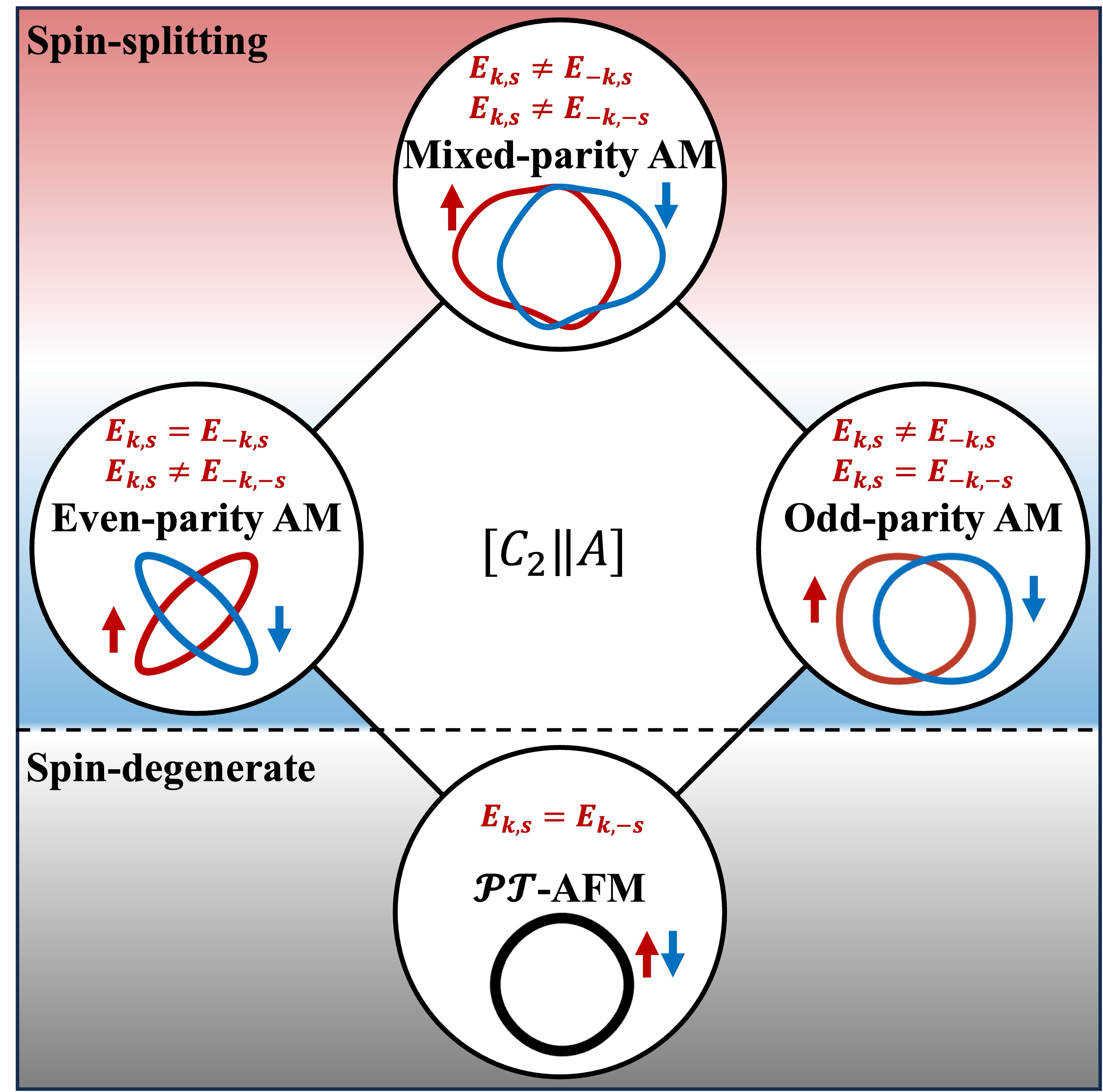
Orbitals, as another fundamental degree of freedom of electrons [70], have been shown to provide a microscopic mechanism for the emergence of altermagnetism. In particular, when coupled to different sublattices, orbital degrees of freedom can form real-space orbital orders and generate either even- [71– 73] or odd-parity [60] altermagnetism. It has also been shown that different orbitals on the same site can couple to opposite spins, giving rise to spin-orbital magnetism [74–77]. UnFIG. 1. Four classes of collinear antiferromagnets (AFMs) with zero net spin magnetizations. [C 2 ∥A] represents the symmetry connecting the two spin sectors.
like relativistic spin-orbit coupling [78–80], this type of spinorbital locking breaks time-reversal symmetry and can arise from the interplay between on-site Hubbard and Hund interactions [81]. Importantly, because the spin magnetization is compensated locally on each site, spin-orbital magnetism can retain zero net magnetization even in a two-sublattice system with inequivalent onsite chemical potentials. This is in sharp contrast to Néel-type antiferromagnets with sublatticestaggered local spin moments, where a staggered chemical po2 tential generally induces a finite net spin magnetization and thus drives the system into a ferrimagnetic state [82].
In this Letter, we show that collinear spin-orbital magnets provide a natural platform for realizing mixed-parity altermagnetism. We first establish the symmetry conditions required for mixed-parity altermagnetism, then focus on a specific model with spin-orbital orders that preserve lattice translation symmetry. We identify the spin-orbital order capable of realizing mixed-parity altermagnetism and further demonstrate that this state intermediates between even- and oddparity altermagnetism while preserving spin splitting and zero net magnetization, as illustrated in Fig. 1. Through microscopic calculations, we show that the required spin-orbital order can be interaction-driven. Finally, we suggest that spinresolved orbital Edelstein effects could provide a probe of this order, complementing spin-resolved ARPES, which directly measures the spin-splitting symmetry.
Symmetry analysis.—Mixed-parity altermagnetism is defined by three symmetry conditions. First, as an altermagnetic state, it must host a collinear spin configuration with zero net magnetization [20]. Thus, the two antiparallel spin sectors are related by a symmetry of the ordered state. Second, the spin splitting must be non-even-parity, namely E k,s ̸ = E −k,s for generic k. This excludes [ C̄ 2 ∥T ] and, more generally, any symmetry that acts as an inversion operation within a given spin sector [60]. For two-dimensional systems, out-of-plane rotational symmetries of the form [C 2 ∥C nz ] with n = 3, 4 are likewise excluded, as they enforce spin-degenerate bands and even-parity spin splitting, respectively. Third, the spin splitting must also be non-odd-parity, namely E k,s ̸ = E −k,−s for generic momentum k. This excludes symmetries that relate opposite spins while reversing momentum, including [C 2 ∥P], effective time-reversal symmetry, and, in two dimensions (2D), rotational symmetries [C 2 ∥C nz ] with n = 2, 6. More generally, all such forbidden symmetries, whether enforcing even- or odd-parity spin splitting, must remain absent even when combined with operations that leave k invariant, such as translation τ and, in 2D, mirror symmetry M z . Satisfying only the first and second (third) conditions gives oddparity (even-parity) altermagnetism, while mixed-parity altermagnetism requires all three.
This analysis further shows that, in 2D, a vertical mirror symmetry in real space is singled out among the crystalline symmetries relating the two antiparallel spin sectors. Unlike the rotational, inversion, or effective time-reversal symmetries discussed above, a vertical mirror alone does not enforce purely even- or odd-parity spin splitting. In previously studied even-parity cases, the mirror symmetry ensures zero net spin magnetization, whereas [ C̄ 2 ∥T ] fixes the parity of the spin splitting [18, 20]. Breaking [ C̄ 2 ∥T ] therefore releases this constraint. This can be achieved by mechanisms that generate orbital magnetization, such as sublattice currents [58, 59], chiral orbital order [60], and dynamical CPL [62–65, 83]. These mechanisms break both [C 2 ∥M i ] and [ C̄ 2 ∥T ] while preserving their combination [C 2 ∥M i T ], thereby stabilizing mixedparity altermagnetism. In this work, we focus on CPL as a highly tunable route to the mixed-parity state.
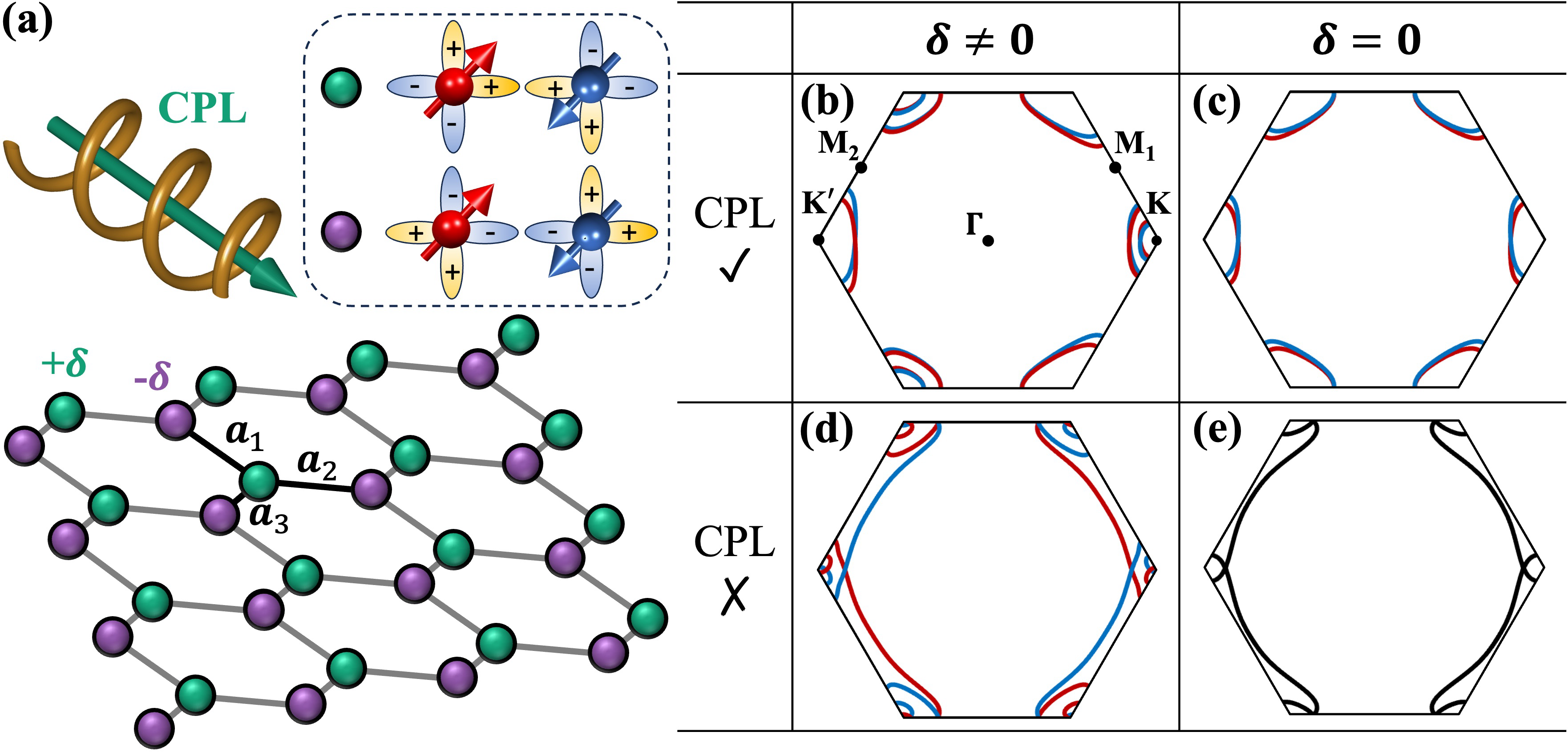
Spin-orbital magnetism.—We now implement the above symmetry analysis in a concrete model. To permit non-evenparity spin splitting under driving, we consider a noncentrosymmetric monolayer, thereby excluding inversion symmetry, which would otherwise enforce E k,s = E −k,s . Within this setting, collinear spin-orbital magnets provide appropriate platforms for realizing mixed-parity altermagnetism. Because opposite spins couple to different real orbitals on the same site, a mirror symmetry that leaves each sublattice invariant while exchanging the two orbitals naturally gives rise to [C 2 ∥M i ]. Under CPL, its combined antiunitary counterpart [C 2 ∥M i T ] can remain intact and protect mixed-parity altermagnetism. A minimal model therefore consists of two sublattices, two orbitals, and two spins, giving rise to an eightband Hamiltonian. Without loss of generality, we consider a two-dimensional hexagonal lattice with d xz and d yz orbitals [see Fig. 2(a)],
where J i=1,2,3,4,5,6 denotes the order parameters of the different spin-orbital magnetic phases O i , and τ , σ, and s are Pauli matrices acting on orbital, sublattice, and spin space, respectively. These six channels exhaust the on-site spin-orbital orders compatible with spin conservation and lattice translation symmetry. The spin-independent Hamiltonian is
(next-)nearest-neighbor hopping along bond d j with polar angle θ j . The corresponding hopping matrices are
(t 2 ) and t 1 (t 3 ) denote the intra-orbital and inter-orbital hopping amplitudes for (next-)nearest-neighbor bonds, respectively, while δ is a staggered sublattice potential. The latter can arise from ferroelectric polarization and be controlled by a vertical electric field E z [82]. For simplicity, we set |a i | = 1 throughout.
Before the drive is applied, the Hamiltonian supports either d-wave spin splitting or spin-degenerate bands, depending on the order parameter J i and the staggered potential δ; the corresponding symmetries and phases are summarized in Table I. We first consider δ = 0. In this limit, the O 4 phase realizes the recently discussed intrinsic spin-orbital d-wave altermagnetism [75], also referred to as atomic altermagnetism [76], protected by [C 2 ∥M x ], which relates opposite spin sectors through an on-site interchange of the orbital combinations d xz ± d yz . The O 1,2,3 phases remain spin degenerate because the two spin sectors are related by inversion. By contrast, in the O 5,6 phases no symmetry relates the two antiparallel spin sectors, and the system enters either a fully compensated ferrimagnetic state [84, 85] or a ferromagnetic state.
3
Symmetry Spin-splitting
TABLE I. Symmetry classification and properties of six spin-orbital orders, with or without sublattice-staggered potential δ and the pres-
to the symbols ✓and ✗, respectively. Here, mixed, ferri., ferro., d, f , p x/y , and PT denote the mixed-parity altermagnetism, ferrimag-
symmetric antiferromagnetism, respectively.
When δ ̸ = 0, the two sublattices become inequivalent, and phases whose zero magnetization relies on a sublatticeexchanging symmetry generally acquire a finite magnetization. Accordingly, the O 1 and O 2 phases become ferrimagnets. By contrast, zero net spin magnetization is preserved in the O 3 and O 4 phases by [C 2 ∥M x ], which remains valid at finite δ. Since finite δ further breaks [C 2 ∥P], the O 3 phase becomes a d-wave altermagnet. Its d-wave form reverses with the sign of δ, enabling electrical control of the spin-splitting pattern, for example through gating. This behavior is qualitatively different from altermagnets with Néel-type order, where a staggered potential typically induces ferrimagnetism.
Light-driven mixed-parity altermagnetism.—Mixed-parity altermagnetism arises naturally in the O 3 and O 4 phases when a finite sublattice-staggered potential δ is combined with CPL. We describe the drive by a time-periodic vector potential
Hamiltonian through the Peierls phase e iA(t)·d j acquired by hopping along bond d j . In the high-frequency off-resonant regime, where ℏω is the largest energy scale, the periodically driven system is described by the effective Floquet Hamiltonian [86, 87]
component. For CPL propagating along the z direction, we
bels the light helicity. The zeroth-order Floquet Hamiltonian simply renormalizes the hopping amplitudes, namely H 0 =
preserves the symmetries of the undriven Hamiltonian. Here J n (x) is the nth-order Bessel function of the first kind. The conversion of spin-splitting parity is thus controlled by the
As shown in Fig. 2, the Fermi surfaces in the O 3 phase exhibit mixed-parity spin splitting when both δ ̸ = 0 and CPL are present. Since the spin splitting is symmetry-dictated and FIG. 2. (a) Schematic of the lattice model and the ingredients leading to mixed-parity altermagnetism. The green and purple spheres denote the two sublattices. The dashed box illustrates the O 3 spinorbital order, in which opposite spin sectors on a given site are coupled to different local orbital configurations, represented by the petal-like patterns and spin arrows. The light-yellow and light-blue lobes indicate the sign of the order parameter on the d xz (x-oriented lobes) and d yz (y-oriented lobes) orbitals. (b-e) Spin-resolved Fermi
the O 3 phase. Depending on the presence of δ and CPL, the spin-resolved Fermi surfaces exhibit (b) mixed-parity, (c) p y -wave, (d) d-wave, and (e) spin-degenerate patterns. The parameters are
the intra-sublattice hoppings {t 2 , t 3 } do not alter the essential symmetries, we neglect them for analytical transparency. The leading Floquet correction then takes the form
where the explicit functions f i (k) are given in Supplemental Material (SM) Sec. I [88]. This correction breaks both
preserving [C 2 ∥M x T ]. Consequently, the O 3 and O 4 phases at finite δ realize mixed-parity altermagnetism. Moreover, because H ′ (k) ∝ η, the Floquet correction is helicity controlled and can shift the Fermi surfaces between valleys, suggesting a route toward valley-polarized spin transport [89–91].
tinues to relate the antiparallel spin sectors. The driven O 1 , O 2 , and O 3 phases therefore become f -, p x -, and p y -wave
wave) pattern in the O 2 (O 3 ) phase is selected by the remain-
phase remains a d-wave altermagnet, protected by the two intact orthogonal effective mirrors [C 2 ∥M i T ] (i = x, y). Taken together with the structure of the order parameters J i , these results indicate that spin-orbital altermagnets generally cannot realize an odd-parity phase if the spin-orbit order is uniform across the two sublattices (referring to these σ 0 -orders, including O 4,5,6 ). The reason is that these orders preserve the inversion symmetry (see Table I), which enforces even-parity spin splitting. Sublattice-staggered spin-orbit order is therefore essential for realizing odd-parity spin-orbital altermagnetism.
4
tion of (a) the parameter t 3 /t 0 and (b) δ for the six channels, with the dashed line marking the parameters t 3 /t 0 and δ adopted in (c), which represents the U -J H /U phase diagram. U and J H denote the intra-orbital Hubbard interaction and Hund coupling, respectively.
The above analysis further shows that mixed-parity altermagnetism is not a fine-tuned exception, but the generic intermediate spin-split phase between even- and odd-parity altermagnets. In Fig. 2, we illustrate this using the O 3 phase as an example. When δ = 0 and CPL is absent, it is an antiferromagnet with spin-degenerate bands [Fig. 2(e)]. A finite δ generates d-wave spin splitting [Fig. 2(d)], whereas CPL at δ = 0 generates p-wave spin splitting [Fig. 2(c)]. When both are present, the band structure necessarily becomes mixedparity [Fig. 2(b)]. In this sense, mixed-parity altermagnetism plays a role parallel to that of PT -symmetric antiferromagnets, which serve as the intermediate phase when spin degeneracy is allowed. This follows from symmetry: the symmetry groups enforcing even- and odd-parity spin splitting are mutually incompatible, and if both were present simultaneously, the bands would become spin degenerate. Therefore, when tuning between even- and odd-parity altermagnets while maintaining both spin splitting and zero net magnetization, mixed-parity altermagnetism naturally emerges as the intermediate regime.
Magnetic phase diagram.—We next establish the microscopic accessibility of the spin-orbital orders introduced above. Starting from a repulsive two-orbital HubbardHund model, we analyze magnetic instabilities using the multi-orbital random-phase approximation (RPA) [81, 88],
susceptibility and U s the spin-channel interaction vertex [88]. A divergence at the critical interaction U c signals a magnetic instability with ordering wave vector Q. We focus on Q = 0, where the ordered state preserves the lattice periodicity and can be classified into the six spin-orbital channels O 1,2,3,4,5,6 . The leading instability is then identified by projecting χ RPA spin onto these channels and comparing the projected susceptibili-
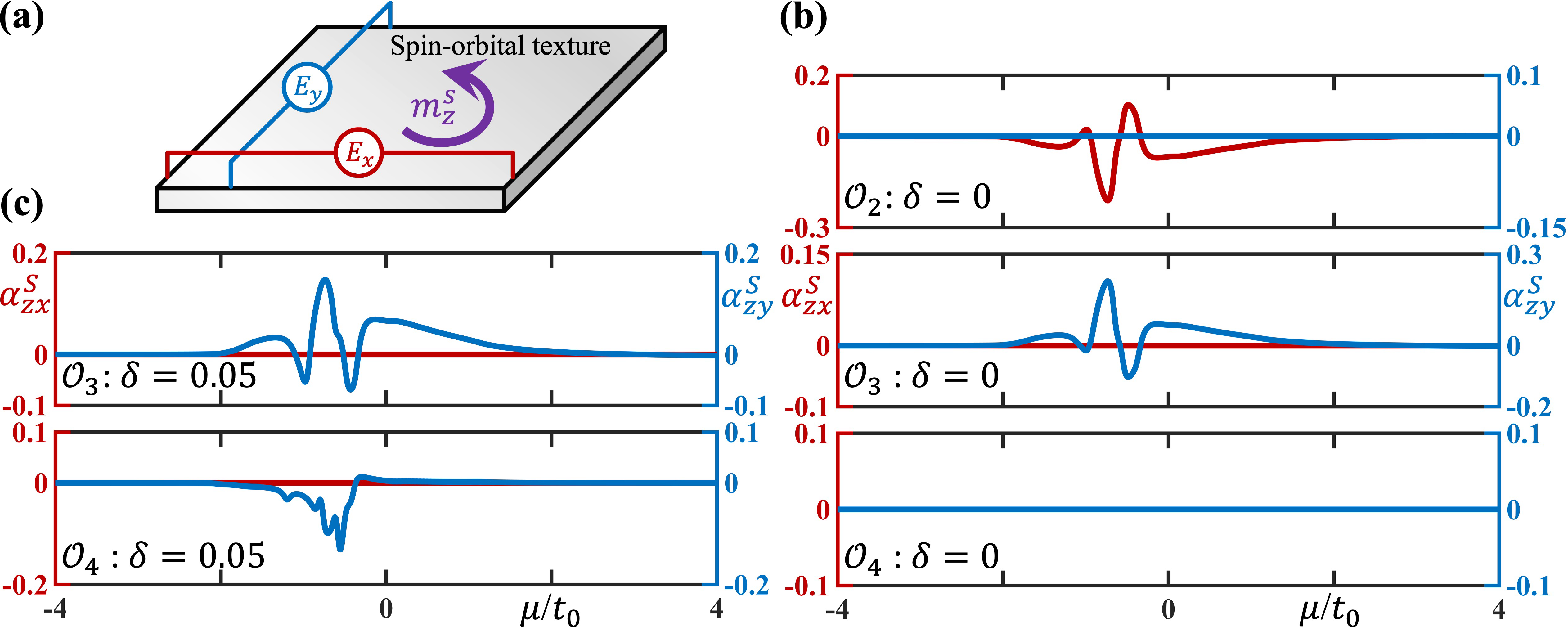
Figure 3 presents the projected RPA susceptibilities versus t 3 /t 0 and δ, together with the U -J H /U phase diagram at the FIG. 4. (a) Schematic of the SOEE. In spin-orbital magnets with spin-orbital texture, an electric field E i=x,y can induce an orbital polarization m si in each spin sector. (b)-(c) SOEE (in units of e 2 τ /(2ℏ 2 )) as a function of µ/t 0 before CPL is applied for three
respectively. Here, µ represents the chemical potential. The parame-
representative parameters marked by dashed lines. The leading instability is governed mainly by the competing O 1 , O 2 , and O 3 channels. Increasing t 3 /t 0 drives the dominant channel from the Néel-like O 1 order to O 3 , and then to O 2 at larger t 3 /t 0 . The O 3 instability remains stable over a broad range of δ, while large |δ| favors O 2 . The resulting phase diagram contains a sizable O 3 region at small J H /U , whereas O 1 dominates at larger J H /U . Its robustness against chemical potential is shown in the SM Sec.II [88]. Thus, provided off-resonant light does not substantially reconstruct the spinorbital order, the O 3 phase serves as a realistic parent state for the light-driven odd-parity phase at δ = 0 and the mixedparity phase at δ ̸ = 0.
Spin-resolved orbital Edelstein effect.—Spin-orbital magnets carry intertwined spin-orbital textures [75], making the orbital Edelstein effect (OEE) a natural probe of the underlying order even before CPL is applied. In each spin sector, an electric field induces a nonequilibrium orbital polarization,
is therefore directly constrained by the same symmetries that classify the spin-orbital order.
Since orbital polarization is axial whereas the electric field is polar, the linear OEE vanishes in inversion-symmetric systems. Thus, when [C 2 ∥P] relates the two spin sectors, their OEE responses have opposite signs and cancel in the to-
the allowed components: a vertical mirror [E∥M j ] allows the response to an electric field normal to the mirror plane and forbids that parallel to it. Accordingly, [C 2 ∥M j ] makes the two spin sectors display identical OEE for the normal component but opposite OEE for the parallel component. The SOEE in mirror-symmetric spin-orbital magnets is therefore intrinsically anisotropic and directly tied to the underlying symmetry.
These symmetry constraints directly diagnose the predriven phases. In 2D, only the out-of-plane orbital polarizas tion is well defined, so the relevant tensor elements are α
zx 5 s and α
zy . For δ = 0 [Fig. 4(b)], the O 4 phase retains inversion symmetry and therefore exhibits no OEE, whereas the O 2 and
respectively. Once δ ̸ = 0 is introduced [Fig. 4(c)], inversion symmetry is broken and finite OEE becomes allowed in the O 4 phase as well. The O 3 and O 4 phases then share the same symmetry and response structure: [C 2 ∥M x ] enforces
at finite δ and the O 5 phase are ferrimagnetic, so their spinresolved OEE responses are no longer symmetry related. The O 1 and O 6 phases retain C 3 symmetry and therefore exhibit no OEE.
Under CPL, the real-space mirror symmetries are broken, but their combinations with time reversal can remain preserved. Since time reversal itself does not forbid the OEE, the symmetry-allowed tensor structure of the response remains unchanged by the drive. The SOEE thus provides a complementary probe of the underlying spin-orbital order both before and after driving, and thereby of the parent order responsible for the even-, odd-, and, in particular, mixed-parity altermagnetic states.
Discussions and conclusions.—In summary, we have shown that mixed-parity altermagnetism constitutes a distinct altermagnetic phase beyond the even- and odd-parity classes. Spin-orbital magnets provides a particularly favorable platform for realizing this phase, because magnetic compensation can occur locally on each site through orbital-selective coupling to opposite spins. We further showed that the characteristic spin-resolved orbital Edelstein effects provide an electrical probe for the parent spin-orbital orders of the mixed-parity phase.
From an experimental perspective, layered materials and magnetic heterostructures with inequivalent magnetic layers provide promising platforms. Possible candidates include layered vanadates, Fe-based layered compounds, and double perovskites such as Ba 2 CaOsO 6 [76], Ba 2 YReO 6 , and Sr 2 MgOsO 6 . In these systems, a gate-controlled potential difference can play the role of the staggered potential δ, while CPL provides a tunable knob for driving parity conversion. Since the zero-magnetization condition in spin-orbital magnets does not rely on equivalent sublattices, the material constraints are less restrictive than in altermagnets with conventional Néel order. Our results therefore extend altermagnetism beyond the even- and odd-parity cases to the mixed-parity regime, identifying mixed-parity altermagnetism as an intermediate spin-split phase connecting them.
Acknowledgements.— Z.-Y. Zhuang would like to thank Xiao-Jiao Wang and Shu-Xuan Wang for fruitful discussions. Z.-Y.Z. and Z.Y. are supported by Guangdong Basic and Applied Basic Research Foundation (Grant No. 2023B1515040023), and Fundamental and Interdisciplinary Disciplines Breakthrough Plan of the Ministry of Education of China (JYB2025XDXM403). S.B.Z. is supported by the National Natural Science Foundation of China (Grant No. 12488101), the Innovation Program for Quantum Science and Technology (Grant No. 2021ZD0302801). L.H.H. is supported by National Key R&D Program of China (Grant No. 2025YFA1411501), the National Natural Science Foundation of China (Grant Nos. 12561160109, 12574148), the Fundamental Research Funds for the Central Universities (Grant No. 226-2024-00068).
[1] J. E. Hirsch, Spin-split states in metals, Phys. Rev. B 41, 6820
(1990). [2] H. Ikeda and Y. Ohashi, Theory of unconventional spin density
wave: A possible mechanism of the micromagnetism in u-based heavy fermion compounds, Phys. Rev. Lett. 81, 3723 (1998). [3] C. Wu and S.-C. Zhang, Dynamic generation of spin-orbit cou-
pling, Phys. Rev. Lett. 93, 036403 (2004). [4] C. Wu, K. Sun, E. Fradkin, and S.-C. Zhang, Fermi liquid in-
stabilities in the spin channel, Phys. Rev. B 75, 115103 (2007). [5] S. Hayami, Y. Yanagi, and H. Kusunose, Momentum-dependent
spin splitting by collinear antiferromagnetic ordering, Journal of the Physical Society of Japan 88, 123702 (2019). [6] S. Hayami, Y. Yanagi, and H. Kusunose, Bottom-up design of
spin-split and reshaped electronic band structures in antiferromagnets without spin-orbit coupling: Procedure on the basis of augmented multipoles, Phys. Rev. B 102, 144441 (2020). [7] Q. Liu, X. Dai, and S. Blügel, Different facets of unconven-
tional magnetism, Nature Physics 21, 329 (2025). [8] H. Chen, Q. Niu, and A. H. MacDonald, Anomalous hall effect
arising from noncollinear antiferromagnetism, Phys. Rev. Lett. 112, 017205 (2014). [9] S. Nakatsuji, N. Kiyohara, and T. Higo, Large anomalous hall
effect in a non-collinear antiferromagnet at room temperature, Nature 527, 212 (2015). [10] L. Šmejkal, A. H. MacDonald, J. Sinova, S. Nakatsuji, and
T. Jungwirth, Anomalous Hall antiferromagnets, Nature Reviews Materials 7, 482 (2022). [11] A. Birk Hellenes, T. Jungwirth, R. Jaeschke-Ubiergo,
A. Chakraborty, J. Sinova, and L. Šmejkal, P-wave magnets, arXiv e-prints , arXiv:2309.01607 (2023). [12] B. Brekke, P. Sukhachov, H. G. Giil, A. Brataas, and J. Linder,
Minimal Models and Transport Properties of Unconventional
[13] Y. P. Zhu, X. Chen, X. R. Liu, Y. Liu, P. Liu, H. Zha, G. Qu,
M. Zeng, S. Jayaram, M. Lenger, J. Ding, S. Mo, K. Tanaka, M. Arita, Z. Liu, M. Ye, D. Shen, J. Wrachtrup, Y. Huang, R. H. He, S. Qiao, Q. Liu, and C. Liu, Observation of plaid-like spin splitting in a noncoplanar antiferromagnet, Nature 626, 523 (2024). [14] Y. Yu, M. B. Lyngby, T. Shishidou, M. Roig, A. Kreisel,
M. Weinert, B. M. Andersen, and D. F. Agterberg, Odd-Parity Magnetism Driven by Antiferromagnetic Exchange, Phys. Rev. Lett. 135, 046701 (2025). [15] Q. Song, S. Stavrić, P. Barone, A. Droghetti, D. S. Anto-
nenko, J. W. Venderbos, C. A. Occhialini, B. Ilyas, E. Ergeçen, N. Gedik, S. W. Cheong, R. M. Fernandes, S. Picozzi, and R. Comin, Electrical switching of a p-wave magnet, Nature 642, 64 (2025). [16] R. Yamada, M. T. Birch, P. R. Baral, S. Okumura, R. Nakano, 6 S. Gao, M. Ezawa, T. Nomoto, J. Masell, Y. Ishihara, K. K. Kolincio, I. Belopolski, H. Sagayama, H. Nakao, K. Ohishi, T. Ohhara, R. Kiyanagi, T. Nakajima, Y. Tokura, T. hisa Arima, Y. Motome, M. M. Hirschmann, and M. Hirschberger, Metallic p-wave magnet with commensurate spin helix (2025), arXiv:2502.10386 [cond-mat.str-el]. [17] Z.-Y. Zhuang, D. Zhu, Z. Wu, and Z. Yan, Cartesian nodal lines
and magnetic kramers weyl nodes in spin-split antiferromagnets, Newton , 100403 (2026). [18] H.-Y. Ma, M. Hu, N. Li, J. Liu, W. Yao, J.-F. Jia, and J. Liu,
Multifunctional antiferromagnetic materials with giant piezomagnetism and noncollinear spin current, Nature Communications 12, 2846 (2021). [19] L. Šmejkal, J. Sinova, and T. Jungwirth, Emerging Research
Landscape of Altermagnetism, Phys. Rev. X 12, 040501 (2022). [20] L. Šmejkal, J. Sinova, and T. Jungwirth, Beyond Conventional
Ferromagnetism and Antiferromagnetism: A Phase with Nonrelativistic Spin and Crystal Rotation Symmetry, Phys. Rev. X 12, 031042 (2022). [21] L.-D. Yuan, Z. Wang, J.-W. Luo, E. I. Rashba, and A. Zunger,
Giant momentum-dependent spin splitting in centrosymmetric low-Z antiferromagnets, Phys. Rev. B 102, 014422 (2020). [22] L.-D. Yuan, Z. Wang, J.-W. Luo, and A. Zunger, Prediction of
low-Z collinear and noncollinear antiferromagnetic compounds having momentum-dependent spin splitting even without spinorbit coupling, Phys. Rev. Mater. 5, 014409 (2021). [23] P. Liu, J. Li, J. Han, X. Wan, and Q. Liu, Spin-Group Symme-
try in Magnetic Materials with Negligible Spin-Orbit Coupling, Phys. Rev. X 12, 021016 (2022). [24] X. Chen, J. Ren, Y. Zhu, Y. Yu, A. Zhang, P. Liu, J. Li, Y. Liu,
Spin Space Groups, Phys. Rev. X 14, 031038 (2024). [25] Y. Jiang, Z. Song, T. Zhu, Z. Fang, H. Weng, Z.-X. Liu, J. Yang,
and C. Fang, Enumeration of spin-space groups: Toward a complete description of symmetries of magnetic orders, Phys. Rev. X 14, 031039 (2024). [26] Z. Xiao, J. Zhao, Y. Li, R. Shindou, and Z.-D. Song, Spin Space
Groups: Full Classification and Applications, Phys. Rev. X 14, 031037 (2024). [27] Y. Liu, X. Chen, Y. Yu, J. Etxebarria, J. M. Perez-Mato, and
Q. Liu, Symmetry classification of magnetic orders using oriented spin space groups, Nature 652, 869 (2026). [28] T. Osumi, S. Souma, T. Aoyama, K. Yamauchi, A. Honma,
K. Nakayama, T. Takahashi, K. Ohgushi, and T. Sato, Observation of a giant band splitting in altermagnetic MnTe, Phys. Rev. B 109, 115102 (2024). [29] S. Lee, S. Lee, S. Jung, J. Jung, D. Kim, Y. Lee, B. Seok,
J. Kim, B. G. Park, L. Šmejkal, C.-J. Kang, and C. Kim, Broken Kramers Degeneracy in Altermagnetic MnTe, Phys. Rev. Lett. 132, 036702 (2024). [30] J. Krempaský, L. Šmejkal, S. W. D’Souza, M. Hajlaoui,
G. Springholz, K. Uhlı́řová, F. Alarab, P. C. Constantinou,
A. Birk Hellenes, Z. Jansa, H. Reichlová, Z. Šobáň, R. D. Gonzalez Betancourt, P. Wadley, J. Sinova, D. Kriegner, J. Minár, J. H. Dil, and T. Jungwirth, Altermagnetic lifting of Kramers spin degeneracy, Nature 626, 517 (2024). [31] M. Hajlaoui, S. Wilfred D’Souza, L. Šmejkal, D. Krieg-
ner, G. Krizman, T. Zakusylo, N. Olszowska, O. Caha, J. Michalička, J. Sánchez-Barriga, A. Marmodoro, K. Výborný,
G. Springholz, Temperature dependence of relativistic valence band splitting induced by an altermagnetic phase transition, Advanced Materials 36, 2314076 (2024).
[32] S. Reimers, L. Odenbreit, L. Šmejkal, V. N. Strocov, P. Con-
stantinou, A. B. Hellenes, R. Jaeschke Ubiergo, W. H. Campos,
Dunin-Borkowski, S. Das, M. Kläui, J. Sinova, and M. Jourdan, Direct observation of altermagnetic band splitting in CrSb thin films, Nature Communications 15, 2116 (2024). [33] J. Ding, Z. Jiang, X. Chen, Z. Tao, Z. Liu, T. Li, J. Liu,
J. Sun, J. Cheng, J. Liu, Y. Yang, R. Zhang, L. Deng, W. Jing, Y. Huang, Y. Shi, M. Ye, S. Qiao, Y. Wang, Y. Guo, D. Feng, and D. Shen, Large Band Splitting in g-Wave Altermagnet CrSb, Phys. Rev. Lett. 133, 206401 (2024). [34] G. Yang, Z. Li, S. Yang, J. Li, H. Zheng, W. Zhu, Z. Pan, Y. Xu,
S. Cao, W. Zhao, A. Jana, J. Zhang, M. Ye, Y. Song, L.-H. Hu, L. Yang, J. Fujii, I. Vobornik, M. Shi, H. Yuan, Y. Zhang, Y. Xu, and Y. Liu, Three-dimensional mapping of the altermagnetic spin splitting in CrSb, Nature Communications 16, 1442 (2025). [35] M. Zeng, M.-Y. Zhu, Y.-P. Zhu, X.-R. Liu, X.-M. Ma, Y.-J.
Hao, P. Liu, G. Qu, Y. Yang, Z. Jiang, K. Yamagami, M. Arita,
Y. Huang, Q. Liu, and C. Liu, Observation of Spin Splitting in Room-Temperature Metallic Antiferromagnet CrSb, Advanced Science 11, 2406529 (2024). [36] C. Li, M. Hu, Z. Li, Y. Wang, W. Chen, B. Thiagarajan, M. Le-
andersson, C. Polley, T. Kim, H. Liu, C. Fulga, M. G. Vergniory, O. Janson, O. Tjernberg, and J. van den Brink, Topological Weyl altermagnetism in CrSb, Communications Physics 8, 311 (2025). [37] W. Lu, S. Feng, Y. Wang, D. Chen, Z. Lin, X. Liang, S. Liu,
W. Feng, K. Yamagami, J. Liu, C. Felser, Q. Wu, and J. Ma, Signature of Topological Surface Bands in Altermagnetic Weyl Semimetal CrSb, Nano Letters 25, 7343 (2025). [38] B. Jiang, M. Hu, J. Bai, Z. Song, C. Mu, G. Qu, W. Li, W. Zhu,
H. Pi, Z. Wei, Y.-J. Sun, Y. Huang, X. Zheng, Y. Peng, L. He, S. Li, J. Luo, Z. Li, G. Chen, H. Li, H. Weng, and T. Qian, A metallic room-temperature d-wave altermagnet, Nature Physics 21, 754 (2025). [39] F. Zhang, X. Cheng, Z. Yin, C. Liu, L. Deng, Y. Qiao, Z. Shi,
S. Zhang, J. Lin, Z. Liu, M. Ye, Y. Huang, X. Meng, C. Zhang, T. Okuda, K. Shimada, S. Cui, Y. Zhao, G. H. Cao, S. Qiao, J. Liu, and C. Chen, Crystal-symmetry-paired spin–valley locking in a layered room-temperature metallic altermagnet candidate, Nature Physics 21, 760 (2025). [40] L. Šmejkal, A. B. Hellenes, R. González-Hernández, J. Sinova,
and T. Jungwirth, Giant and Tunneling Magnetoresistance in Unconventional Collinear Antiferromagnets with Nonrelativistic Spin-Momentum Coupling, Phys. Rev. X 12, 011028 (2022). [41] R. González-Hernández, L. Šmejkal, K. Výborný, Y. Yahagi,
J. Sinova, T. c. v. Jungwirth, and J. Železný, Efficient electrical spin splitter based on nonrelativistic collinear antiferromagnetism, Phys. Rev. Lett. 126, 127701 (2021). [42] J. A. Ouassou, A. Brataas, and J. Linder, dc Josephson Effect in
Altermagnets, Phys. Rev. Lett. 131, 076003 (2023). [43] H. Bai, Y. C. Zhang, Y. J. Zhou, P. Chen, C. H. Wan, L. Han,
W. X. Zhu, S. X. Liang, Y. C. Su, X. F. Han, F. Pan, and
spin splitting effect in antiferromagnet ruo 2 , Phys. Rev. Lett. 130, 216701 (2023). [44] Y. Fang, J. Cano, and S. A. A. Ghorashi, Quantum Geometry
Induced Nonlinear Transport in Altermagnets, Phys. Rev. Lett. 133, 106701 (2024). [45] D. Zhu, Z.-Y. Zhuang, Z. Wu, and Z. Yan, Topological su-
perconductivity in two-dimensional altermagnetic metals, Phys. Rev. B 108, 184505 (2023).
7
son Junction Induced by Altermagnetism, Phys. Rev. Lett. 133, 226002 (2024). [47] S.-B. Zhang, L.-H. Hu, and T. Neupert, Finite-momentum
Cooper pairing in proximitized altermagnets, Nature Communications 15, 1801 (2024). [48] D. Zhu, D. Liu, Z.-Y. Zhuang, Z. Wu, and Z. Yan, Field-
sensitive dislocation bound states in two-dimensional d-wave altermagnets, Phys. Rev. B 110, 165141 (2024). [49] S. A. A. Ghorashi, T. L. Hughes, and J. Cano, Altermagnetic
Routes to Majorana Modes in Zero Net Magnetization, Phys. Rev. Lett. 133, 106601 (2024). [50] Z. Jin, Z. Zeng, Y. Cao, and P. Yan, Skyrmion Hall Effect in
Altermagnets, Phys. Rev. Lett. 133, 196701 (2024). [51] L. Han, X. Fu, R. Peng, X. Cheng, J. Dai, L. Liu, Y. Li,
Y. Zhang, W. Zhu, H. Bai, Y. Zhou, S. Liang, C. Chen, Q. Wang,
trical 180 ◦ switching of Néel vector in spin-splitting antiferromagnet, Science Advances 10, eadn0479 (2024). [52] D. S. Antonenko, R. M. Fernandes, and J. W. F. Venderbos,
Mirror Chern Bands and Weyl Nodal Loops in Altermagnets, Phys. Rev. Lett. 134, 096703 (2025). [53] J.-X. Hu, O. Matsyshyn, and J. C. W. Song, Nonlinear Su-
perconducting Magnetoelectric Effect, Phys. Rev. Lett. 134, 026001 (2025). [54] M. Hu, X. Cheng, Z. Huang, and J. Liu, Catalog of c-paired
spin-momentum locking in antiferromagnetic systems, Phys. Rev. X 15, 021083 (2025). [55] X. Duan, J. Zhang, Z. Zhu, Y. Liu, Z. Zhang, I. Žutić, and
T. Zhou, Antiferroelectric Altermagnets: Antiferroelectricity Alters Magnets, Phys. Rev. Lett. 134, 106801 (2025). [56] H.-J. Lin, S.-B. Zhang, H.-Z. Lu, and X. C. Xie, Coulomb drag
in altermagnets, Phys. Rev. Lett. 134, 136301 (2025). [57] Y. Chen, X. Liu, H.-Z. Lu, and X. C. Xie, Electrical Switching
of Altermagnetism, Phys. Rev. Lett. 135, 016701 (2025). [58] Y.-P. Lin, Odd-parity altermagnetism through sublattice cur-
rents: From Haldane-Hubbard model to general bipartite lattices, arXiv e-prints , arXiv:2503.09602 (2025). [59] M. Zeng, Z. Qin, L. Qin, S. Feng, D.-H. Xu, and R. Wang, The
electronic and transport properties in the Haldane-Hubbard with odd-parity altermagnetism, arXiv e-prints , arXiv:2507.09906 (2025). [60] Z.-Y. Zhuang, D. Zhu, D. Liu, Z. Wu, and Z. Yan, Odd-
parity altermagnetism originated from orbital orders (2025), arXiv:2508.18361 [cond-mat.mes-hall]. [61] M. Zeng, L. Qin, S. Feng, D.-H. Xu, and R. Wang, The spin hall
conductivity in the hole-doped bilayer haldane-hubbard model with odd-parity alm (2025), arXiv:2510.12602 [cond-mat.strel]. [62] B. Li, D.-F. Shao, and A. A. Kovalev, Floquet Spin Split-
ting and Spin Generation in Antiferromagnets, arXiv e-prints , arXiv:2507.22884 (2025). [63] T. Zhu, D. Zhou, H. Wang, and J. Ruan, Floquet odd-parity
collinear magnets, arXiv e-prints , arXiv:2508.02542 (2025). [64] S. Huang, Z. Qin, F. Zhan, D.-H. Xu, D.-S. Ma,
and R. Wang, Light-induced Odd-parity Magnetism in Conventional Collinear Antiferromagnets, arXiv e-prints , arXiv:2507.20705 (2025). [65] D. Liu, Z.-Y. Zhuang, D. Zhu, Z. Wu, and Z. Yan, Light-
indcued odd-parity altermagnets on dimerized lattices (2025), arXiv:2508.18360 [cond-mat.mes-hall]. [66] B. Pan, P. Zhou, Y. Hu, S. Liu, B. Zhou, H. Xiao, X. Yang,
and L. Sun, Floquet-induced altermagnetic transition in a-type antiferromagnetic bilayers, Phys. Rev. B 112, 224430 (2025).
[67] Z. Li, L. Li, M. Guan, and S. Meng, Robust and tunable flo-
quet altermagnets in sliding a-type antiferromagnetic bilayers (2025), arXiv:2512.06416 [cond-mat.mtrl-sci]. [68] P. A. Frigeri, D. F. Agterberg, A. Koga, and M. Sigrist,
Superconductivity without inversion symmetry: Mnsi versus
[69] E. Bauer, G. Hilscher, H. Michor, C. Paul, E. W. Scheidt,
A. Gribanov, Y. Seropegin, H. Noël, M. Sigrist, and P. Rogl, Heavy fermion superconductivity and magnetic order in noncentrosymmetric cept 3 Si, Phys. Rev. Lett. 92, 027003 (2004). [70] Y. Tokura and N. Nagaosa, Orbital physics in transition-metal
oxides, science 288, 462 (2000). [71] V. Leeb, A. Mook, L. Šmejkal, and J. Knolle, Spontaneous For-
mation of Altermagnetism from Orbital Ordering, Phys. Rev. Lett. 132, 236701 (2024). [72] M. Vila, V. Sunko, and J. E. Moore, Orbital-spin locking and its
optical signatures in altermagnets, Phys. Rev. B 112, L020401 (2025). [73] Q. N. Meier, A. Carta, C. Ederer, and A. Cano, Net and com-
pensated altermagnetism from staggered orbital order: Layerdependent spin splitting in sr n+1 cr n o 3n+1 , Phys. Rev. Lett. 136, 116705 (2026). [74] S. Giuli, C. Mejuto-Zaera, and M. Capone, Altermagnetism
from interaction-driven itinerant magnetism, Phys. Rev. B 111, L020401 (2025). [75] Z.-M. Wang, Y. Zhang, S.-B. Zhang, J.-H. Sun, E. Dagotto, D.-
H. Xu, and L.-H. Hu, Spin-orbital altermagnetism, Phys. Rev. Lett. 135, 176705 (2025). [76] R. Jaeschke-Ubiergo, V.-K. Bharadwaj, W. Campos,
R. Zarzuela, N. Biniskos, R. M. Fernandes, T. Jungwirth, J. Sinova, and L. Šmejkal, Atomic altermagnetism (2025), arXiv:2503.10797 [cond-mat.mtrl-sci]. [77] P. d’Ornellas, V. Leeb, A. G. Grushin, and J. Knolle, Altermag-
netism without crystal symmetry, Phys. Rev. B 113, 024426 (2026). [78] C. L. Kane and E. J. Mele, Quantum Spin Hall Effect in
Graphene, Phys. Rev. Lett. 95, 226801 (2005). [79] B. A. Bernevig, T. L. Hughes, and S.-C. Zhang, Quantum Spin
Hall Effect and Topological Phase Transition in HgTe Quantum Wells, Science 314, 1757 (2006). [80] V. Galitski and I. B. Spielman, Spin–orbit coupling in quantum
gases, Nature 494, 49 (2013). [81] C. Lu, C. Cao, H. Yuan, P. Coleman, and L.-H. Hu, Breakdown
of stoner ferromagnetism by intrinsic altermagnetism (2025), arXiv:2510.00614 [cond-mat.str-el]. [82] B. Wang, Y. Li, Y. Liu, and C.-C. Liu, Spontaneous fully
compensated ferrimagnetism (2026), arXiv:2602.24135 [condmat.str-el]. [83] D. Zhu, D. Liu, Z.-Y. Zhuang, Z. Wu, and Z. Yan, Light-induced
even-parity unidirectional spin splitting in coplanar antiferromagnets (2026), arXiv:2601.03358 [cond-mat.mtrl-sci]. [84] Y. Liu, S.-D. Guo, Y. Li, and C.-C. Liu, Two-Dimensional Fully
Compensated Ferrimagnetism, Phys. Rev. Lett. 134, 116703 (2025). [85] J. Feng, X. Zhou, J. Chen, M. Xu, X. Yang, and Y. Li, Fer-
roelectric antiferromagnetic lifting of spin-valley degeneracy, Phys. Rev. B 111, 214446 (2025). [86] T. Kitagawa, T. Oka, A. Brataas, L. Fu, and E. Demler, Trans-
port properties of nonequilibrium systems under the application of light: Photoinduced quantum hall insulators without landau levels, Phys. Rev. B 84, 235108 (2011). [87] N. Goldman and J. Dalibard, Periodically driven quantum sys-
tems: Effective hamiltonians and engineered gauge fields, Phys. Rev. X 4, 031027 (2014).
8 [88] See Supplemental Material for the derivation of Floquet lattice
Hamiltonian, the chemical potential dependence of χ RPA Γ,α , and the orbital Edelstein effect. [89] D. Xiao, M.-C. Chang, and Q. Niu, Berry phase effects on elec-
tronic properties, Rev. Mod. Phys. 82, 1959 (2010). [90] J. R. Schaibley, H. Yu, G. Clark, P. Rivera, J. S. Ross, K. L.
Seyler, W. Yao, and X. Xu, Valleytronics in 2D materials, Nature Reviews Materials 1, 16055 (2016). [91] S. A. Vitale, D. Nezich, J. O. Varghese, P. Kim, N. Gedik,
P. Jarillo-Herrero, D. Xiao, and M. Rothschild, Valleytronics: Opportunities, Challenges, and Paths Forward, Small 14, 1801483 (2018).
[92] T. Yoda, T. Yokoyama, and S. Murakami, Current-induced or-
bital and spin magnetizations in crystals with helical structure, Scientific reports 5, 12024 (2015). [93] T. Yoda, T. Yokoyama, and S. Murakami, Orbital edelstein ef-
fect as a condensed-matter analog of solenoids, Nano Letters 18, 916 (2018). [94] C. Niu, J.-P. Hanke, P. M. Buhl, H. Zhang, L. Plucinski,
D. Wortmann, S. Blügel, G. Bihlmayer, and Y. Mokrousov, Mixed topological semimetals driven by orbital complexity in two-dimensional ferromagnets, Nature communications 10, 3179 (2019).