⬇ Download Markdown · ⬇ Download LaTeX · ⬇ original · view original
Spin Hall and Edelstein Effects in Novel Chiral Noncollinear
Altermagnets
arXiv:2410.17993v2 [cond-mat.mtrl-sci] 13 Nov 2024
1 Leibniz Institute for Solid State and Materials Research,
IFW Dresden, Helmholtzstraße 20, 01069 Dresden, Germany
2 Max Planck Institute for Chemical Physics of Solids, 01187 Dresden, Germany
Université Paris-Saclay, CEA-Saclay, 91191 Gif-sur-Yvette, France
4 Würzburg-Dresden Cluster of Excellence Ct.qmat,
Technische Universitat Dresden, 01062, Dresden, Germany
5 Département de Physique et Institut Quantique,
Université de Sherbrooke, Sherbrooke, J1K 2R1 Québec, Canada.
6 Donostia International Physics Center,
20018 Donostia–San Sebastian, Spain
dresden.de, [email protected] 1
I. INTRODUCTION
Altermagnets (AMs) are compensated magnetic phases that share features of fer-
romagnets and antiferromagnets characterized by an alternation of magnetic moments
synchronized with an alternation of local multipoles around magnetic atoms[1, 2].
In their original setting, altermagnets are collinearly ordered antiferromagnets that
have zero net magnetization but yet a spin-splitting of electronics bands, also in the
absence of relativistic spin-orbit coupling (SOC). This leads to Fermi surfaces with
non-trivial patterns of spin polarization in momentum space, for instance of d-wave
type, that can sustain spin-currents [1, 2], like ferromagnets while being robust to stray
magnetic fields unlike their ferromagnetic counterparts. Such properties of altermagnets
offer an intriguing opportunity to leverage the complementary advantages of ferro-
and antiferromagnets in spintronics [1–6]. The recently developed Landau theory of
collinear altermagnetism [7], provides a yet more general, symmetry-based definition:
2
II. LANDAU THEORY OF CHIRAL NONCOLLINEAR AM
In order to elaborate on the nature of altermagnetism in chiral, non-collinear com-
pensated magnets, it is useful to first introduce altermagnetism in its original context,
namely in collinear, compensated magnets with an inversion center in the crystal struc-
ture. With this foundation, we will then be in a position to discuss the new physics
that emerges when the inversion center and collinearity are lost.
Altermagnetism is most conveniently defined in the limit of zero SOC. This is because
there is a separation of energy scales in altermagnetic systems where the scale associated
with spin splitting in the band structure is much larger than spin-orbit splittings. With
this in mind, we consider a lattice with some space group G. In the paramagnetic
phase, the magnetism is symmetric under the elements of G as well as rotations in
spin space and time reversal. In formulating a Landau theory for such systems we
4
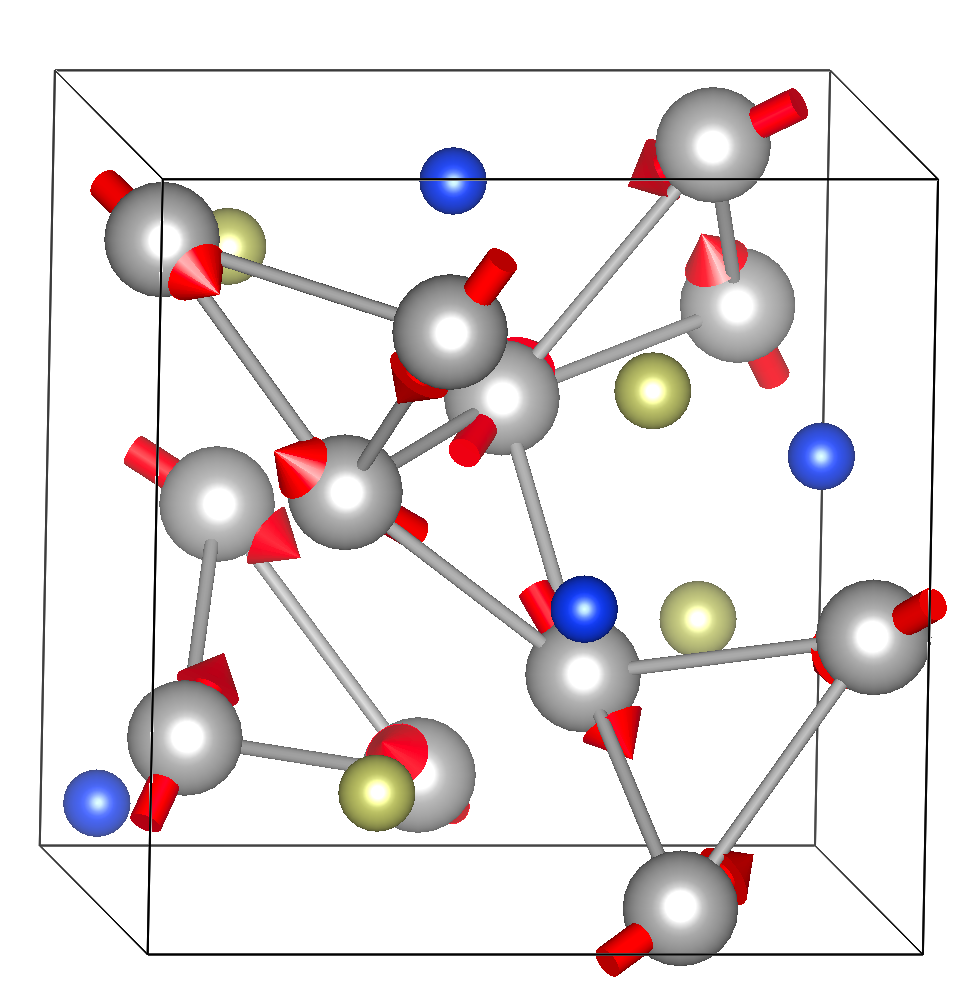
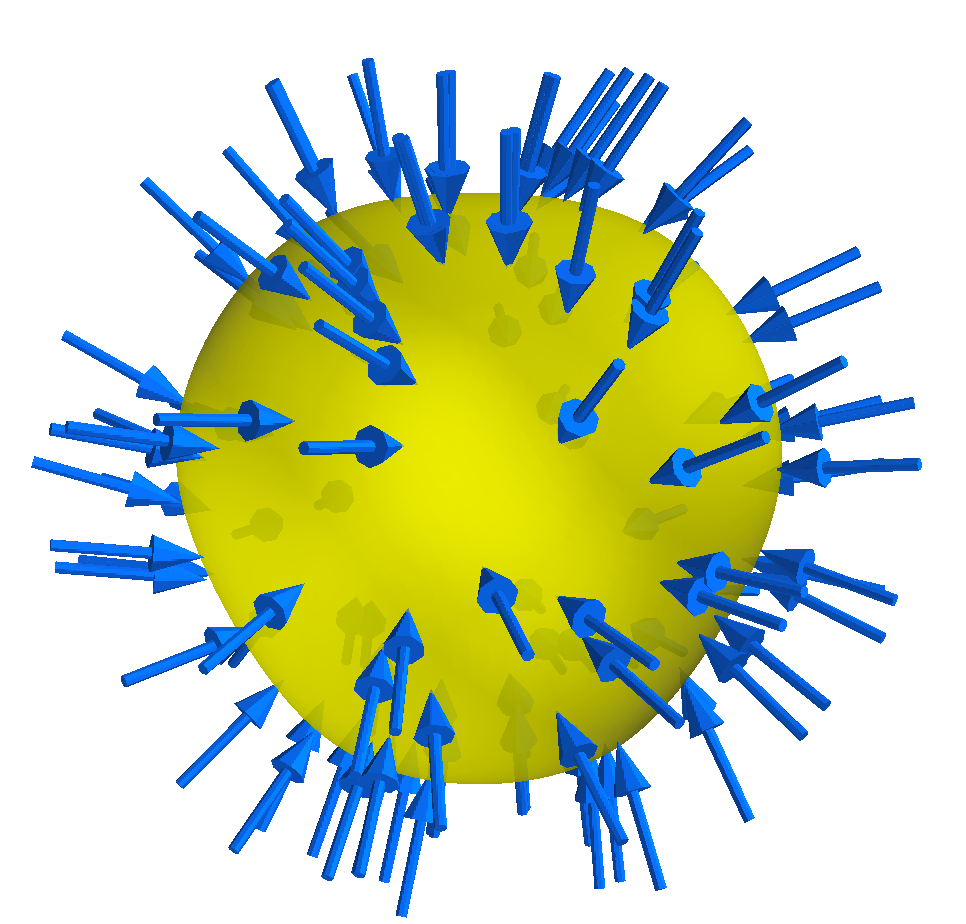
III. ELECTRONIC PROPERTIES OF MN 3 IRSI
Energy(eV)
0.2
k y 0.0
-0.2
-0.4
Γ X M Γ R k x X/M R
k x
IV. SPIN HALL AND EDELSTEIN EFFECTS
0.0 σ
0 (c) σ 1 σ s (×10 2 (ћ/e)S/cm)
(a)
(b)
-0.2 k
z k x -0.3
E x -0.4
-0.5 -0.5 -0.4 -0.3 -0.2 -0.1 0.0 0.1 0.2 0.3 0.4 0.5 5.0
4.0 Edelstein k y E x 3.0 2.0 σ 0 σ 1 0.0 -2.0 (d) 1.0 -0.5 -0.4 -0.3 -0.2 -0.1 0.0 0.1 0.2 0.3 0.4 0.5 χ s (×10 -10 (ћm/V)
SHE (×10 -1 )
-0.1 4.0 -1.0 2.0 -3.0 1.0
0.0 -0.5 -0.4 -0.3 -0.2 -0.1 0.0 0.1 0.2 0.3 0.4 0.5
E/t a -5.0 -0.5 -0.4 -0.3 -0.2 -0.1 0.0 0.1 0.2 0.3 0.4 0.5
E-E f (eV)
V. SUMMARY AND CONCLUSIONS
Using group theory and Landau theory, we have predicted the existence of non-
collinear chiral altermagnets and their distinctive electronic and transport properties.
Compared to collinear altermagnets, non-collinear systems exhibit a more intricate
momentum-space spin texture, extending the classification scheme for collinear systems.
On theoretical grounds, we have established the presence of a unique spin-momentum
locking mechanism that arises in the absence of SOC, as a direct consequence of the
14
VI. METHODS
VII. ACKNOWLEDGEMENTS
[65] G. Kresse and J. Furthmu¨ller, Efficient iterative schemes for ab initio total-energy cal-
culations using a plane-wave basis set, Phys. Rev. B 54, 11169 (1996).
[66] P. E. Bl¨ochl, Projector augmented-wave method, Phys. Rev. B 50, 17953 (1994).
[67] N. Marzari and D. Vanderbilt, Maximally localized generalized wannier functions for
composite energy bands, Phys. Rev. B 56, 12847 (1997).
22