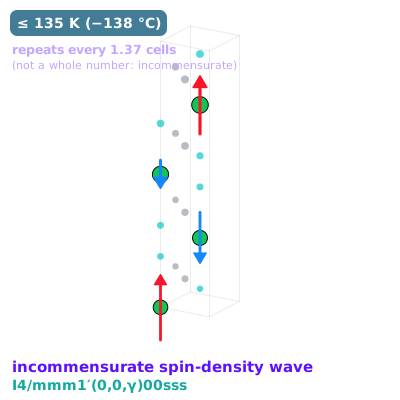
Incommensurate: the magnetic pattern repeats every so many cells, but not a whole number of them, so it never lines up with the crystal lattice. Here it's a spin-density wave: the size of the spin swells and shrinks as you move along.
ordered ≤ 135 K (−138 °C)Colour: where that sits relative to 25 °C. Saturation: how much margin it has.
Structure · 11 properties
Magnetic group
I4/mmm1′(0,0,γ)00sss
Point group
4/mmm1′
Parent space group
I 4/m m m No. 139
Repeats every
1.37 cells along c (not a whole number: that's what incommensurate means)
Propagation
[0 0 0.7302] 1k
Cell
a 4.2 · b 4.2 · c 10.23 Å · α 90° · β 90° · γ 90°
Transition
135 K (−138 °C)
Measured at
100 K
Magnetic ions
U
Largest moment component
2.49 μB
Method
NPD
Symmetry
Stereogram of the magnetic point group: each operation applied to one direction. Filled = upper hemisphere, ring = lower; red operations include time reversal. Lines are mirrors; polygons are 2/3/4/6-fold axes; the centre ring is inversion.
sha256 of this copy: 10f24e8da4e16de40b46bf793f5c673ad1f7f97a1120ee6b739189c97ff4da80 The mirror keeps the bytes Bilbao served, so the original should hash the same unless MAGNDATA has revised the entry since: shasum -a 256 1.1.115_UPd2Ge2.mcif.