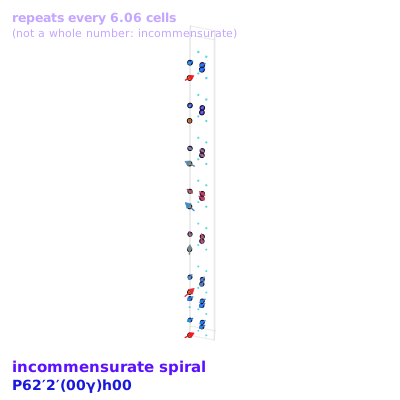
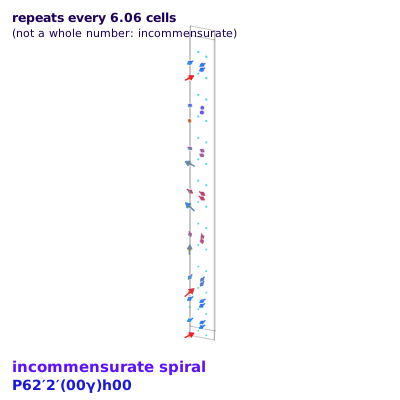
Incommensurate: the magnetic pattern repeats every so many cells, but not a whole number of them, so it never lines up with the crystal lattice. Here it's a spiral: the spin direction rotates as you move along.
Structure · 9 properties
Magnetic group
P62′2′(00γ)h00
Point group
62′2′
Parent space group
P 6/m m m No. 191
Repeats every
6.06 cells along c (not a whole number: that's what incommensurate means)
Propagation
[0 0 0.1651] 1k
Cell
a 5.2081 · b 5.2081 · c 8.1522 Å · α 90° · β 90° · γ 120°
Magnetic ions
Dy, Mn
Largest moment component
7.154 μB
Method
NPD
Symmetry
Stereogram of the magnetic point group: each operation applied to one direction. Filled = upper hemisphere, ring = lower; red operations include time reversal. Lines are mirrors; polygons are 2/3/4/6-fold axes; the centre ring is inversion.
sha256 of this copy: c4077673d8daa3e60bf37f20504dbb85fcf83b9fda29d697bf2564dde3ca100f The mirror keeps the bytes Bilbao served, so the original should hash the same unless MAGNDATA has revised the entry since: shasum -a 256 1.1.10_DyMn6Ge6.mcif.