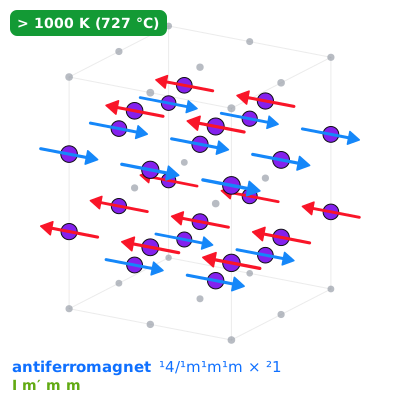
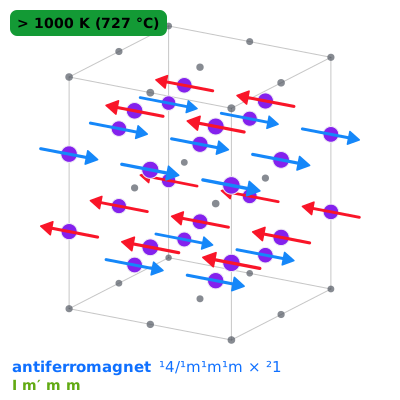
No net magnetisation, and up and down sublattices are related by a shift or by inversion, so the bands stay spin-degenerate: a conventional antiferromagnet.
Spin group ¹4/¹m¹m¹m × ²1: each symmetry marked ¹ keeps every spin, ² swaps up and down.
ordered > 1000 K (727 °C)Colour: where that sits relative to 25 °C. Saturation: how much margin it has.
Structure · 10 properties
Magnetic group
I m′ m m BNS 71.535
Parent space group
I 4/m m m No. 139
Spins
collinear · net moment 0 μB per cell
Propagation
[0 0 0] 1k
Cell
a 3.3295 · b 3.3295 · c 8.5398 Å · α 90° · β 90° · γ 90°
Transition
>1000 K (727 °C)
Measured at
300 K
Magnetic ions
Mn
Largest moment component
4.3 μB
Method
NPD
Symmetry
Stereogram of the magnetic point group: each operation applied to one direction. Filled = upper hemisphere, ring = lower; red operations include time reversal. Lines are mirrors; polygons are 2/3/4/6-fold axes; the centre ring is inversion.
sha256 of this copy: 3a37eb2493bfa68d6f70825cf65d05aa18f5b132fe31e9f482aec73954f3ac17 The mirror keeps the bytes Bilbao served, so the original should hash the same unless MAGNDATA has revised the entry since: shasum -a 256 0.639_Mn2Au.mcif.