⬇ Download Markdown · ⬇ Download LaTeX · ⬇ original · view original
Surface Functionalization Enables Two-Dimensional Altermagnetism and Giant Tunnel
Magnetoresistance Zhou Cui, 1 Ziye Zhu, 1, ∗ Bowen Hao, 1 Xunkai Duan, 1 Xuan Zhou, 1 Yali Xie, 2 Huali Yang, 2 Baisheng Sa, 3, † Runwei Li, 1, 2 and Tong Zhou 1, ‡ 1
4
Ningbo Institute of Digital Twin, Eastern Institute of Technology, Ningbo 315200, China 2 Zhejiang Province Key Laboratory of Magnetic Materials and Application Technology, Ningbo Institute of Materials Technology and Engineering, Chinese Academy of Sciences, Ningbo 315201, China 3 Materials Genome Institute, College of Materials Science and Engineering, Fuzhou University, Fuzhou 350108, China.
(Dated: July 7, 2026)
Two-dimensional (2D) altermagnets (AMs) are highly desirable for ultrafast, stray-field-free spintronics because they combine compensated magnetic order and momentum-dependent spin splitting with the scalability, tunability, and interface compatibility of atomically thin materials. However, practical 2D AMs remain scarce. Rather than relying solely on the search for intrinsic 2D AMs, an appealing route is to transform known 2D antiferromagnets (AFMs) into AMs through symmetry engineering. Here, we propose surface functionalization as a symmetry-guided, nonvolatile chemical switch for realizing this AFM-to-AM transformation. By breaking inversion and out-of-plane mirror symmetries while preserving the rotation symmetry connecting oppositespin sublattices, single-sided functionalization lifts spin degeneracy and induces altermagnetic spin splitting. Using monolayer FeSe as a representative platform, first-principles calculations show that hydrogenation, oxidation, and fluorination convert spin-degenerate antiferromagnetic FeSe into a d-wave AM with pronounced momentum-dependent spin splitting. At the device level, our transport simulations reveal that the functionalized FeSe monolayer magnetic tunnel junctions exhibit giant tunnel magnetoresistance (TMR) up to 1.87 × 10 3 %, originating from momentum-selective spin filtering between parallel and antiparallel Néel-vector configurations. The strong dependence of TMR on functionalization geometry further demonstrates that surface chemistry provides an effective control knob for altermagnetic transport. Our work establishes a symmetry-to-chemistry-todevice strategy for engineering 2D AMs and developing high-performance altermagnetic spintronic devices.
Altermagnets (AMs) have recently emerged as a distinct class of collinear magnets beyond conventional ferromagnets and antiferromagnets (AFMs), combining compensated magnetic order in real space with momentum-dependent spin splitting in reciprocal space [1–14]. This unusual combination enables spin-polarized electronic responses without net magnetization, opening opportunities for ultrafast and strayfield-free spintronic transport [15–19], multiferroics [20–32], topology [33–38], proximity-driven phenomena [39] and spin transistor devices [40, 41]. In particular, two-dimensional (2D) AMs are highly desirable because atomically thin materials provide exceptional scalability, interface engineering capability, and compatibility with van der Waals device architectures [42, 43]. Practical 2D AMs, however, remain scarce, creating a central bottleneck for both fundamental studies and device applications of altermagnetism.
Beyond the search for intrinsic 2D AMs [44–46], a promising strategy is to transform known 2D AFMs into AMs by symmetry engineering. The central requirement is to remove the symmetries that enforce spin degeneracy between opposite-spin sublattices while retaining the crystal-rotationrelated symmetry that produces the characteristic momentumdependent spin splitting [9–12]. Electric fields, strain, bilayer stacking, and twisting have been proposed for this purpose [47–49]. Nevertheless, these approaches require volatile external fields, delicate stacking control, or structurally complex heterostructures, raising challenges for stability, reproducibility, and device integration. A nonvolatile, chemically simple, and experimentally accessible route for converting 2D AFMs into AMs is therefore highly desirable.
2
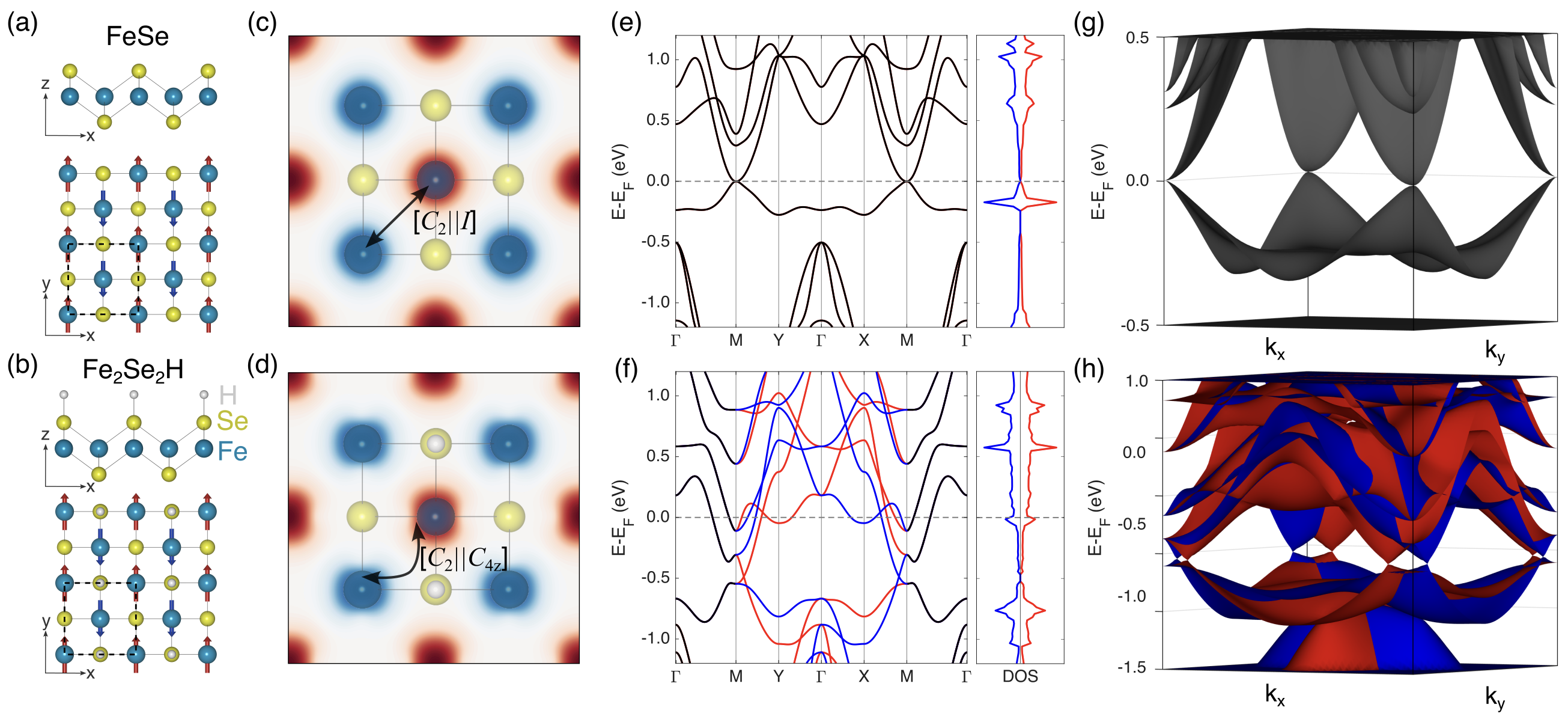
FIG. 2. Crystal structures of (a) FeSe and (b) the surface functionalization Fe 2 Se 2 H monolayers, shown from side and top views. Spin charge densities of (c) FeSe and (d) Fe 2 Se 2 H, with red and blue representing spin-up and spin-down components, respectively. Spin-resolved band structures and density of states for (e) FeSe and (f) Fe 2 Se 2 H, where black, red, and blue lines denote spin-degenerate, spin-up, and spin-down states. The corresponding spin-resolved density of states is shown on the right, with the Fermi level set to zero. (g) and (h) present the corresponding three-dimensional band structures.
Here we propose surface functionalization as a symmetryguided chemical switch for realizing such an AFM-to-AM transformation. In pristine 2D AFMs, opposite-spin sublattices may be connected by inversion symmetry I or out-ofplane mirror symmetry M z , yielding spin-degenerate bands and conventional AFM behavior. Single-sided surface functionalization reshapes the local bonding environment and breaks I and M z , while the in-plane rotation symmetry connecting opposite-spin sublattices can remain preserved. This symmetry change lifts the spin degeneracy and converts the system into an AM with momentum-dependent spin splitting. Compared with field- or stacking-based approaches, surface functionalization provides a nonvolatile chemical degree of freedom controlled by the functional group, adsorption site, and interfacial geometry [50, 51]. Established treatments such as hydrogenation [52, 53], oxidation [54], and halogenation [55] therefore offer practical routes to chemically engineer altermagnetism in 2D materials [56, 57].
We demonstrate this strategy in monolayer FeSe, a widely studied 2D AFM monolayer with spin degeneracy ensured by I and M z symmetries [47, 58–64]. Our first-principles calculations show that the simple hydrogenation and oxidation can break these symmetries and convert FeSe into a d-wave AM with pronounced momentum-dependent spin splitting. The device consequence of this chemically induced altermagnetism is particularly striking. We construct Fe 2 Se 2 H-based altermagnetic tunnel junctions and evaluate their spin-dependent transport using nonequilibrium Green’sfunction simulations. Because the altermagnetic spin polarization is locked to momentum, the tunneling conductance depends sensitively on the relative orientation of the Néel vectors in the two AM electrodes. In the parallel configuration, the momentum-space spin-filtering channels are well matched, producing a high-conductance state. In the antiparallel configuration, the spin-filtering channels become mismatched and the transmission is strongly suppressed, yielding a high-resistance state. This momentum-selective altermagnetic spin filtering produces a giant tunnel magnetoresistance up to 1.87 × 10 3 %. Moreover, the tunnel magnetoresistance is strongly tunable by the functionalization geometry, demonstrating that surface chemistry provides an efficient control knob for altermagnetic transport. Our work thus establishes a symmetry-to-chemistry-to-device strategy for engineering 2D AMs and suggest broadly applicable route to altermagnetic spintronic devices.
Design principle. From a symmetry perspective, realizing altermagnetism requires that opposite-spin sublattices be related by rotation-related symmetry operations (R), rather than by direct translation (t) or inversion (I) [9–12]. In 2D systems, additional constraints includes the out-of-plane mirror symmetry (M z ) and the twofold rotation about the z axis (C 2z ) [48]. The surface-functionalization-driven AFM-to-AM transition proposed here is also designed based on this symmetry criterion. Here, we consider a specific class of magnetic point groups in which the opposite-spin sublattices are not connected by a pure translation t, as commonly found in buckled lattices or some intrinsically distorted crystals. In such systems, even for a minimal AFM lattice, the oppositespin sublattices may still be related by inversion I, which can be schematically expressed as {C 2 ∥ I} in Fig. 1(a). The 3
band structure therefore remains spin-degenerate, corresponding to a conventional AFM. Surface functionalization lowers the overall symmetry without introducing additional symmetry operations, and generally breaks the I and M z symmetries. Consequently, in the functionalized AFM lattice, only the Rrelated symmetry remains to connect the opposite-spin sublattices, denoted as {C 2 ∥ R} in Fig. 1(b), thereby lifting the spin degeneracy and giving rise to an AM with momentumdependent spin splitting.
The proposed symmetry-guided AFM-to-AM transition strategy is particularly suitable for transport devices, as surface functionalization can produce comparatively sizable spin splitting relative to previously proposed strategies. We construct a functionalized altermagnetic magnetic tunnel junction (AMTJ), in which two functionalized AM layers are separated by a nonmagnetic insulating spacer, as shown in Fig. 1(c). When the Néel vectors of the two AM layers are parallel (PC), their k ∥ -dependent spin-polarization patterns are matched, allowing spin-selected electrons to tunnel efficiently through both layers and resulting in low resistance. In contrast, when the Néel vectors are antiparallel (APC), the spinpolarization patterns are mismatched, so electrons transmitted through the first AM layer are filtered out by the second one, thereby suppressing the tunneling current and giving rise to a high-resistance state, as illustrated in Fig. 1(d). This contrast produces a large tunnel magnetoresistance, defined as TMR = (T PC − T APC )/T APC , where T PC and T APC are the Brillouin-zone-averaged transmissions for the parallel and antiparallel Néel-vector configurations, respectively.
Altermagnetism in functionalized FeSe. To verify the symmetry-guided design principle in a realistic material platform, we take iron selenide (FeSe), a prototypical and widely studied material, as a representative case. FeSe is among the most intriguing Fe-based superconductors and has attracted worldwide interest both experimentally and theoretically in recent years [58–62], while theoretical calculations suggest that its monolayer form may host an AFM order [47, 63, 64]. Pristine FeSe crystallizes in a tetragonal lattice with P4/nmm space-group symmetry and is composed of edge-sharing Fecentered FeSe 4 tetrahedra [Fig. 2(a)]. Its symmetry operations include I, the fourfold rotation (C 4 ) and M symmetry, as fully described in Tab. S1. After considering the AFM order, the magnetic space group becomes P4 ′ /n ′ m ′ m ′ , with reduced symmetry. Nevertheless, the opposite-spin sublattices remain connected by I or M z [Fig. 2(c)]. Therefore, pristine FeSe monolayer behaves as a conventional AFM, with spindegenerate bands throughout the Brillouin zone [Figs. 2(e) and (g)].
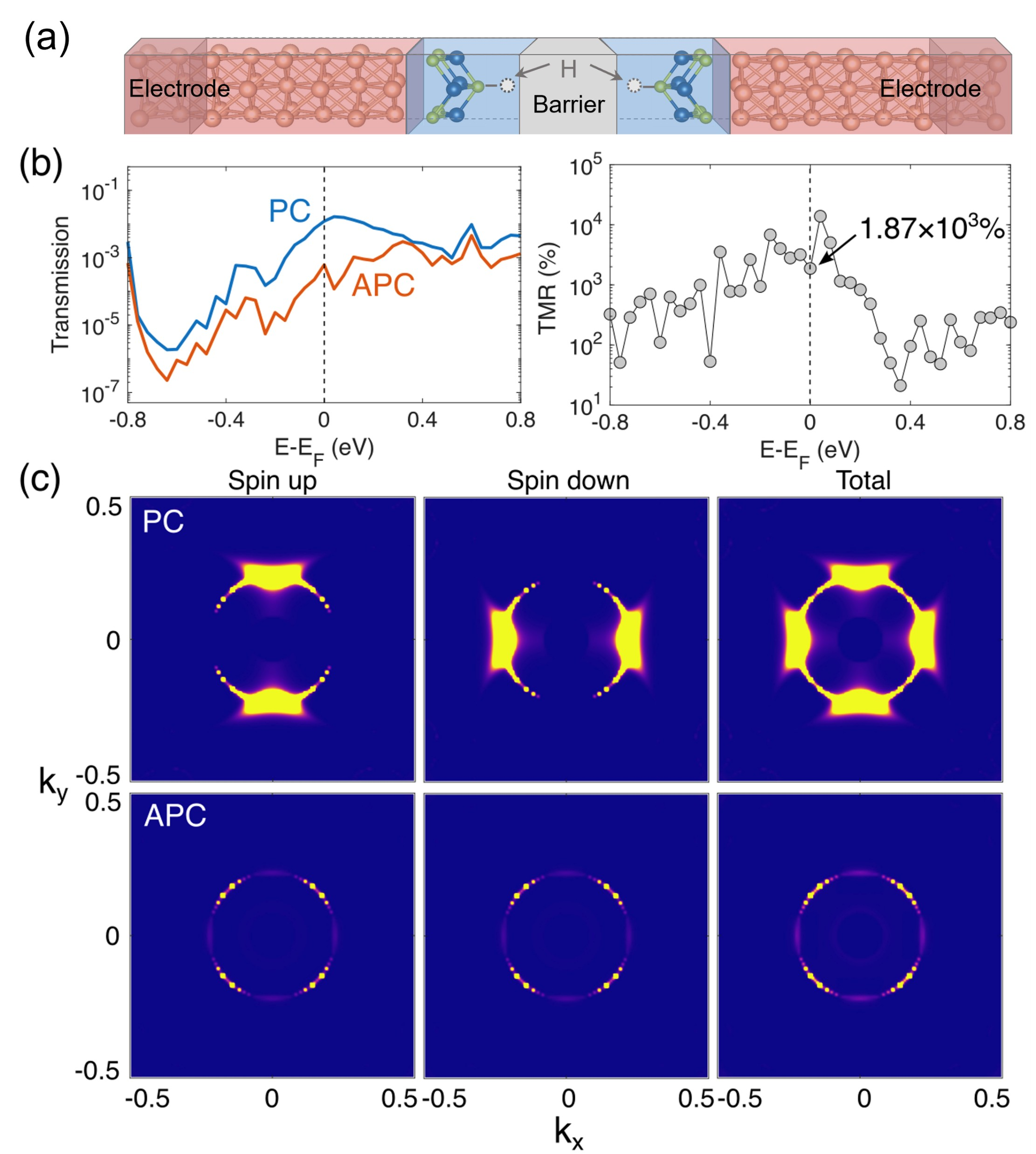
In contrast, single-sided surface hydrogenation lowers the symmetry of the system. The resulting Fe 2 Se 2 H monolayer has the space group P4mm and the magnetic space group P4 ′ m ′ m [Fig. 2(b)]. Surface functionalization selectively breaks the I and M z symmetries while preserving the R-related symmetries, such as C 4z , that connect oppositespin sublattices [Fig. 2(d)]. Such a symmetry configuration satisfies the requirement for altermagnetism. Consequently, FIG. 3. The spin-dependent transport properties of the proposed AMTJ device. (a) Structural models of the Au/Fe 2 Se 2 H/GeF 4 /Fe 2 Se 2 H/Au AMTJ. (b) Energy-dependent spin-resolved transmission coefficients for PC and APC configurations, and TMR ratio. (c) k ∥ -resolved transmission spectra at the Fermi energy for spin-up, spin-down, and total channels under PC and APC configurations.
the band structure of Fe 2 Se 2 H exhibits momentum-dependent spin splitting [Figs. 2(f) and 2(h)], and the three-dimensional (3D) band dispersion further reveals its d-wave character. Similar results in Fig. S1 are also found for other adsorbed elements, such as Fe 2 Se 2 O and Fe 2 Se 2 F, with their dynamic stability confirmed in Fig. S2. It is worth noting that neither FeSe nor Fe 2 Se 2 H monolayers possess the direct t symmetry. Although they contain the C 2z operation, it does not connect opposite-spin sublattices. Therefore, these systems satisfy the prerequisite of our design principle.
More intriguingly, Fe 2 Se 2 H also exhibits nontrivial topological features. As shown in Figs. 2(f) and (h), we identify two pairs of opposite Weyl points near −0.5 eV, located along the M–Y and X–M paths. When spin-orbit coupling (SOC) is included, these Weyl crossings are gapped and generate pronounced Berry-curvature hotspots with opposite signs in the two spin-polarized sectors, as shown in Fig. S3. Integration of the Berry curvature gives opposite Chern numbers for the two Weyl pairs, with C s = −1 along X–M and C s = +1 along Y–M, leading to a quantized spin Hall conductivity plateau inside the SOC-induced gap. The edge spectrum further confirms this topological character by showing counterpropagating edge states, demonstrating the coexistence of d-wave altermagnetism and topological states in Fe 2 Se 2 H monolayer.
4
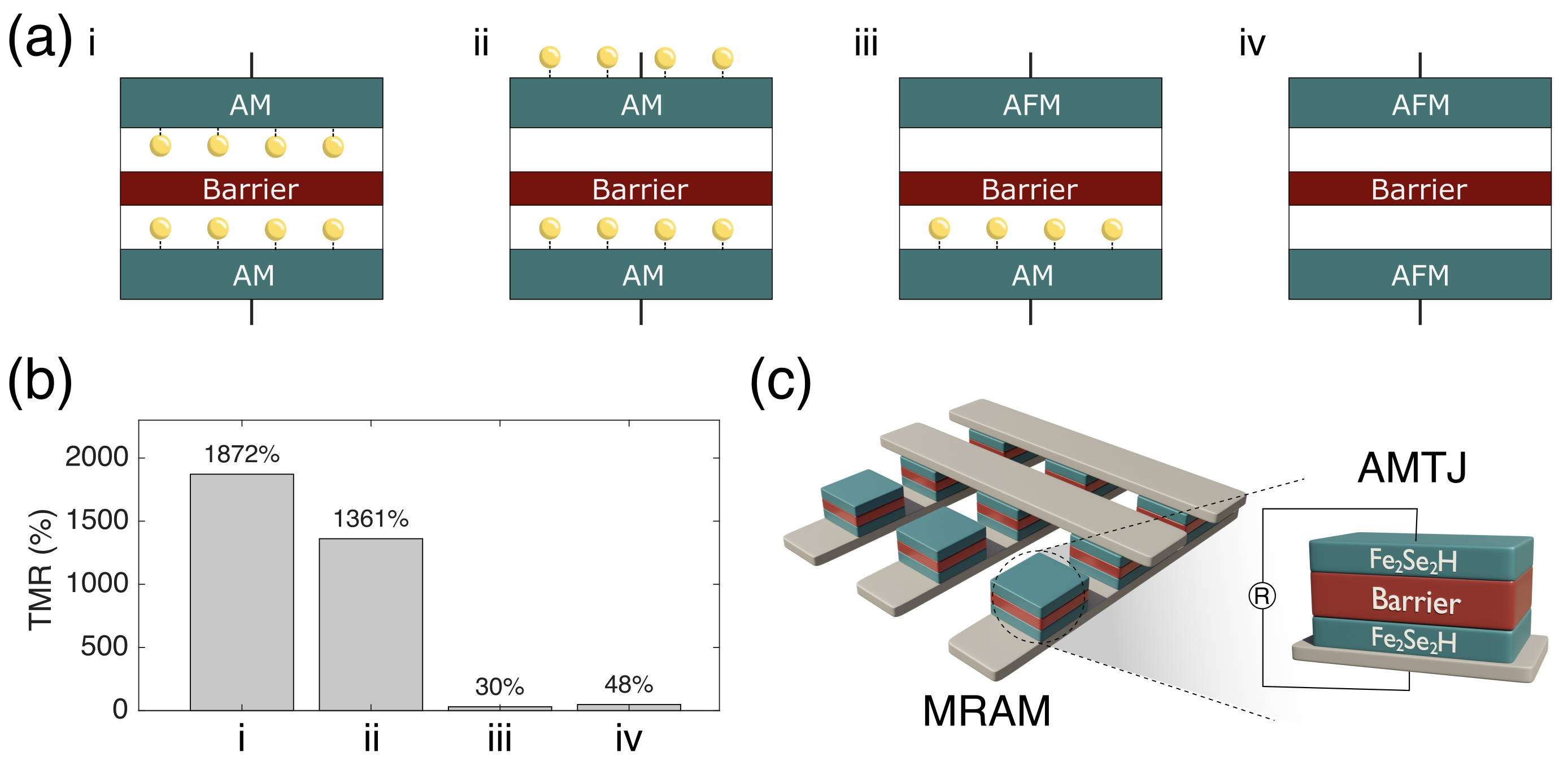
FIG. 4. Surface functionalization-controlled tuning of TMR in AMTJ. (a) Schematic configurations of four-type hydrogenation at the barrier interfaces under PC and APC configurations. (b) Corresponding TMR ratios for different hydrogenation configurations. (c) Schematic illustration of AMTJs integrated into magnetoresistive random-access memory (MRAM) architectures. The device consists of Fe 2 Se 2 H electrodes separated by a GeF 4 tunneling barrier.
Functionalization-controlled transport. Having established the functionalization-induced altermagnetic spin splitting in Fe 2 Se 2 H, we next examine whether this symmetry-driven electronic structure can be translated into a measurable tunneling response. As a preliminary indication, we calculate the spin-resolved transmission along the [100] transport direction for pristine FeSe and functionalized Fe 2 Se 2 H, as shown in Fig. S4. In pristine FeSe, the spin-up and spin-down transmission curves nearly overlap, consistent with its spin-degenerate conventional AFM band structure. By contrast, Fe 2 Se 2 H exhibits a pronounced spin-dependent transmission near the Fermi level, indicating that surface functionalization introduces an efficient spin-selective tunneling channel.
To evaluate the device-level consequence of the surface functionalization-induced altermagnetism, we construct a vertical Au/Fe 2 Se 2 H/GeF 4 /Fe 2 Se 2 H/Au tunnel junction, as shown in Fig. 3(a). In this junction, the two Fe 2 Se 2 H monolayers act as spin pinned and free layers, while the GeF 4 layer serves as the nonmagnetic tunneling barrier and the Au layers function as metallic electrodes. The transport response is examined by comparing two relative Néel vector configurations of the Fe 2 Se 2 H spin filters: the parallel configuration (PC), in which the two Néel vectors are aligned, and the antiparallel configuration (APC), in which they are reversed with respect to each other. The calculated energy-dependent transmission curves are shown in Fig. 3(b). Around the Fermi level, the transmission in the PC is much larger than that in the APC, giving rise to a sizable TMR of 1.87 × 10 3 %. This value is significantly higher than those reported for many AM-based devices [65–67], demonstrating the strong potential of functionalized Fe 2 Se 2 H for high-performance spintronic applications.
The microscopic origin of this large TMR is further revealed by the k ∥ -resolved transmission maps in Fig. 3(c). In the PC, the high-transmission regions are strongly anisotropic and spin selective: the spin-up and spin-down channels appear in different sectors of the 2D Brillouin zone, forming complementary transmission windows. Because the two Fe 2 Se 2 H layers share the same Néel-vector orientation, these spin-resolved windows are well registered across the junction, and their contributions add up to a large total transmission; While in the APC, the reversal of one Néel vector shifts the spin-selective tunneling windows out of registry, so the bright transmission lobes observed in the PC are largely suppressed and only weak residual channels remain. The resulting contrast between the open momentum-space channels in the PC and the blocked channels in the APC accounts for the high- and low-conductance states, respectively, and identifies momentum-selective altermagnetic spin filtering as the microscopic origin of the large TMR in the Fe 2 Se 2 H-based AMTJ.
Surface-functionalization engineering offers an additional degree of freedom for designing AMTJ, because different adsorption geometries can directly change the layer composition, interfacial symmetry, and spin-filtering efficiency of the device. To clarify how functionalization affects tunneling transport, we compare four representative junction configurations, Fig. 4(a). Configurations i and ii contain two functionalized altermagnetic Fe 2 Se 2 H layers, but differ in the relative positions of the surface H atoms with respect to the tunneling barrier. In contrast, configurations iii and iv involve partially or fully unfunctionalized AFM FeSe layers, thereby weakening or removing the altermagnetic spin-selective transport channel. The calculated TMR ratios are summarized in Fig. 4(b). The fully functionalized AMTJ in configuration I exhibits the largest TMR of 1872%, while configuration ii still maintains a large TMR of 1361%. In sharp contrast, configurations iii and iv show much smaller TMR values of only 30% and 48%, respectively. This comparison demonstrates that the large TMR originates from the functionalization-induced altermagnetic spin splitting rather than from conventional AFM tunneling. It also shows that not only the presence of functionalization, but also the adsorption geometry relative to the barrier, plays a decisive role in determining the transport efficiency.
These results establish surface functionalization as an effective control knob for altermagnetic tunnel transport. By selecting whether the FeSe layers are functionalized and how the functional groups are arranged at the interface, one can simultaneously tune the symmetry, spin splitting, and momentumdependent spin filtering of the junction. As illustrated in Fig. 4(c), such functionalized Fe 2 Se 2 H-based AMTJs can be naturally integrated into a magnetic random-access memory (MRAM) architecture, suggesting a feasible route toward device implementation. More broadly, the ability to encode tunnel-transport functionality through interfacial chemical design offers a practical guideline for developing scalable twodimensional altermagnetic junctions.
In summary, we have proposed a symmetry-guided surfacefunctionalization strategy to transform 2D AFM into AM. By reshaping the local bonding environment, surface functionalization breaks the I and M z symmetries while preserving 5 the R-related symmetry connecting opposite-spin sublattices, thereby enabling a AFM-to-AM transition. Taking monolayer FeSe as a representative platform, we show that singlesided hydrogenation, oxidation, and fluorination can induce sizable d-wave altermagnetic spin splitting, with Fe 2 Se 2 H further exhibiting nontrivial topological states. At the device level, an Fe 2 Se 2 H-based AMTJ displays a large TMR of 1.87 × 10 3 %, originating from momentum-selective altermagnetic spin filtering, while different functionalization configurations demonstrate that adsorption geometry provides an effective control knob for tunnel transport. By exploiting the chemical flexibility of surface functionalization, this strategy enables controllable design of altermagnetism in atomically thin materials through the choice of functional groups, adsorption geometries, and interfacial configurations. It therefore points to functionalized altermagnets as versatile building blocks for high-TMR spintronic devices, magnetic randomaccess memory, spin filtering, and topological spin transport.
mula [72]:
Calculation methods. The first-principles calculations based on density functional theory (DFT) are performed using the projector augmented-wave (PAW) pseudopotential method as implemented in the VASP code [68]. The PerdewBurke-Ernzerhof generalized gradient approximation (GGAPBE) is employed to describe the exchange and correlation functional. The plane-wave energy cutoff is set to 500 eV, with a total energy convergence criterion of 1 × 10 −6 eV. All atoms in the unit cell are allowed to relax until the HellmannFeynman force on each atom was less than 0.01 eV/Å. In the case of two-dimensional films, a vacuum space exceeding 20 Å is implemented to eliminate interactions between adjacent slabs. The GGA+U method with an effective Hubbard U value of 0.8 eV is used to address the correction effects of d electrons of Fe atoms [63, 69]. Phonopy code is adopted to calculate the phonon dispersion curves. The DFT-D3 interaction is taken into account.
The spin transport properties are calculated in QuantumATK package, based on DFT and the nonequilibrium Green’s function (NEGF) [70]. The norm-conserving PseudoDojo pseudopotentials within a linear combination of atomic orbitals (LCAO) framework is utilized to address electron exchange and correlation interactions. The wave functions are expanded using a double-zeta basis set, with a cutoff energy of 120 Hartree for the calculations of the constructed devices. 7 × 7 × 210 and 121 × 121 k-point meshes are employed to the self-consistent and spin-dependent transmission calculations, which are dense sufficient to get the accurate results. The spin-dependent conductance of the tunnel junction per unit cell area is calculated as follows [71]:
Acknowledgements—This work is supported by the Zhejiang Provincial Natural Science Foundation of China (LR25A040001), the Zhejiang Provincial Leading Innovative and Entrepreneurial Team Project (2025R01017), the National Natural Science Foundation of China (12474155, 12504108), the Zhejiang Leading Goose (Lingyan) Project (2026C02A2013(SD2)), and the China Postdoctoral Science Foundation (2025M773440). The computational resources for this research were provided by the High Performance Computing Platform at the Eastern Institute of Technology, Ningbo.
G σ =
(1)
where T σ (E) is the k-point averaged transmission function at energy E and T k σ (E) is the k-resolved transmission function with σ = (↑, ↓). The TMR ratio is calculated by the for-
(2)
where G PC and G APC are the total spin-dependent conductance of parallel configuration (PC) and antiparallel configuration (APC) states, which are defined as:
↑ ↓ where T
PC and T PC represent the spin-up and spin-down transmission coefficients at the Fermi level when the MTJs are in ↑ ↓ PC state, and T
APC and T APC represent the spin-up and spindown transmission coefficients at the Fermi level when the MTJs are in APC state.
Z. Cui, Z. Y. Zhu and B. W. Hao contributed equally to this work.
[email protected] ‡ [email protected] [1] C. Wu, K. Sun, E. Fradkin, and S.-C. Zhang, Fermi liquid in-
stabilities in the spin channel, Phys. Rev. B 75, 115103 (2007). [2] S. Hayami, Y. Yanagi, and H. Kusunose, Momentum-dependent
spin splitting by collinear antiferromagnetic ordering, J. Phys. Soc. Jpn. 88, 123702 (2019). [3] L. Šmejkal, R. González-Hernández, T. Jungwirth, and
J. Sinova, Crystal time-reversal symmetry breaking and spontaneous hall effect in collinear antiferromagnets, Sci. Adv. 6, eaaz8809 (2020). [4] L.-D. Yuan, Z. Wang, J.-W. Luo, E. I. Rashba, and A. Zunger,
Giant momentum-dependent spin splitting in centrosymmetric low-Z antiferromagnets, Phys. Rev. B 102, 014422 (2020). [5] I. I. Mazin, K. Koepernik, M. D. Johannes, R. González-
Hernández, and L. Šmejkal, Prediction of unconventional magnetism in doped FeSb 2 , Proc. Natl. Acad. Sci. 118, e2108924118 (2021). [6] L. Yuan, Z. Wang, J. Luo, and A. Zunger, Prediction of low-Z
collinear and noncollinear antiferromagnetic compounds having momentum-dependent spin splitting even without spin-orbit coupling, Phys. Rev. Mater. 5, 014409 (2021).
† 6 [7] H. Ma, M. Hu, N. Li, J. Liu, W. Yao, J. Jia, and J. Liu, Mul-
tifunctional antiferromagnetic materials with giant piezomagnetism and noncollinear spin current, Nat. Commun. 12, 2846 (2021). [8] Q. Liu, X. Dai, and S. Blügel, Different facets of unconventional
magnetism, Nat. Phys. 21, 329 (2025). [9] L. Šmejkal, J. Sinova, and T. Jungwirth, Beyond conventional
ferromagnetism and antiferromagnetism: A phase with nonrelativistic spin and crystal rotation symmetry, Phys. Rev. X 12, 031042 (2022). [10] L. Šmejkal, J. Sinova, and T. Jungwirth, Emerging research
landscape of altermagnetism, Phys. Rev. X 12, 040501 (2022). [11] L. Bai, W. Feng, S. Liu, L. Šmejkal, Y. Mokrousov, and Y. Yao,
Altermagnetism: Exploring new frontiers in magnetism and spintronics, Adv. Funct. Mater. 34, 2409327 (2024). [12] C. Song, H. Bai, Z. Zhou, L. Han, H. Reichlova, J. H. Dil, J. Liu,
materials, Nat. Rev. Mater. 10, 473 (2025). [13] S. Bhowal and A. Bose, Non-relativistic spin splitting: Features
and functionalities, arXiv:2510.20306 (2025). [14] T. Jungwirth, J. Sinova, R. M. Fernandes, Q. Liu, H. Watan-
abe, S. Murakami, S. Nakatsuji, and L. Šmejkal, Symmetry, microscopy and spectroscopy signatures of altermagnetism, Nature 649, 837 (2026). [15] G. Gurung, M. Elekhtiar, Q.-Q. Luo, D.-F. Shao, and E. Y.
Tsymbal, Nearly perfect spin polarization of noncollinear antiferromagnets, Nat. Commun. 15, 10242 (2024). [16] B. Chi, L. Jiang, Y. Zhu, G. Yu, C. Wan, and X. Han,
Anisotropic spin filtering by an altermagnetic barrier in magnetic tunnel junctions, Phys. Rev. Appl. 23, 014013 (2025). [17] K. Samanta, D.-F. Shao, and E. Y. Tsymbal, Spin filtering with
insulating altermagnets, Nano Lett. 25, 3150 (2025). [18] R. D. Gonzalez Betancourt, J. Zubáč, R. Gonzalez-Hernandez,
K. Geishendorf, Z. Šobáň, G. Springholz, K. Olejnı́k,
A. Thomas, H. Reichlová, J. Železný, and D. Kriegner, Spontaneous anomalous hall effect arising from an unconventional compensated magnetic phase in a semiconductor, Phys. Rev. Lett. 130, 036702 (2023). [19] Z. Zhou, X. Cheng, M. Hu, R. Chu, H. Bai, L. Han, J. Liu,
F. Pan, and C. Song, Manipulation of the altermagnetic order in CrSb via crystal symmetry, Nature 638, 645 (2025). [20] X. Duan, J. Zhang, Z. Zhu, Y. Liu, Z. Zhang, I. Žutić, and
T. Zhou, Antiferroelectric altermagnets: Antiferroelectricity alters magnets, Phys. Rev. Lett. 134, 106801 (2025). [21] Z. Zhu, X. Duan, J. Zhang, B. Hao, I. Žutić, and T. Zhou, Two-
dimensional ferroelectric altermagnets: From model to material realization, Nano Lett. 25, 9456 (2025). [22] Z. Zhu, Y. Liu, X. Duan, J. Zhang, B. Hao, S.-H. Wei, I. Žutić,
and T. Zhou, Emergent multiferroic altermagnets and spin control via noncollinear molecular polarization, Sci. China Phys. Mech. Astron. 68, 127562 (2025). [23] M. Gu, Y. Liu, H. Zhu, K. Yananose, X. Chen, Y. Hu,
A. Stroppa, and Q. Liu, Ferroelectric switchable altermagnetism, Phys. Rev. Lett. 134, 106802 (2025). [24] W. Sun, C. Yang, W. Wang, Y. Liu, X. Wang, S. Huang, and
Z. Cheng, Proposing altermagnetic-ferroelectric type-III multiferroics with robust magnetoelectric coupling, Adv. Mater. 37, 2502575 (2025). [25] R. Cao, R. Dong, R. Fei, and Y. Yao, Designing spin-driven
multiferroics in altermagnets, arXiv:2412.20347 (2024). [26] W.-T. Guo, J. Xu, Y. Yang, H. Zhang, and H. Wang, Altermag-
netic type-II multiferroics with néel-order-locked electric polarization, arXiv:2505.01964 (2026).
[27] A. Urru, D. Seleznev, Y. Teng, S. Y. Park, S. E. Reyes-Lillo, and
K. M. Rabe, G-type antiferromagnetic BiFeO 3 is a multiferroic g-wave altermagnet, Phys. Rev. B 112, 104411 (2025). [28] R. Peng, S. Fang, P. Ho, F. Liu, T. Zhou, J. Liu, and Y. S. Ang,
Ferroelastic altermagnetism, npj Quantum Mater. 11, 5 (2026). [29] Z. Cui, Z. Zhu, X. Duan, B. Hao, X. Chen, J. Zhang,
and T. Zhou, Symmetry-driven unconventional magnetoelectric coupling in perovskite altermagnets: From bulk to the twodimensional limit, Adv. Sci. n/a, e00004 (2026). [30] Y. Huang, C. Hua, R. Xu, J. Liu, Y. Zheng, and Y. Lu, Spin in-
version enforced by crystal symmetry in ferroelastic altermagnets, Phys. Rev. Lett. 135, 266701 (2025). [31] N. Ding, H. Ye, S.-S. Wang, and S. Dong, Ferroelastically tun-
able altermagnets, Phys. Rev. B 112, L220410 (2025). [32] H. Yu, J. Ji, W. Luo, X. Gong, and H. Xiang, Recent advances
in unconventional ferroelectrics and multiferroics, Adv. Mater. n/a, e07070 (2025). [33] P.-J. Guo, Z.-X. Liu, and Z.-Y. Lu, Quantum anomalous Hall
effect in collinear antiferromagnetism, npj Comput. Mater. 9, 70 (2023). [34] H.-Y. Ma and J.-F. Jia, Altermagnetic topological insulator and
the selection rules, Phys. Rev. B 110, 064426 (2024). [35] P. Feng, C.-Y. Tan, M. Gao, X.-W. Yan, Z.-X. Liu, P.-J. Guo,
F. Ma, and Z.-Y. Lu, Type-II quantum spin Hall insulator, arXiv:2503.13397 (2025). [36] R.-W. Zhang, C. Cui, Y. Wang, J. Duan, Z.-M. Yu, and Y. Yao,
Quantized spin-hall conductivity in altermagnet Fe 2 Te 2 O with mirror-spin coupling, arXiv:2503.10681 (2025). [37] X. Chen, J. Zhang, B. Hao, J. Qian, Z. Zhu, I. Žutić, Z. Zhang,
and T. Zhou, Altermagnets enable gate-switchable helical and chiral topological transport with spin-valley-momentum-locked dual protection, arXiv:2603.06487 (2026). [38] R. Huang, Y. Hu, X. Chen, P. Yu, S. Tan, I. Zutic, and T. Zhou,
Towards scalable braiding: Topological superconductivity unlocked under arbitrary magnetic field directions in curved planar josephson junctions, arXiv:2504.20031 (2026). [39] Z. Zhu, R. Huang, X. Chen, Z. Cui, X. Duan, J. Zhang, I. Žutić,
and T. Zhou, Altermagnetic proximity effect, Phys. Rev. Lett. 136, 186702 (2026). [40] L.-S. Liu, K. Shao, H.-D. Li, X. Wan, W. Chen, and D. Y. Xing,
Altermagnetic spin precession and spin transistor, Phys. Rev. Lett. 136, 106301 (2026). [41] Z. Zhu, X. Chen, X. Duan, Z. Cui, J. Zhang, I. Žutić,
and T. Zhou, Altermagnetoelectric spin field effect transistor, arXiv:2512.02974 (2025). [42] K. S. Novoselov, A. Mishchenko, A. Carvalho, and A. H. Cas-
tro Neto, 2d materials and van der Waals heterostructures, Science 353, aac9439 (2016). [43] R. Xu, Y. Gao, and J. Liu, Chemical design of monolayer alter-
magnets, arXiv:2505.15484 (2025). [44] X. Chen, Y. Liu, P. Liu, Y. Yu, J. Ren, J. Li, A. Zhang, and
Q. Liu, Unconventional magnons in collinear magnets dictated by spin space groups, Nature 640, 349 (2025). [45] X. Wan, S. Mandal, Y. Guo, and K. Haule, High-throughput
search for metallic altermagnets by embedded dynamical mean field theory, Phys. Rev. Lett. 135, 106501 (2025). [46] Z.-F. Gao, S. Qu, B. Zeng, Y. Liu, J.-R. Wen, H. Sun, P.-J.
Guo, and Z.-Y. Lu, AI-accelerated discovery of altermagnetic materials, Natl. Sci. Rev. 12, nwaf066 (2025). [47] I. Mazin, R. González-Hernández, and L. Šmejkal, In-
duced Monolayer Altermagnetism in MnP(S,Se) 3 and FeSe, arXiv:2309.02355 (2023). [48] S. Zeng and Y.-J. Zhao, Bilayer stacking A-type altermagnet:
A general approach to generating two-dimensional altermag7 netism, Phys. Rev. B 110, 174410 (2024). [49] Y. Liu, J. Yu, and C.-C. Liu, Twisted magnetic van der waals
bilayers: an ideal platform for altermagnetism, Phys. Rev. Lett. 133, 206702 (2024). [50] X. Du, L. Wang, Y. Chen, H. Zhang, J. Li, and W. Zhao, Engi-
neering symmetry breaking in 2D layered materials, Nat. Rev. Phys. 3, 123 (2021). [51] T. Brill, L. Müller, A. Schmidt, and M. Hoffmann, Molecular
functionalization of 2D materials, J. Mater. Chem. C 9, 3456 (2021). [52] S. Barnowsky, F. Hoffmann, T. Meier, K. Schneider, and
M. Schulz, Magnetic state control of non-van der waals 2D materials by hydrogenation, ACS Nano 18, 13456 (2024). [53] L. Albino, M. Rossi, E. Bianchi, P. Conti, and D. Galli, The
chimera of 2D- and 1D-graphene magnetization by hydrogenation or fluorination, Nanoscale 16, 5567 (2024). [54] W. Zhang, X. Li, Q. Chen, M. Xu, and L. Wang, Oxidation-
induced electronic and structural modification of graphene and 2D materials, Adv. Mater. 31, 1901825 (2019). [55] C. Song, H. Liu, J. Zhang, W. Li, and M. Xu, Surface-
functionalization induced spintronic and photocatalytic features in group-III monochalcogenide monolayers, Appl. Surf. Sci. 621, 155405 (2023). [56] M. Garrido, A. Naranjo, and E. M. Pérez, Characterization of
emerging 2D materials after chemical functionalization, Chem. Sci. 15, 3428 (2024). [57] S. Sovizi, S. Angizi, S. A. A. Alem, R. Goodarzi, M. R. Rah-
mani Taji Boyuk, H. Ghanbari, R. Szoszkiewicz, A. Simchi, and P. Kruse, Plasma processing and treatment of 2D transition metal dichalcogenides: Tuning properties and defect engineering, Chem. Rev. 123, 13869 (2023). [58] Z. Wei, S. Qin, C. Ding, et al., Identifying s-wave pairing
symmetry in single-layer FeSe from topologically trivial edge states, Nat. Commun. 14, 5302 (2023). [59] R. Shi, Q. Li, X. Xu, B. Han, R. Zhu, F. Liu, R. Qi, X. Zhang,
J. Du, J. Chen, D. Yu, X. Zhu, J. Guo, and P. Gao, Atomic-scale observation of localized phonons at FeSe/SrTiO 3 interface, Nat. Commun. 15, 3418 (2024). [60] J. Li, S. Li, K. Liu, X. Li, L. Nie, D. Zhao, M. Shi, T. Wu,
and X. Chen, Pressure-dependent orbital-selective nematicity in FeSe, npj Quantum Mater. 10, 105 (2025).
[61] Z. F. Wang, H. Zhang, D. Liu, C. Liu, C. Tang, C. Song,
Y. Zhong, J. Peng, F. Li, C. Nie, L. Wang, X. J. Zhou,
high-temperature superconductor FeSe/SrTiO 3 (001) film, Nat. Mater. 15, 968 (2016). [62] J.-F. Ge, Z.-L. Liu, C. Liu, C.-L. Gao, D. Qian, Q.-K. Xue,
Y. Liu, and J.-F. Jia, Superconductivity above 100 K in singlelayer FeSe films on doped SrTiO 3 , Nat. Mater. 14, 285 (2015). [63] A. Luo, Z. Song, and G. Xu, Fragile topological band in the
checkerboard antiferromagnetic monolayer FeSe, npj Comput. Mater. 8, 26 (2022). [64] A. González-Garcı́a, W. López-Pérez, P. Pacheco, L. Ramı́rez-
Montes, and R. González-Hernández, Coexistence of d-wave altermagnetism and topological states in janus FeSeX (X = S, Te) monolayers, Phys. Rev. Mater. 10, 044004 (2026). [65] D.-F. Shao, S.-H. Zhang, M. Li, C.-B. Eom, and E. Y. Tsymbal,
Spin-neutral currents for spintronics, Nat. Commun. 12, 7061 (2021). [66] Y. Shi, G. Zhan, L. Xu, K. Luo, J. Liu, Z. Wu, and H. Liu, Spin-
dependent transport in altermagnet CrSb-based magnetic tunnel junction, Appl. Phys. Lett. 127, 182409 (2025). [67] Q. Cui, Y. Zhu, X. Yao, P. Cui, and H. Yang, Giant spin-
hall and tunneling magnetoresistance effects based on a twodimensional nonrelativistic antiferromagnetic metal, Phys. Rev. B 108, 024410 (2023). [68] P. E. Blöchl, Projector augmented-wave method, Phys. Rev. B
50, 17953 (1994). [69] Y. Yuan, W. Li, B. Liu, P. Deng, Z. Xu, X. Chen, C. Song,
domain walls in FeSe films, Nano Lett. 18, 7176 (2018). [70] M. Brandbyge, J.-L. Mozos, P. Ordejón, J. Taylor, and K. Stok-
bro, Density-functional method for nonequilibrium electron transport, Phys. Rev. B 65, 165401 (2002). [71] R. Landauer, Electrical resistance of disordered one-
dimensional lattices, Philos. Mag. 21, 863 (1970). [72] S. Yuasa, T. Nagahama, A. Fukushima, Y. Suzuki, and K. Ando,
Giant room-temperature magnetoresistance in single-crystal Fe/MgO/Fe magnetic tunnel junctions, Nat. Mater. 3, 868 (2004).