⬇ Download Markdown · ⬇ Download LaTeX · ⬇ original · view original
Rui Peng 1,* , Guangxu Su 1 , Yangyang Fan 1 , Jiaan Li 1 , Fanxin Liu 1,† , Yee Sin Ang 2,‡ 1 2 School of Physics, Zhejiang University of Technology, Hangzhou 310023, China
Science, Mathematics and Technology Cluster, Singapore University of Technology and Design,
Singapore 487372, Singapore.
Email: * [email protected], † [email protected], ‡ [email protected]
The synergy of ferroicity with altermagnetism offers a novel platform for designing
multifunctional altermagnetic-spintronic device technology. In this work, we propose a
mechanism to achieve nonvolatile electrical manipulation of spin and layer degrees of
freedom in an altermagnetic bilayer via sliding ferroelectricity. Using first-principles
calculations, we show that an interlayer translation can induce a switchable out-of-plane
ferroelectric polarization in bilayer CuF 2 , which directly couples to and reverses the d-wave
altermagnetic spin splitting. Notably, the altermangetic spin splitting is layer-locked, the
sliding ferroelectricity-driven switching thus embodying a nonvolatile spin-layertronics
functionality that couples spin-polarized transport and layer degree of freedom in a single
platform. We show that in quadrilayer CuF 2 , four polarization states are identified which may
offer multi-state logic device applications. These findings establish sliding ferroelectricity as
a versatile tool for designing voltage-controlled, high-speed and energy-efficient spin-
layertronic devices based on altermagnets.
1
Altermagnetism represents an emerging frontier in collinear magnetism, uniquely combining
antiferromagnetic (AFM) symmetry with a momentum-dependent spin splitting reminiscent
of ferromagnets [1-5]. This novel class exhibits zero net magnetization, ensuring robustness
against external fields and compatibility with high-speed operations, while simultaneously
hosting a non-relativistic spin-split electronic structure that is crucial for spin manipulation
[6-25]. Such a dichotomy unlocks a wealth of emergent phenomena—including the
generation of non-collinear spin currents [1,6,16], anomalous Hall effects [4,10], and
substantial tunneling magnetoresistance [7]—which collectively position altermagnets as a
highly promising platform for next-generation spintronics. The recent experimental
confirmation of various altermagnetic candidates has further amplified their potential for
ultra-compact device integration [26-31]. However, a central challenge persists: achieving
efficient, purely electrical control over the altermagnetic order and its associated spin
polarization remains essential for their seamless integration with modern electronics.
The pursuit of electrical control in altermagnets motivates their integration with ferroic
orders, leading to the emerging class of multiferroic altermagnets [32-42]. One prominent
example is the altermagnetoelectric effect, where ferroelectric (FE) polarization couples
directly to the altermagnetic spin texture, allowing electrical switching of the magnetic order
[32-39]. This success invites the exploration of other ferroic couplings, such as with
ferroelasticity, to achieve mechanical or strain-based control [40-42]. A particularly promising
yet distinct avenue is the integration of altermagnetism with sliding ferroelectricy—a
phenomenon unique to van der Waals multilayers, in which a lateral interlayer translation
induces interfacial charge redistribution and generates a switchable out-of-plane
polarization [43-52]. While major efforts have been focused on harnessing sliding
ferroelectricy to manipulate unconventional magnetism in bilayer heterostructures [53-55],
how the layer degree of freedom (DOF)—inherent in a multilayered system—couple
cooperatively with both altermagnetic and sliding-FE orders to tunable multifunctional
behavior remains unexplored thus far. Critically, the simultaneous manipulation of the layer
DOF and altermagnetism via sliding ferroelectricity shall substantially broaden the physics
and application potential of multiferroic altermagnets.
2 In this work, we propose the concept of nonvolatile switchable spin-layertronics in
two-dimensional (2D) multiferroic altermagnet by integrating sliding ferroelectricity with
altermagnetism and layer DOF in a bilayer setup. Using monolayer CuF 2 —a known
altermagnet exfoliable from its bulk phase [56–57]—as a building block, we show that bilayer
CuF 2 in specific stacking configurations exhibits intrinsic sliding ferroelectricity with two
stable FE states, denoted FE-I and FE-II, and sizable out-of-plane polarization (±1.23 pC/m)
that enables efficient electrical control. Notably, the system exhibit layer-locked
altermagnetic spin-split bands, which are energetically shifted in the opposite fashion by the
intrinsic out-of-plane FE polarization. Switching between FE-I and FE-II thus reverses the
energetic shifting of these layer-locked altermagnetic spin-split bands, resulting in
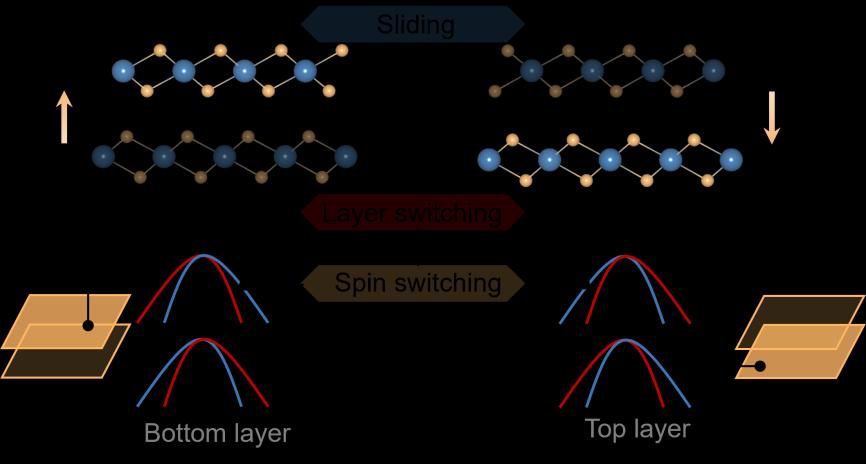
altermangetic spin reversal (see Fig. 1). By extending to quadrilayer CuF 2 , we identify four
inequivalent FE polarization states, in which the layer and the spin-polarized current can be
separately controlled via sliding ferroelectricity, thus offering a spin-layertronic platform to
achieve multistate device functionalities. Our findings reveal sliding-ferroelectricity-driven
altermagnetic bilayer as a viable platform for electrically controllable, multi-state spin-
layertronic route towards advanced memory and logic devices.
Fig. 1 Concept of sliding-ferroelectricity driven spin-layertronic in an altermagnetic bilayer. Upon switching of the FE states (FE-I and FE-II), the built-in electric polarization is reversed. The reversal of the FE polarization causes the altermagnetic spin-split bands to energetically shift in the opposite direction for the two sub-monolayers, thus leading to altermagnetic spin switching.
3
2.1 Sliding Ferroelectricicty in Bilayer CuF 2 Among the commonly reported 2D altermagnetic materials, several prototypical structural
motifs prevail, including the V 2 Se 2 O type (space group P4/mmm; No. 123) [6,7,12], CrS
type (space group P4/mmm; No. 123) [8,16,17], and CuF 2 type (space group P2₁/c; No. 14)
[9,42]; see Fig. S1. For the first two structural families, their stable bilayer stacking
configurations crystallize in space group P4/nmm (No. 129), which lacks polarity and
precludes the emergence of sliding ferroelectricity. In contrast, the CuF 2 -type structure
presents a distinct case. To understand the origin of the polarity in its bilayer stacking
configuration, it is instructive to compare its monolayer structure with those of another two
similar structures with the MX 2 (M = metal, X = nonmetal) stoichiometry. Fig. S1 compares ̅ m1; No. 164), 1T’ WTe 2 the crystal structures of monolayers 1T MoS 2 (space group P𝟑
(space group P2 1 /m; No. 11) and CuF 2 . In monolayer 1T MoS 2 , the Mo atom is octahedrally
coordinated by six S atoms. In monolayer 1T’ WTe 2 , the W atoms undergo spontaneous
dimerization due to Peierls distortion, resulting in a distorted octahedral coordination. In
contrast, the octahedral coordination in monolayer CuF 2 is distorted in a different manner,
driven by the Jahn–Teller effect. Recent studies demonstrated the out-of-plane switchable
electric polarization in bilayer 1T’ systems [44,45,47,48]. This polarization arises from
uncompensated interlayer vertical charge transfer, which can be switched through interlayer
sliding. Inspired by these findings, we stack monolayers CuF 2 into a bilayer system and
explore the potential of sliding ferroelectricity in bilayer CuF 2 .
The bilayer structure is constructed by stacking the top layer onto the bottom layer under
the symmetry operation {m z |(t x , t y , d)}, where t x and t y represent the translation distances
along the x- and y-directions, respectively, and d denotes the interlayer distance. The energy
landscapes of bilayer CuF 2 as a function of t x and t y are presented in Fig. 2(a, b). As shown,
the energy profile exhibits a double-well potential along the x-direction and a single-well
potential along the y-direction. Energy minima occur at t x = ±a 0 and t y = b 0 , where a 0 = 1/6a
and b 0 = 1/2b (with a and b being the crystal constants of bilayer CuF 2 ). Correspondingly,
bilayers governed by {m z |(±a 0 , b 0 , d FE )} correspond to two equivalent FE states, labeled FE-
I and FE-II, while the configuration under {m z |(0, b 0 , d IM )} represents an intermediate (IM)
4 state, with d FE and d IM referring to the interlayer distances of the FE and IM states,
respectively [see Fig. 2(c)]. The energy barrier between the two FE states is 3.83 meV/atom.
The two FE states can be reversibly switched via interlayer sliding. They can also be related
to each other by a glide operation with respect to the horizontal plane.
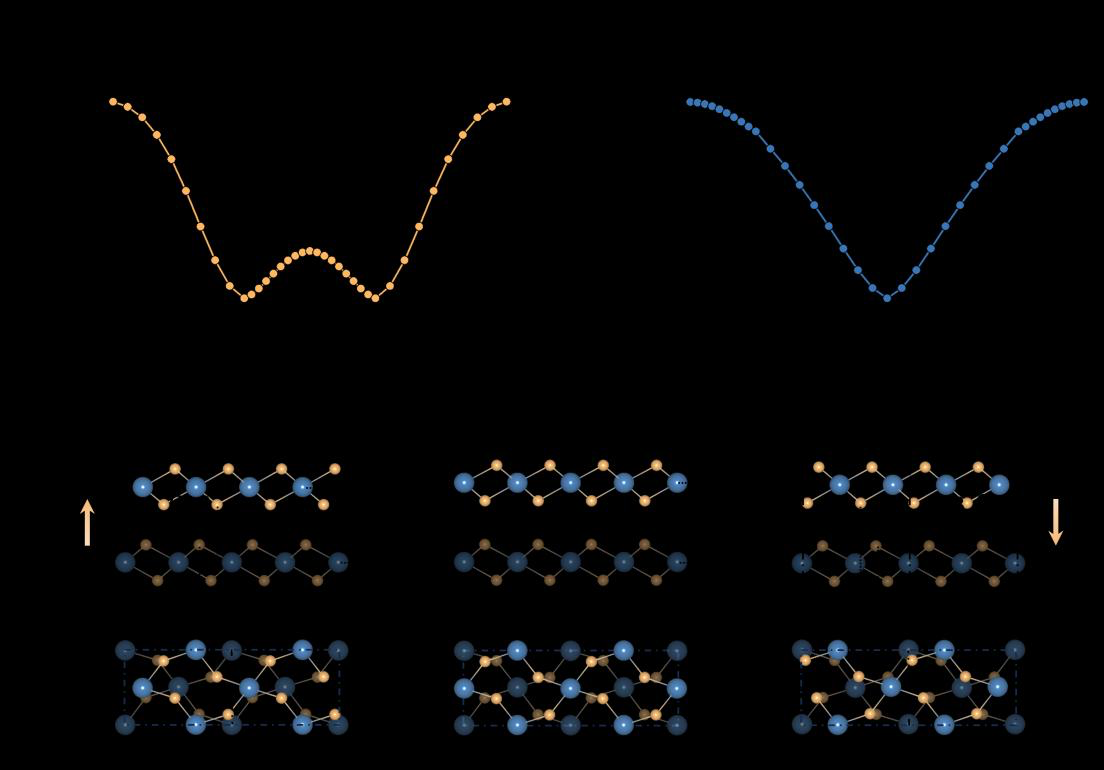
Fig. 2 Energy profiles of bilayer CuF 2 along (a) x- and (b) y-directions. (c) Crystal structures
of FE-I, IM, and FE-II states from side and top views.
The space group of FE-I (FE-II) state is Pc (No. 7), which lacks inversion symmetry. The
optimized lattice constants of FE-I (FE-II) state are a = 5.32 Å and b = 3.72 Å. The asymmetry
in atomic positions between the top and bottom layers results in a corresponding shift of the
charge centers, which directly gives rise to the spontaneous out-of-plane electric polarization
in FE-I (FE-II) state. Using the Berry phase approach, the electric polarization is calculated
to be +1.23 pC/m for FE-I state and −1.23 pC/m for FE-II state (see Fig. S2). This magnitude
exceeds that of several recently reported 2D sliding FE bilayers, such as MnBi 2 Te 4
(0.45 pC/m) [49] and MX 2 (M = Mo, W; X = S, Se; 0.59–0.77 pC/m) [51], and is comparable
to values found in B 2 X 3 (X = S, Se, Te; 1.23 pC/m) [52] and BX (X = P, As, Sb; 0.965–
1.075 pC/m) [50]. The presence of out-of-plane electric polarization is further corroborated
by differential charge density analysis. As shown in the insets of Fig. S2, a clear interlayer 5 charge transfer in FE-I state indicates an upward-oriented electric polarization. Conversely,
the direction of charge transfer is reversed in FE-II state, confirming an oppositely oriented
polarization. In contrast, the IM state crystallizes in the space group Pca2 1 (No. 29). The
specific gliding symmetry present in the IM state suppresses the out-of-plane component of
the electric polarization, leading to a net zero polarization along the stacking direction.
2.2 FE Reversal of Layer-Locked Altermagnetic Spin-Split Bands in Bilayer CuF 2 In our previous work, monolayer CuF 2 was identified as an altermagnet [42]. To determine
the magnetic ground states of bilayer CuF 2 , we calculated the energy differences between
C-type and G-type AFM orders for both the FE and IM states (see Fig. S3). In FE-I (FE-II)
state, the C-type AFM order is found to be 0.78 meV per unit cell higher in energy than the
G-type AFM order, indicating that the G-type AFM order is energetically favorable. The
computed magnetic moments on the Cu sites of FE-I (FE-II) state are 0.625 (0.624), −0.625
(−0.624), −0.624 (−0.625), and 0.624 (0.625) μ B for Cu1, Cu2, Cu3, and Cu4, respectively.
Due to symmetry breaking, the Cu atoms in the top (bottom) layer exhibit slightly smaller
magnetic moments than those in the bottom (top) layer, although the net magnetic moment
remains zero. Similarly, in the IM state, the C-type AFM order is 2.12 meV per unit cell higher
than the G-type AFM, confirming the G-type order as the magnetic ground state.
In order to examine whether the synergistic switch of electric and spin/layer
polarizations exist in this system, we plot the layer-resolved spin-polarized band structures
and density of states for FE-I and FE-II states in Fig. 3, and those of IM state in Fig. S4. In
the IM state, altermagnetic spin splitting is preserved within each layer, with opposite spin
splitting between the two layers, forming a layer-locked spin-momentum coupling. The
energy bands are layer-degenerate due to the absence of out-of-plane electric polarization,
which leads to spin degeneracy across the entire system. From a symmetry perspective, the
out-of-plane glide symmetry, when combined with the global spinor rotation {m z | 0 1/2 0}U,
prohibits spin splitting. This is because the glide operation exchanges the two atoms with
opposite spin—Cu1 and Cu3 (and similarly Cu2 and Cu4)—while leaving the 2D k-space
invariant, thereby enforcing spin degeneracy throughout the 2D Brillouin zone.
6
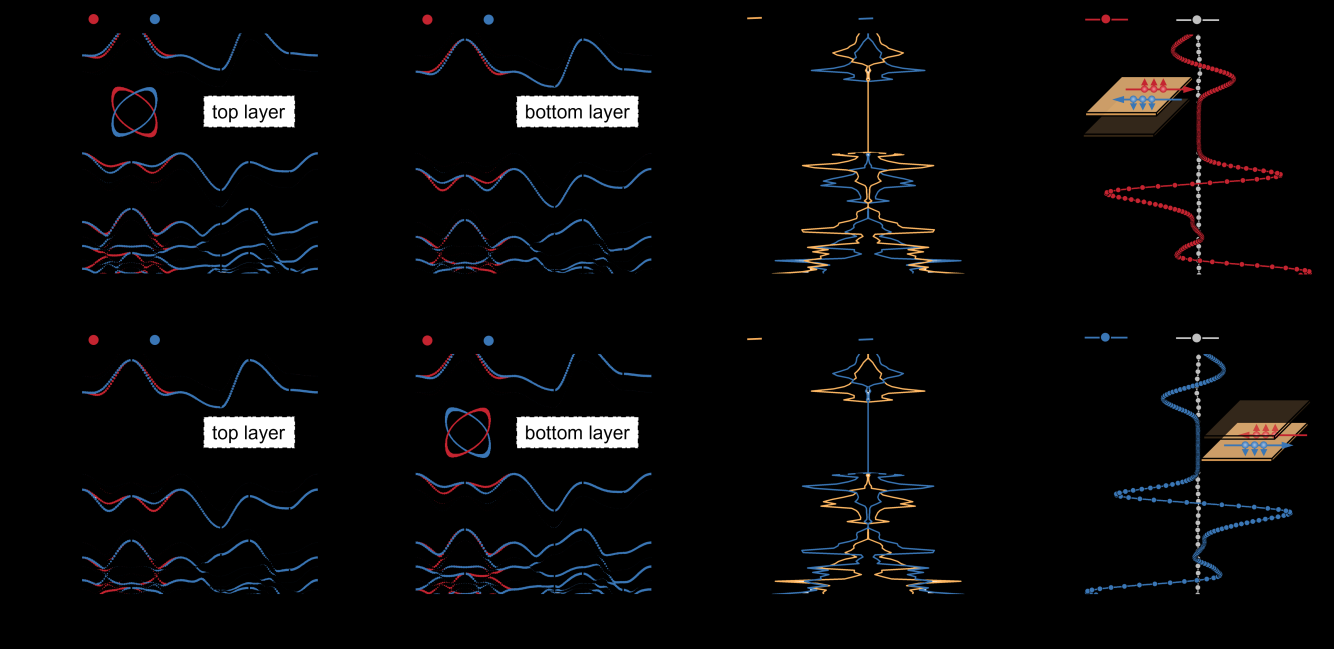
Fig. 3 Layer-resolved spin-polarized band structures of (a) FE-I and (b) FE-II states with the
contribution from the top layer. Inset in (a) is the isoenergy contours near the Fermi level of
FE-I state. Layer-resolved spin-polarized band structures of (c) FE-I and (d) FE-II states with
the contribution from the bottom layer. Inset in (d) is the isoenergy contours near the Fermi
level of FE-II state. Density of states of (e) FE-I and (f) FE-II states. Fermi level is set to zero
in (a) to (f). Longitudinal and transverse spin conductivities in (g) FE-I and (h)FE-II states.
Insets are schematic diagrams of the layer-polarized spin currents in FE-I and FE-II states.
In contrast, the layer degeneracy is broken in FE-I (FE-II) state due to the presence
of out-of-plane electric polarization. As shown in Fig. 3(a-f), the conduction band minimum
(CBM) of FE-I (FE-II) state is mainly from the bottom (top) layer, while the valence band
maximum (VBM) is domanited by the top (bottom) layer. The layer polarization between the
top and bottom layers is measured as 0.13 (−0.13) eV in FE-I (FE-II) state. This results in a
net altermagnetic spin splitting in the band structures of both FE-I and FE-II states,
resembling that of monolayer CuF 2 . The spin-up and spin-down states remain degenerate
along M–X–Γ–Y–M, while altermagnetic spin splitting emerges along M′–Γ–M. Furthermore,
the spin-momentum coupling pattern is opposite between FE-I and FE-II states. Upon FE
switching, the spin polarization is simultaneously reversed, enabling nonvolatile control of
the altermagnetic spin splitting. This spin reversal is also evident in the isoenergy contours
of FE-I and FE-II states, further confirming the feasibility of manipulating altermagnetic spin 7 splitting through FE polarization switching, as illustrated in the insets of Fig. 3(a) and (d).
2.3 Sliding Ferroelectricity Driven Spin-Layertronics in Multilayer CuF 2 The reversal of altermagnetic spin splitting leads to concomitant changes in other physical
properties. In altermagnets, an anisotropic spin splitting allows an external in-plane electric
field to generate a spin current [1,6,16]. The spin conductivity of bilayer CuF 2 can be
calculated using the Boltzmann transport equation. As illustrated in Fig. 3(g), the longitudinal
spin conductivity in FE-I state is zero, while a sizable signal appears in the transverse
direction. Notably, upon FE switching, the conductivity reverses sign owing to the opposite
spin-momentum coupling patterns between FE-I and FE-II states, as shown in Fig. 3(h).
These results demonstrate that FE polarization can effectively control spin currents in bilayer
CuF 2 , enabling nonvolatile spin information encoding and electric-field-controllable
spintronic device applications.
It is noteworthy that the layer polarization is accompanied by spin polarization, which
in turn results in a layer-polarized spin current. Specifically, in the FE-I and FE-II states, the
spin current is predominantly localized in the top and bottom layers, respectively, thereby
endowing the spin current with an additional layer DOF; see the insets in Fig. 3(g-h).
Consequently, the layer-spin polarization can alternatively be detected by examining the
layer localization of the spin current. We describe a state exhibiting coexisting spin and layer
polarization that is switchable via FE polarization as (P, S, L), where P = ±1 corresponds to
upward and downward electric polarization, S = ± 1 represents spin-up and spin-down
currents, and L = ±1 denotes the top and bottom layers. Accordingly, the FE-I and FE-II
states can be expressed as (+1,+1,+1) and (−1,−1,−1), respectively, implying the synergistic
regulation of spin current and layer occupation by ferroelectric switching.
The interplay between electric, spin and layer polarization can be further extended to
multilayer systems. For instance, in quadrilayer CuF 2 , interlayer sliding gives rise to four
inequivalent polarization states: (+2,+1,+2), (+1,−1,−1), (−1,+1,+1), and (−2,−1,−2); see Fig.
S5. The (+2,+1,+2) state, characterized by consecutive AA stacking across two FE-I
configurations, naturally exhibits upward electric polarization. Applying a glide operation to
this state yields the (−2,−1,−2) state, which reverses the out-of-plane electric polarization
direction. Similarly, the (+1,−1,−1) state, formed by AA stacking across FE-I and FE-II 8 configurations, also shows upward electric polarization, and its glide counterpart (−1,+1, +1)
state reverses the electric polarization. Owing to their distinct stacking sequences, the
absolute electric polarization values differ between the (±2,±1,±2) and (±1,∓1,∓1) states.
(±2,±1,±2) states exhibit a larger electric polarization of ±4.22 pC/m, whlie (±1,∓1,∓1)
states have an electric polarization of ±1.45 pC/m. Fig. 4 displays the band structures of
these four states in quadrilayer CuF 2 . In the (±2,±1,±2) states, the VBM originates from the
two outer layers, whereas in the (±1,∓1,∓1), the VBM arises from the two inner layers. This
layer-dependent band-edge localization enables selective manipulation of spin currents
within specific layers, opening avenues for electric-controlled spin-layertronic functionality
across all four constituent layers.
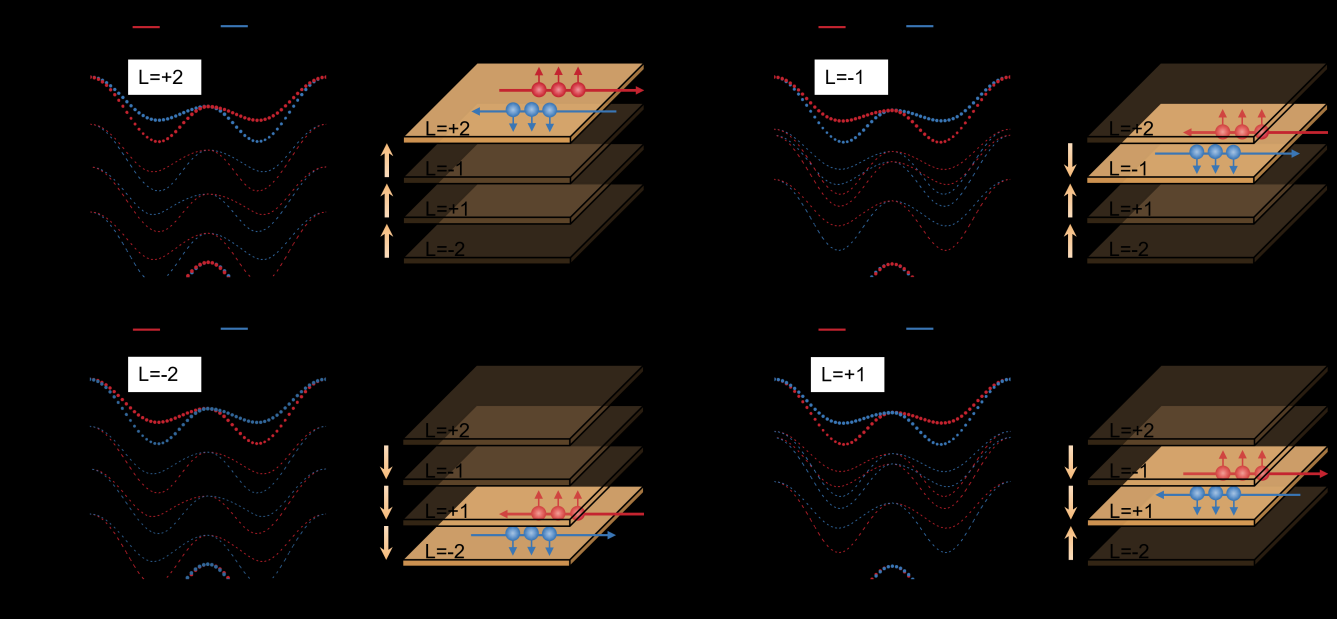
Fig. 4 Layer-resolved spin-polarized band structures and schematic diagrams of layer-
polarized spin current in (a) (+2,+1,+2), (b) (+1,−1,−1), (c) (−2,−1,−2), and (d) (−1,+1,+1)
states. Fermi level is set to zero.
In summary, we have proposed and theoretically validated a strategy to achieve nonvolatile
FE-switchable spin-layertronics by integrating altermagnetism with sliding ferroelectricity in
multilayer heterostructures. We demonstrated that interlayer sliding induces out-of-plane FE
polarization in bilayer CuF 2 which directly couples to and reverses the layer-locked d-wave
altermagnetic spin-splitting texture. Transport calculations revealed that the corresponding
9 layer-locked spin conductivities can be ferroelectrically encoded, highlighting the potential
of sliding FE altermagnets as nonvolatile nanomechanical spin-layer switches. Extending to
quadrilayer CuF 2 , we identify four inequivalent polarization states, thus revealing a material
platform for electrically controllable, multi-state spin-layer logic and memory devices. Our
work not only addresses the key challenge of multiferroic switching in altermagnets, but also
establishes FE control of spin-layertronic that enriches the device application landscape of
altermangets.
First-principles calculations are performed based on density functional theory (DFT) [58] as implemented in Vienna ab initio simulation package (VASP) [59]. Exchange-correlation interaction is described by the Perdew-Burke-Ernzerhof (PBE) parametrization of generalized gradient approximation (GGA) [60]. Structures are relaxed until the force on each atom is less than 0.01 eV/Å. The cutoff energy and electronic iteration convergence criterion are set to 500 eV and 10 −5 eV, respectively. To sample the 2D Brillouin zone, a Monkhorst–Pack (MP) k-grid mess [61] of 5 × 9 × 1 is used for bilayer CuF 2 . To avoid the interaction between adjacent layers, a vacuum space of 20 Å is added. FE switching barrier is obtained by nudged elastic band (NEB) method [62]. Berry phase approach is employed to evaluate the out-of-plane electric polarization [63]. The spin-resolved transport properties are calculated using a housing-made code, in which the electron energy and electron group velocity are evaluated from the Wannier-based tight binding Hamiltonian [64].
Supporting Information is available from the Wiley Online Library or from the author.
This work is funded by the National Natural Science Foundation of China (Nos. 12304431),
and Natural Science Foundation of Zhejiang Province (Nos. LQ24A040015). Y. S. A.
acknowledges the supports from the Kwan Im Thong Hood Cho Temple Early Career Chair 10 Professorship in Sustainability and the Singpaore Ministry of Education Academic Research
Fund Tier 2 (MOE-T2EP50224-0021).
The authors declare no conflict of interest.
R.P. and Y.S.A. conceived and designed the project. R.P. performed the calculations and analysis. R.P. and Y.S.A. wrote the manuscript with inputs from all authors. F.X.L. reviewed and analysed the results. All the authors discussed the contents and prepared the manuscript.
The data that support the findings of this study are available from the corresponding author upon reasonable request.
Altermagnetism, Sliding ferroelectricity, Layer degree of freedom, First-principles calculations, Nonvolatile switching
J. Železný, Efficient electrical spin splitter based on nonrelativistic collinear antiferromagnetism, Phys. Rev. Lett. 126, 127701 (2021). 2. L. Šmejkal, J. Sinova, and T. Jungwirth, Emerging research landscape of altermagnetism,
Phys. Rev. X 12, 040501 (2022).
antiferromagnetism: a phase with nonrelativistic spin and crystal rotation symmetry, Phys. Rev. X 12, 031042 (2022).
11 4. L. Šmejkal, A. H. MacDonald, J. Sinova, S. Nakatsuji, and T. Jungwirth, Anomalous Hall
antiferromagnets, Nat. Rev. Mater. 7, 482 (2022). 5. L. Bai, W. Feng, S. Liu, L. Šmejkal, Y. Mokrousov, and Y. Yao, Altermagnetism: Exploring
new frontiers in magnetism and spintronics, Adv. Funct. Mater. 34, 2409327 (2024).
antiferromagnetic materials with giant piezomagnetism and noncollinear spin current, Nat. Commun. 12, 2846 (2021).
magnetoresistance effects based on a two-dimensional nonrelativistic antiferromagnetic metal, Phys. Rev. B 108, 024410 (2023).
locked transport in room temperature collinear antiferromagnetic semimetallic CrO monolayer, Appl. Phys. Lett. 123, 022402 (2023).
computational screening: Symmetry requirements, chiral magnons, and spin-orbit effects, Appl. Phys. Lett. 124, 182409 (2024). 10. H. Jin, Z. Tan, Z. Gong, and J. Wang, Anomalous Hall effect in two-dimensional vanadium
tetrahalogen with altermagnetic phase, Phys. Rev. B 110, 155125 (2024). 11. R.-W. Zhang, C. Cui, R. Li, J. Duan, L. Li, Z.-M. Yu, and Y. Yao, Predictable gate-field
control of spin in altermagnets with spin-layer coupling, Phys. Rev. Lett. 133, 056401 (2024). 12. J. Gong, Y. Wang, Y. Han, Z. Cheng, X. Wang, Z.-M. Yu, and Y. Yao, Hidden real topology
and unusual magnetoelectric responses in two-dimensional antiferromagnets, Adv. Mater. 36, 2402232 (2024).
using spin group theory, Phys. Rev. B 110, 054406 (2024).
altermagnetism in bilayer systems, Phys. Rev. Lett. 133, 166701 (2024).
generating two-dimensional altermagnetism, Phys. Rev. B 110, 174410 (2024). 16. R. Peng, J. Yang, L. Hu, W.-L. Ong, P. Ho, C. S. Lau, J. Liu, and Y. S. Ang, All-electrical
layer-spintronics in altermagnetic bilayer, Mater. Horiz. 12, 2197 (2025).
physics in stacked bilayer altermagnetic systems, Nano Lett. 25, 6032 (2025).
dictated by spin space groups, Nature 640, 349 (2025).
12 19. Y. Che, Y. Chen, X. Liu, H. Lv, X. Wu, and J. Yang, Inverse design of 2D altermagnetic
metal−organic framework monolayers from Hückel Theory of nonbonding molecular orbitals, JACS Au 5, 381 (2025).
topological phases in altermagnet/topological insulator heterostructure by floquet engineering, Adv. Sci. 0:e22203 (2026).
properties of w-MnSe altermagnet, Adv. Funct. Mater. 35, 2505813 (2025).
Hall conductivity in altermagnets, Adv. Sci. e15002 (2025). 23. C. Song, H. Bai, Z. Zhou, L. Han, H. Reichlova, J. H. Dil, J. Liu, X. Chen, and F. Pan,
Altermagnets as a new class of functional materials, Nat. Rev. Mater. 10, 473 (2025).
antiferromagnetic systems, Phys. Rev. X 15, 021083 (2025). 25. F. Zhang, X. Cheng, Z. Yin, C. Liu, L. Deng, Y. Qiao, Z. Shi, S. Zhang, J. Lin, Z. Liu, et
al., Crystal-symmetry-paired spin-valley locking in a layered room-temperature metallic altermagnet candidate, Nat. Phys. 21, 760 (2025). 26. M. Leiviskä, J. Rial, A. Bad’ura, R. L. Seeger, I. Kounta, S. Beckert, D. Kriegner, I.
Joumard, E. Schmoranzerová, J. Sinova, et al., Anisotropy of the anomalous Hall effect in thin films of the altermagnet candidate Mn 5 Si 3 , Phys. Rev. B 109, 224430 (2024). 27. L. Han, X. Fu, R. Peng, X. Cheng, J. Dai, L. Liu, Y. Li, Y. Zhang, W. Zhu, H. Bai, et al.,
Electrical 180° switching of Néel vector in spin-splitting antiferromagnet, Sci. Adv. 10, eadn0479 (2024). 28. J. Krempaský, L. Šmejkal, S. W. D’Souza, M. Hajlaoui, G. Springholz, K. Uhlířová, F.
Alarab, P. C. Constantinou, V. Strocov, D. Usanov, et al., Altermagnetic lifting of Kramers spin degeneracy, Nature 626, 517 (2024). 29. S. Lee, S. Lee, S. Jung, J. Jung, D. Kim, Y. Lee, B. Seok, J. Kim, B. G. Park, L. Šmejkal,
et al., Broken Kramers degeneracy in altermagnetic MnTe, Phys. Rev. Lett. 132, 036702 (2024). 30. M. Hajlaoui, S. Wilfred D’Souza, L. Šmejkal, D. Kriegner, G. Krizman, T. Zakusylo, N.
Olszowska, O. Caha, J. Michalička, J. Sánchez-Barriga, et al., Temperature dependence of relativistic valence band splitting induced by an altermagnetic phase transition, Adv. Mater. 36, 2314076 (2024).
Manipulation of the altermagnetic order in CrSb via crystal symmetry, Nature 638, 645 (2025).
13 32. M. Gu, Y. Liu, H. Zhu, K. Yananose, X. Chen, Y. Hu, A. Stroppa, and Q. Liu, Ferroelectric
switchable altermagnetism, Phys. Rev. Lett. 134, 106802 (2025).
altermagnets: antiferroelectricity alters magnets, Phys. Rev. Lett. 134, 106801 (2025).
altermagnetic-ferroelectric type-III multiferroics with robust magnetoelectric coupling,
Adv. Mater. 37, 2502575 (2025).
altermagnets: from model to material realization, Nano Lett. 25, 9456 (2025). 36. Z. Zhu, Y. Liu, X. Duan, J. Zhang, B. Hao, S. H. Wei, I. Žutić, and T. Zhou, Emergent
multiferroic altermagnets and spin control via noncollinear molecular polarization, Sci. China-Phys. Mech. Astron. 68, 127562 (2025).
multiferroics VOX 2 , Phys. Rev. B 112, 104427 (2025) .
arXiv:2411.19928v1. 39. W, Guo, J. Xu, Y. Yang, H. Wang, and H, Zhang, Altermagnetic type-II multiferroics with
Néel-order-locked electric polarization, arXiv:2505.01964v2. 40. N. Ding, H. Ye, S. Wang, and S. Dong, Ferroelasticity tunable altermagnets, Phys. Rev.
B 112, L220410 (2025). 41. Y. Huang, C. Hua, R. Xu, J. Liu, Y. Zheng, and Y. Lu, Spin inversion enforced by crystal
symmetry in ferroelastic altermagnets, Phys. Rev. Lett. 135, 266701 (2025). 42. R. Peng, S. Fang, P. Ho, F. Liu, T. Zhou, J. Liu, Y. S. Ang, Ferroelastic altermagnetism,
npj Quantum Mater. 11, 5 (2026). 43. L. Li and M. Wu, Binary compound bilayer and multilayer with vertical polarizations: Two-
dimensional ferroelectrics, multiferroics, and nanogenerators, ACS Nano 11, 6382 (2017). 44. Z. Fei, W. Zhao, T. A. Palomaki, B. Sun, M. K. Miller, Z. Zhao, J. Yan, X. Xu, and D. H.
Cobden, Ferroelectric switching of a two-dimensional metal. Nature 560, 336 (2018). 45. Q. Yang, M. Wu, and J. Li, Origin of two-dimensional vertical ferroelectricity in WTe 2
bilayer and multilayer, J. Phys. Chem. Lett. 9, 7160 (2018). 46. M. Wu and J. Li, Sliding ferroelectricity in 2D van der Waals materials: Related physics
and future opportunities, PNAS 118, e2115703118 (2021). 47. Y. Wan, T. Hu, X. Mao, J. Fu, K. Yuan, Y. Song, X. Gan, X. Xu, M. Xue, Room-temperature
ferroelectricity in 1T′-ReS 2 multilayers, Phys. Rev. Lett. 128, 067601 (2022).
14 48. T. Zhang, X. Xu, Y. Dai, B. Huang, Y. Ma, Intrinsic ferromagnetic triferroicity in bilayer T′-
VTe 2 , Appl. Phys. Lett. 120, 192903 (2022). 49. R. Peng, T. Zhang, Z. He, Q. Wu, Y. Dai, B. Huang, and Y. Ma, Intrinsic layer-polarized
anomalous Hall effect in bilayer MnBi 2 Te 4 , Phys. Rev. B 107, 085411 (2023). 50. Z. Wang, Z. Gui, and L. Huang, Sliding ferroelectricity in bilayer honeycomb structures:
A first-principles study, Phys. Rev. B 107, 035426 (2023).
Sławińska, Robust Zeeman-type band splitting in sliding ferroelectrics, Phys. Rev. Mater. 8, 024005 (2024). 52. Y. Guo, R. Meng, X. Hu, L. Lin, Y. Jiang, M. Yang, Y. You, L. Zhang, Y. Xu, and X. Yan,
Sliding ferroelectricity in kagome-B 2 X 3 (X = S, Se, Te) bilayers, Appl. Phys. Lett. 124, 152901 (2024). 53. Y. Zhu, M. Gu, Y. Liu, X. Chen, Y. Li, S. Du, and Q. Liu, Sliding ferroelectric control of
unconventional magnetism in stacked bilayers, Phys. Rev. Lett. 135, 056801 (2025).
by sliding ferroelectricity via lattice symmetry-mediated magnetoelectric coupling, Nano Lett. 24, 11179 (2024). 55. Z. Guo, S. Qian, X. Zhou, W. Wang, Z. Cheng, X. Wang, Sliding ferroelectric metal with
ferrimagnetism, Nat. Commun. 17, 549 (2026). 56. C. Billy and H. M. Haendler, The crystal structure of copper(II) fluoride, J. Am. Chem.
Soc. 79, 1049 (1957).
and CuF 2 , Phys. Rev. Mater. 8, 034407 (2024).
effects, Phys. Rev. 140, A1133 (1965). 59. G. Kresse and J. Furthmüller, Efficient iterative schemes for ab initio total-energy
calculations using a plane-wave basis set, Phys. Rev. B 54, 11169 (1996).
simple, Phys. Rev. Lett. 77, 3865 (1996). 61. H. J. Monkhorst and J. D. Pack, Special points for Brillouin-zone integrations, Phys. Rev.
B 13, 5188 (1976).
finite systems: structure and dynamics of (H 2 O) 2 , Phys. Rev. B 48, 2081 (1993). 63. R. D. King-Smith and D. Vanderbilt, Theory of polarization of crystalline solids, Phys. Rev.
B 47, 1651 (1993). 64. A. A. Mostofi, J. R. Yates, G. Pizzi, Y.-S. Lee, I. Souza, D. Vanderbilt, and N. Marzari, An
15 updated version of wannier90: a tool for obtaining maximally-localised Wannier functions, Comput. Phys. Commun. 185, 2309 (2014).
16