
⬇ Download Markdown · ⬇ Download LaTeX · ⬇ original · view original
Y. Behovits 1 , A. L. Chekhov 1 , A. Ruge 1 , R. Rouzegar 1 , B. Rosinus Serrano 1 , A. P. Fellows 2 , B. John 2 , M. Thämer 2 , S. Reimers 3 , F. Renner 4 , T. Dannegger 4 , U. Nowak 4 , T.S. Seif ert 1 , M. Kläui 3 , M. Jourdan 3 and T. Kampf rath 1
Berlin, Germany
Konstanz, Germany 1 Summary
Ultraf ast electric manipulation of magnetic order in solids is critical f or the development of f uture terahertz data processing [1, 2]. A f ascinating concept f or such high-speed operation is of f ered in metallic antif erromagnets by Néel spin-orbit torque [3, 4]. It should allow one to coherently rotate the ordered spins by simply applying an electric current of suitable amplitude and polarity [5]. However, such switching has been severely hampered by competing heat -induced ef f ects [6-8], and it has not yet been achieved on the intrinsically ultraf ast time scales of antif erromagnets. Here, we report robust, direction-controlled and non-thermal rotation of the Néel vector 𝑳 by ±90° at room temperature in the antif erromagnet Mn 2 Au driven by phase-locked terahertz current pulses. All observed f eatures are consistent with ultraf ast Néel spin-orbit torque: First, nonlinear optical imaging reveals that the terahert z current direction sets the f inal orientation of 𝑳 in the absence of any bias f ield f or at least two months. Second, transient optical biref ringence shows that the switching proceeds ultraf ast in less than 15 picoseconds. Finally, atomistic spin-dynamics simulations reproduce the observed dynamics and conf irm the minor role of thermal ef f ects. While the switching is already one order of magnitude f aster than in f erromagnets at comparable dissipated energy [9], our simulations predict routes toward switching times and energies which are another order of magnitude lower. Our approach can be transf erred to electric-f ield-driven switching in many more antif erromagnets [10-16], including magnetoelectric insulators [17-19]. The engineering of spin torques, resonance f requencies and read - out mechanisms provides an exciting pathway toward on-chip applications of terahertz antif erromagnetic spin-orbitronics.
2 Figures a b
Approach to ultraf ast NSOT. An incident terahertz electric-f ield pulse 𝑬 (red) drives a charge current 𝒋 (red) inside a Mn 2 Au thin f ilm and, thus, exerts NSOT on the Néel vector 𝑳 (blue). To enhance the charge current locally, the f ilm is microstructured in the shape of a bowtie antenna.
3


4 a Probe Terahertz
b // // // //
100 200 10 20
(ps) (s)
1 Signal 0.5 1.0 0.4 0.1 0
1 0 -1 -5 0 5 10 15
Time (ps)
20 25 30 Fig. 3 | Terahertz Néel-vector dynamics. a, Schematic of the terahertz-pump magneto-optic-probe experiment with terahertz current 𝒋 = 𝑗𝒖 𝑥 . Prior to the terahertz pump pulse, an external magnetic f ield 𝑩 ext = 𝐵 ext 𝒖 𝑥 sets the magnetization 𝑴 of the f erromagnetic Ni 80 Fe 20- layer (Py) adjacent to the antif erromagnetic Mn 2 Au and, thus, initializes its Néel vector 𝑳. At a delay 𝜏 af ter the pump, the optical probe pulse interrogates 𝑳 through magnetic linear biref ringence (MLB). b, MLB signals 𝑆 MLB (𝜏) vs 𝜏
where 𝑗 0max ≈ 3 ⋅ 10 13 A/m 2 . The black curve displays the reconstructed terahertz current density 𝑗(𝜏) /𝑗 0 inside the Mn 2 Au f ilm. As the signals predominantly scale with 〈sin 2 𝜑 𝑳 〉 [Eq. (3)], signal values of 0 and 1 (gray-dashed lines) correspond to f ully horizontally and vertically aligned Néel vectors within the probing volume (see black double-arrows).
5 𝑗/𝑗 0 a
c𝜑 𝑳 (deg)
𝑗 0 ⁄ 𝑗 0 max = 0.8 d
Fig. 4 | Atomistic spin-dynamics simulations. a, Wavef orm of the terahertz current density 𝑗(𝜏) /𝑗 0 . b-d, Simulated Néel-vector def lection 𝜑 𝑳 (𝜏) f or increasing terahertz peak current density 𝑗 0 ⁄ 𝑗 0max at a thermostat temperature of 300 K. The 𝜑 𝑳 (𝜏) is averaged over the 30 nm thickness of the Mn 2 Au thin f ilm. The impact of thermal, stochastic f ields is assessed by repeating each simulation 50 times. The individual results are shown by semi-transparent lines. Black arrows in panel b show the corresponding direction of the Néel vector 𝑳. e, Calculated MLB signals 〈sin 2 𝜑 𝑳 〉 , obtained by averaging over the 50 simulation runs shown in each panel b-d.
6 Main text
Introduction
Antif erromagnets have powerf ul benef its over f erromagnets with regard to f uture applications in ultraf ast data processing [1, 2]. Examples include smaller volume f or storing one bit and robustness against perturbing magnetic f ields up to 10 T . Importantly, long-wavelength magnons at extremely high f requencies of ∼ 1 THz permit ultraf ast unif orm coherent spin dynamics and even magnetic switching [20-22]. Further, antif erromagnets are abundant and come with various spatial symmetries that enable novel f unctionalities [23, 24].
A f ascinating example is the f ield-like Néel spin-orbit torque (NSOT) that emerges when collinear antif erromagnetic order breaks the inversion symmetry of the crystal lattice [3]. In the metallic antif erromagnets CuMnAs and Mn 2 Au, this NSOT can simply be induced by electric currents (Fig. 1a). Ultimately, currents of suitable amplitude and polarity should allow one to rotate the Néel vector 𝑳 by ±90° between dif f erent equilibrium conf igurations [4, 25-28]. Owing to exchange enhancement, such switching is predicted to be ef f icient and ultraf ast down to the picosecond scale, which is the natural time scale of antif erromagnetic spin dynamics [5, 29, 30].
However, ultraf ast implementations of genuine NSOT switching are missing because slow, quasi-DC switching is extremely challenging already: (1) The required current density of ≳ 10 11 A/m 2 induces competing processes, such as heating, strain, domain f ragmentation and structural changes , which dominate f or current pulses longer than ∼ 10 ns [6-8, 31, 32]. (2) Exclusive probing of antif erromagnetic order is nontrivial, in particular the dif f erentiation of antiparallel states ±𝑳 [33].
To address challenge (1), phase-locked sub-picosecond current transients are ideally suited (Fig. 1b): Due to their terahertz center f requency, they can resonantly and, thus, ef f iciently excite coherent antif erromagnetic magnons [34-38]. The sub-picosecond duration is mandatory f or ultraf ast switching and reduces the dissipated heat relative to longer pulses [8, 39, 40]. To tackle challenge (2), optical probes are a highly versatile tool: Magnetic linear biref ringence (MLB) and dichroism can dif f erentiate 0°- and 90°-domains [33], and second-order nonlinear optical ef f ects, such as optical sum-f requency generation (SFG), of f er complementary inf ormation on ±𝑳 states [41-43].
Here, we report the long-sought ultraf ast switching of the Néel vector 𝑳 of the metallic collinear antif erromagnet Mn 2 Au at room temperature by terahertz NSOT (Fig. 1b). First, in Mn 2 Au thin f ilms, SFG microscopy reveals signatures of direction-controlled ±90°-switching of 𝑳 without bias f ield, which persist over at least two months [44, 45]. Second, in Mn 2 Au|Py stacks with the f erromagnet Py, where 𝑳 can easily be initialized, we time-resolve the switching process by MLB [46] over a time window f rom −10 ps to as high as +1 ms with f emtosecond resolution. We f ind that ultraf ast rotation of 𝑳 by 90° happens in less than 15 ps and remains stable until the sample is externally reinitialized af ter ∼ 0.1 ms. Our approach takes f ull advantage of the unique f eatures of NSOT and antif erromagnets : directioncontrolled, non-thermal, robust, ultraf ast and energy-ef f icient. We expect that it can be transf erred to many more antif erromagnets and, thus, be considered a major step toward terahertz antif erromagnetic spin-orbitronics.
Fig. 1a schematically shows the plane of a Mn 2 Au thin f ilm. The Néel vector 𝑳 is given by the dif f erence of the magnetization of the two spin sublattices, which are antiparallel in equilibrium. In a given domain, 𝑳 can take one out of f our 90°-rotated orientations in the magnetic potential energy landscape that arises f rom various anisotropy interactions. Remarkably, by applying an electric current with density 𝒋 in the f ilm plane (Fig. 1a), NSOT is induced and initiates rotation of the Néel vector according to [46, 47]
If the NSOT is suf f iciently strong, it pushes the Néel vector over the energy barrier (gray-shaded areas),
1a).
The NSOT of Eq. (1) has a unique f eature: It reverses when either 𝑳 or 𝒋 is reversed. Theref ore, if we have two domains with opposite initial Néel vectors of ±𝑳 0 (𝜑 𝑳 0 = 0° and 180°) and apply 𝒋 parallel to
7 𝑳 0 , both domains can be switched toward the same f inal direction 𝜑 𝑳 0 = 90° (Fig. 1a). Consequently, NSOT permits macroscopic alignment of the Néel vector in samples that are initially multi-domain, thereby turning a sample with vanishing volume-averaged Néel vector 〈𝑳〉 into a sample with 〈𝑳〉 ≠ 0, without any external bias. Likewise, opposite f inal ±〈𝑳〉 are obtained f or opposite current polarities ±𝒋 and, thus, opposite driving electric f ield s ±𝑬 [Eq. (1)].
In contrast, in centrosymmetric antif erromagnets, NSOT and the more general magneto -electric ef f ect are symmetry-f orbidden [18, 19, 48]. Consequently, the reorientation of 𝑳 is exclusively even in 𝑬 [20, 21] and, f or certain spin modes, also even in the driving magnetic f ield [22]. It is, thus, independent of the polarity of the applied electromagnetic field. However, even if NSOT is symmetry-allowed, it is easily overwhelmed by polarity-independent Joule heating (∝ 𝑬 2 ) [6-8].
Experiments
To realize ultraf ast NSOT switching , phase-locked terahertz pulses with peak electric f ields up to 1.1 MV/cm (Supplementary Fig. 1 and Methods) are applied to an antenna-shaped Mn 2 Au sample to drive a charge current 𝒋 and, thus, NSOT (Fig. 1b). Our samples consist of Mn 2 Au thin f ilms (thickness 30-40 nm) grown on MgO with metallic buf f er and cap layers. Each metal stack is laterally microstructured into a bowtie antenna (length 160 μm, waist 20 μm) to enhance the local current density by a f actor of 5-15 (Supplementary Fig. 2, Supplementary Fig. 3). The antenna resonance f requency is chosen to overlap with the broadband response of the in-plane magnon mode of Mn 2 Au at 0.6 THz [46]. The pump’s impact on the antif erromagnetic order is probed by two magneto-optic approaches. (1) Long af ter excitation, we use phase-resolved optical SFG microscopy to acquire images of the 𝑳 landscape of the Mn 2 Au thin f ilm (Fig. 2a). (2) To time-resolve the spin dynamics in the antenna center, we use a time-delayed optical probe pulse and MLB (Fig. 3a).
Long-term switching of Mn 2 Au Setup. In the f irst experiment, we expose Mn 2 Au antennas to 10 4 consecutive terahertz pump pulses at a repetition rate of 1 kHz. The terahertz current 𝒋 is parallel to the 𝑥 axis (Fig. 1b) with tunable polarity (±𝒋).
Two months af ter exposure, the 𝑳 distribution of the sample is interrogated by wide-f ield SFG microscopy [49, 50]. As schematically shown in Fig. 2a, inf rared (IR) and visible (VIS) laser pulses are collinearly incident onto the sample surf ace and generate an additional ref lected wave at the IR+VIS sum f requency. The SFG f ield relies on the broken inversion symmetry of the sample, which, in bulk Mn 2 Au, solely arises f rom the antif erromagnetic order. By taking SFG micrographs as a f unction of the rotation angle 𝜑 s of the sample about its normal, we extract two SFG signals that scale with cos 𝜑 s and sin 𝜑 s (Methods). They can be shown to f ulf ill
and should, thus, directly report on the in-plane Néel vector 〈𝑳〉 . Here, the brackets 〈⋅〉 indicate averaging
sin 𝜑 Results. Fig. 2b-d shows micrographs of 𝑆
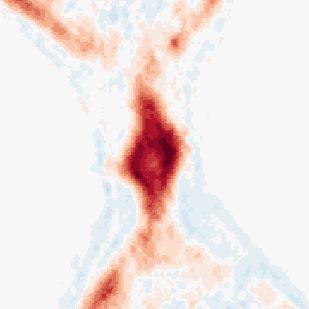
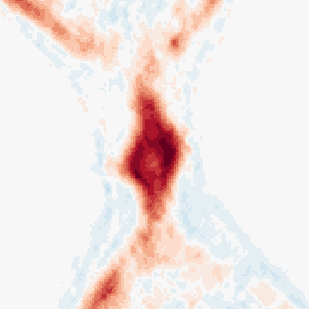
SFG s f or three distinct antennas: one ref erence antenna without terahertz-pulse exposure (Fig. 2b), as well as antennas exposed to 10 4 pulses with positive (Fig. 2c) or negative maximum amplitude (Fig. 2d). For the unexposed antenna, a random signal distribution with relatively small amplitudes is f ound (Fig. 2b). Toward the edges of the narrow antenna center, slightly increased SFG signals are f ound, which may indicate a modif ied magnetic anisotropy in these regions [51].
Remarkably, f or the antenna exposed to terahertz pulses, a strong SFG signal in the antenna center emerges (Fig. 2c). Even more strikingly, f or the sample exposed to terahertz pulses of opposite polarity, we again observe the emergence of a strong signal, but this time with opposite sign (Fig. 2d). The highest signal amplitudes f orm a characteristic shape, with a central diamond-shaped region and straight lines roughly f ollowing the edges of the widening antenna. These regions correspond to the sections with nearly identical current density, as the simulations in Supplementary Fig. 2 show. In contrast, we cos 𝜑 f ind little dif f erences in the signal 𝑆
SFG s between the three antennas (Supplementary Fig. 4).
8 Following Eq. (2), we interpret the SFG signals of Fig. 2b-d as images of the spatially averaged Néel vector 〈𝑳〉 , resulting in f our important implications: (1) The terahertz pulse induces a nonvanishing macroscopic Néel vector 〈𝑳〉 = ⟨𝐿 𝑦 ⟩𝒖 𝑦 f rom an initial state with 〈𝑳 0 〉 ≈ 0. (2) The induced 〈𝑳〉 is perpendicular to the terahertz current density 𝒋. (3) 〈𝑳〉 reverses when the polarity of the terahertz current 𝒋 is reversed. (4) The terahertz-induced 〈𝑳〉 is stable f or at least two months.
Results (1)-(3) are f ully consistent with non-thermal switching through NSOT [Fig. 1b and Eq. (1)]. Thermal switching by Joule heating would be insensitive to the sign of the driving current, in contrast to Fig. 2c,d. Result (4) demonstrates the robustness of the switched antif erromagnetic textures.
Terahertz switching dynamics in Mn 2 Au|Py
Setup. We now turn to the question whether the switching of the Néel vector occurs ultraf ast and address it by a terahertz-pump optical-probe experiment (Fig. 3a). Because such a stroboscopic scheme requires many repetitions of the switching event, the sample need s to be initialized periodically. For this purpose, we use a Mn 2 Au thin f ilm (thickness 30 nm) that is exchange-coupled to an adjacent f erromagnetic-metal layer of Ni 80 Fe 20 (Permalloy Py, 6 nm). It allows us to simultaneously control the unif orm magnetization 𝑴 of the f erromagnet and the Néel vector 𝑳 ∥ 𝑴 of the antif erromagnet by a moderate external magnetic f ield 𝑩 ext = 𝐵 ext 𝒖 𝑥 [52, 53]. In each cycle of the experiment, we f irst apply 𝐵 ext = +220 mT to set the unif orm Py magnetization and, thus, the Mn 2 Au Néel vector 𝑳. By reducing 𝐵 ext to zero, we obtain an approximately homogeneous distribution 𝑳 (𝑥, 𝑦) = +𝑳 0 . In this initialized remnant state, the incident terahertz pump pulse launches a current 𝒋 = 𝑗𝒖 𝑥 and, thus, NSOT (Fig. 3a). Af ter a delay 𝜏, the resulting 𝑳 dynamics is interrogated by a time-delayed optical probe pulse (duration 20 fs, wavelength 800 nm). The resulting signal 𝑆(𝜏, +𝑳 0 ) is proportional to the probe’s polarization rotation. Subsequently, we initialize 𝑳 (𝑥, 𝑦) = −𝑳 0 and obtain the signal 𝑆(𝜏, −𝑳 0 ) . This procedure extends over 2 ms and is repeated periodically to sample 𝑆 (𝜏, ±𝑳 0 ) at all relevant delays 𝜏 f rom −10 ps to as high as +1 ms. The black curve in Fig. 3b shows the wavef orm of the current density 𝑗(𝜏) in the center of the antenna.
f ollowed by echoes at about 10 ps and 20 ps , which result f rom ref lections at the substrate interf aces.
We now f ocus on the MLB signal component 𝑆 MLB (𝜏) that is even under reversal of 𝑳 0 (Methods). Calibration by the quasi-static sample response allows us to relate 𝑆 MLB to the Néel-vector angle 𝜑 𝑳 by
Here, the brackets 〈⋅〉 denote averaging over the probed Mn 2 Au|Py area of ≈ 20 × 30 μm 2 . According to
Results. Fig. 3b shows the signal 𝑆 MLB (𝜏) f or increasing current amplitude inside the antenna. For the lowest peak amplitude 𝑗 0 = 0.1𝑗 0max , the wavef orm resembles the signals in Ref . [53]. In this approximately linear excitation regime, Eq. (3) implies 𝑆 MLB (𝜏) ∝ 〈𝜑 𝑳2 (𝜏)〉 , which is consistent with the dynamics of a complimentary signal ∝ 〈𝜑 𝑳 (𝜏)〉 (Supplementary Fig. 5). Importantly, 𝑆 MLB (𝜏) recovers to its initial value within 5 ps and remains there until at least 𝜏 = 20 μs (Fig. 3b). At 𝜏 ∼ 0.1 ms, the magnitude of the external magnetic f ield has increased f rom 0 mT to 70 mT and starts reinitialization of
We now turn to stronger terahertz current pulses with 𝑗 0 = 0.4𝑗 0max and 1.0𝑗 0max , which result in signal dynamics with two key f eatures (Fig. 3b). (1) The peak signal amplitude 𝑆 MLB (𝜏) saturates around 1 in both cases. (2) 𝑆 MLB (𝜏) reaches an approximately constant value, i.e., a step, within less than 15 ps af ter excitation. Importantly, the step persists up to 0.1 ms, when reinitialization starts (Supplementary Fig. 6). The step height 𝑆 MLB ( +200 ps ) − 𝑆 MLB (−5 ps ) depends on the terahertz f ield strength in a highly nonlinear manner (Supplementary Fig. 7). Feature (1) is consistent with Eq. (3) and sin 2 𝜑 𝑳 ≤ 1. The slight signal overshoot is attributed to the uncertainty of our calibration method. Feature (2) suggests that the local 𝑳 has relaxed to one of the f our equilibrium positions of Fig. 1a. In other words, we have 𝜑 𝑳 = −90°, 0°, +90° or 180°, which implies 9 signal contributions of sin 2 𝜑 𝑳 = 1, 0, 1 or 0 in Eq. (3), respectively. Theref ore, the signal f or 𝜏 > 20 ps can be written as
where 𝑓 −90° and 𝑓 +90° is the volume f raction of domains with 𝜑 𝑳 = −90° and +90°, respectively. Fig. 3b reveals that 𝑆 MLB (𝜏 = 200 ps ) reaches a value up to 0.6. Consequently, in 60% of the probed volume, the Néel vector has rotated by ±90° in response to the strongest terahertz current pulse.
Although the MLB signal [Eqs. (3) and (4)] does not distinguish ±𝑳 domains, we still conclude that 𝑓 +90° prevails over 𝑓 −90° or vice versa f or the f ollowing reasons. First, the SFG micrographs of Fig. 2c,d show that 𝑓 90° and 𝑓 −90° dif f er substantially f or bare Mn 2 Au f ilms, and the same behavior is expected in the Mn 2 Au|Py system. Second, the magnetization 𝑴 of the Py layer (Fig. 3a) exhibits a pronounced precession (Supplementary Fig. 7). We ascribe it to a reorientation of 𝑴 toward the new 𝑳 direction, driven by the interf acial exchange coupling of 𝑳 and 𝑴 (Supplementary Fig. 7). As the precession signal ∝ 𝑀 𝑧 is opposite f or domains with 𝜑 𝑳 = ±90°, its presence indicates the prevalence of one of the orientations, i.e., 𝑓 90° ≠ 𝑓 −90° . Third, we perf orm atomistic spin-dynamics simulations that agree well with the observed switching behavior. Spin-dynamics simulations. We model a system of ∼ 10 6 spins in Mn 2 Au|Py as classical magnetic moments (Methods) [29]. The dynamics of each moment is described by the stochastic Landau-Lif shitzGilbert equation with an ef f ective time-dependent f ield. The latter arises f rom the exchange and spinorbit interactions with the surrounding moments, the quasi-static external magnetic f ield and the driving terahertz charge current, as well as thermal f luctuations at a temperature of 300 K. To assess the impact of thermal f luctuations, each simulation is repeated 50 times.
Fig. 4a displays the experimentally determined terahertz current density 𝒋 = 𝑗𝒖 𝑥 . Fig. 4b-d show the resulting simulated def lection 𝜑 𝑳 (𝜏) of the Néel vector, averaged over the Mn 2 Au thickness, f or a current peak amplitude of 𝑗 0 /𝑗 0max = 0.2 (Fig. 4b), 0.8 (Fig. 4c) and 1.0 (Fig. 4d). In the linear-response regime, at 𝑗 0 = 0.2𝑗 0max , all runs coincide to very good approximation (Fig. 4b). This behavior indicates that stochastic ef f ects due to thermal spin motion are minor. However, for currents around the switching threshold (Fig. 4c-d), we observe that the primary terahertz pulse induces a branching of the dynamics: 𝑳 either relaxes back to 𝜑 𝑳 = 0° or settles at 𝜑 𝑳 = −90°. This branching indicates a more prominent role of stochastic torques close to the maximum of the potential-energy barrier at 𝜑 𝑳 = −45° (Fig. 1a). Even higher current strengths lead to more complex dynamics including +90°-switching (Supplementary Fig. 8), which is expected f rom the bipolar terahertz wavef orms.
To compare the simulations to the experimental signals (Fig. 3b), we calculate the expected MLB signal f rom each simulated 𝜑 𝑳 (𝜏) by means of Eq. (3) and subsequently average over simulation runs. The resulting signal wavef orms 𝑆 MLB (𝜏) (Fig. 4e) inherit the complex dynamics of 𝜑 𝑳 (𝜏) . Remarkably, they are in very good agreement with the measured wavef orms (Fig. 3b). In particular, our simulated system begins to switch at roughly the same threshold current as in the experiment.
The transition region f rom 𝑆 MLB ≈ 0 (no switching) toward 𝑆 MLB ≈ 1 (f ull switching) with increasing current is slightly narrower in the simulations. This apparent discrepancy can be ascribed to the spatial inhomogeneities of the current density in the real sample (Supplementary Fig. 2), whereas our simulations assume a unif orm current distribution. The experiment al probe, theref ore, averages over regions with dif f erent current amplitudes and makes the observed signal a superposition of the signals in Fig. 4e.
To summarize, our spin-dynamics simulations reproduce the general f eatures of the experimental signals very well. Importantly, they show that 𝑳 rotates largely on a deterministic, non-thermal trajectory f or an appreciable range of excitation strengths.
Discussion and conclusion
Our spatially and temporally resolved probes and our simulations provide evidence of terahertz-currentinduced non-thermal switching of the Néel vector 𝑳 in the antif erromagnetic metal Mn 2 Au. We f ind all attractive f eatures of f ield-like terahertz NSOT: directional switching as given by the polarity of the driving current and without the need of a static magnetic bias f ield, long-lived and robust current-induced spin
10 ordering in sample regions with initially zero macroscopic antif erromagnetic order, as well as operation at room temperature, with ultraf ast speed and high ef f iciency.
Remarkably, the switching within 15 ps is more than one order of magnitude f aster than switching of f erromagnets based on damping-like spin-orbit torque [9]. We attribute the short settling time to the ≈ 2 ps short relaxation time of the resonantly driven unif orm in-plane magnon of Mn 2 Au [46] and to the NSOT that reverses sign once 𝜑 𝑳 surpasses 90° [Eq. (1)]. The deposited terahertz-pulse energy density corresponds to ∼ 10 −2 eV per pulse f or each Mn site (Methods), which is about one order of magnitude lower than f or switching by nanosecond pulses in similar structures [8]. It is f urther comparable to a variety of approaches, such as terahertz switching in the antif erromagnetic insulator TmFeO 3 close to the spin-reorientation temperature [21], all-optical magnetization switching in the f errimagnetic alloy GdFeCo [54] and picosecond current-pulse switching in f erro- and f errimagnetic structures [9, 40].
Even though the switching time and deposited terahertz pulse energy of the Mn 2 Au|Py stack are already highly competitive, we anticipate that they can be reduced by more than one order of magnitude. First, while the Py layer is crucial to our pump-probe experiment (Fig. 3a), it is expected to make the response slower and more energy-demanding relative to a bare Mn 2 Au f ilm. Indeed, simulations of such a system indicate that the switching time can be reduced down to the magnon oscillation period of ∼ 1 ps (Supplementary Fig. 9). At the same time, the threshold current is reduced b y a f actor of 4, implying a f actor of 16 smaller dissipated energy. The deposited terahertz pulse energy can be reduced f urther by shaping of the vectorial terahertz electric-f ield transients [29, 30].
Interestingly, according to theory work [29, 55], NSOT in Mn 2 Au is dominated by current-induced accumulation of electron orbital rather than spin angular momentum. In this sense, our switching results could be considered as an ultraf ast implementation of an essential spin-orbitronic f unctionality.
Finally, we expect that our terahertz methodology can be transf erred to all antif erromagnetic systems that show switching by quasi-DC electric-f ields, including conventional [13, 14], chiral [10, 11] and synthetic antif erromagnets [16, 56], as well as altermagnets [12, 15, 24] and magnetoelectric antif erromagnetic insulators [17-19]. Our results open a promising pathway toward on-chip applications of terahertz antif erromagnetic spin-orbitronics. It is f ueled by a broad range of material candidates and the engineering of spin-orbit, orbital and magneto-electric torques , resonance f requencies and read -out mechanisms.
11 References
Jungwirth, T., et al., Antiferromagnetic spintronics. Nature Nanotechnology, 2016. 11(3): p. 231-
Han, J., et al., Coherent antiferromagnetic spintronics. Nature Materials, 2023. 22(6): p. 684-695.
Železný, J., et al., Relativistic Néel-Order Fields Induced by
Antiferromagnets. Physical Review Letters, 2014. 113(15): p. 157201.
Wadley, P., et al., Electrical switching of an antiferromagnet. Science, 2016. 351(6273): p. 587-
antiferromagnet by staggered spin-orbit fields. Physical Review B, 2016. 94(1): p. 014439.
Mn 2 Au and the Role of Thermal Activation. Physical Review Applied, 2018. 9(6): p. 064040.
ultrashort optical pulses. Nature Electronics, 2021. 4(1): p. 30-37.
Review B, 2025. 112(10): p. 104408.
ferromagnet. Science Advances, 2023. 9(36): p. eadh5562.
Higo, T., et al., Perpendicular full switching of chiral antiferromagnetic order by current. Nature,
607(7919): p. 474-479.
Zheng, Z., et al., All-electrical perpendicular switching of chiral antiferromagnetic order. Nature
Materials, 2025.
Chen, Y., et al., Electrical Switching of Altermagnetism. Physical Review Letters, 2025. 135(1): p.
Schmitt, C., et al., Mechanisms of Electrical Switching of Ultrathin CoO/Pt Bilayers. Nano Letters,
24(5): p. 1471-1476.
DuttaGupta, S., et al., Spin-orbit torque switching of an antiferromagnetic metallic heterostructure.
Nature Communications, 2020. 11(1): p. 5715.
Advances, 2024. 10(4): p. eadn0479.
Physical Review Letters, 2018. 121(16): p. 167202.
Communications, 2017. 8(1): p. 13985.
Newton, 2025.
Timescales. Physical Review Letters, 2025. 135(12): p. 126704.
Nature, 2004. 429(6994): p. 850-853.
29 Electrical Current in 21. Schlauderer, S., et al., Temporal and spectral fingerprints of ultrafast all-coherent spin switching.
Nature, 2019. 569(7756): p. 383-387.
Nature Materials, 2024.
Baltz, V., et al., Antiferromagnetic spintronics. Reviews of Modern Physics, 2018. 90(1): p.
Šmejkal, L., Sinova, J., and Jungwirth, T., Emerging Research Landscape of Altermagnetism.
Physical Review X, 2022. 12(4): p. 040501.
large anisotropic magnetoresistance. Nature Communications, 2018. 9(1): p. 348.
Advances, 2018. 4(3): p. eaar3566.
antiferromagnet. Nature Communications, 2018. 9(1): p. 4686.
applications. Nature Communications, 2023. 14(1): p. 1861.
principles. Physical Review B, 2022. 105(17).
pulses. Scientif ic Reports, 2023. 13(1): p. 12270.
Vector. Physical Review Letters, 2019. 123(22): p. 227203.
antiferromagnets. Physical Review Research, 2020. 2(3): p. 033077.
Němec, P., et al., Antiferromagnetic opto-spintronics. Nature Physics, 2018. 14(3): p. 229-241.
Kampf rath, T., et al., Coherent terahertz control of antiferromagnetic spin waves. Nature
Photonics, 2011. 5(1): p. 31-34.
Science, 2021. 374(6575): p. 1608-1611.
Physical Review Letters, 2023. 131(9): p. 096701.
by terahertz magnetic near fields. Nature Communications, 2023. 14(1): p. 1795.
Ilyas, B., et al., Terahertz field-induced metastable magnetization near criticality in FePS3. Nature,
636(8043): p. 609-614.
Wang, M., et al., Field-free switching of a perpendicular magnetic tunnel junction through the
interplay of spin–orbit and spin-transfer torques. Nature Electronics, 2018. 1(11): p. 582-588.
and ferrimagnetic films. Nature Nanotechnology, 2024.
Applied Physics Letters, 1995. 66(21): p. 2906-2908.
30 42. Sekine, D., et al., Second harmonic imaging of antiferromagnetic domains and confirmation of
absence of ferroaxial twins in MnTiO3. Physical Review Materials, 2024. 8(6): p. 064406.
Semiconductor. Physical Review X, 2025. 15(1): p. 011044.
2016, Cambridge: Cambridge University Press.
antiferromagnetic Mn2Au. Nature Communications, 2023. 14(1): p. 6038.
antiferromagnets via staggered-field and antidamping torques. Physical Review B, 2018. 98(10): p. 104430.
Antiferromagnets and ferromagnets. Physical Review B, 2017. 95(1): p. 014403.
balanced imaging. Optics Express, 2023. 31(18): p. 28792-28804.
resolved sum-frequency generation microscopy. Nature Communications, 2024. 15(1): p. 3161.
Physical Review Applied, 2024. 21(6): p. 064030.
exchange coupling of Mn2Au and Permalloy. Nature Communications, 2021. 12(1): p. 6539.
spring system Mn2Au|Py by terahertz spin-torques. arXiv preprint arXiv:2409.18107, 2024.
GdFeCo microstructures. Nature Communications, 2015. 6(1): p. 5839.
antiferromagnets. Nat Commun, 2019. 10(1): p. 5381.
Duine, R.A., et al., Synthetic antiferromagnetic spintronics. Nature Physics, 2018. 14(3): p. 217-
Hirori, H., et al., Single-cycle terahertz pulses with amplitudes exceeding 1 MV/cm generated by
optical rectification in LiNbO3. Applied Physics Letters, 2011. 98(9): p. 091106.
11(3): p. 362-370.
Dimensional SFG Microscopy. The Journal of Physical Chemistry Letters, 2024. 15(43): p. 10849- 10857.
lattice excitation. Science Advances, 2018. 4(7): p. eaar5164.
sampling. Review of Scientif ic Instruments, 2014. 85(1).
31 in an Antiferromagnet ic effect in noncentrosymmetric 62. Barthem, V.M.T.S., et al., Revealing the properties of Mn2Au for antiferromagnetic spintronics.
Nature Communications, 2013. 4(1): p. 2892.
Nowak, U., Classical Spin Models, in Handbook of Magnetism and Advanced Magnetic Materials .
Hinzke, D., et al., Multiscale modeling of ultrafast element-specific magnetization dynamics of
ferromagnetic alloys. Physical Review B, 2015. 92(5): p. 054412.
Physical Review B, 2021. 103(17): p. 174429.
Extrinsic and Intrinsic Contributions. Physical Review X, 2021. 11(2): p. 021030.
32