⬇ Download Markdown · ⬇ Download LaTeX · ⬇ original · view original · CSV: table 1, table 2, table 3
Chiral Altermagnetic Magnetoelectrics
Chengwu Xie, 1, 2, ∗ Weizhen Meng, 3, ∗ Zhenzhou Guo, 1 Xiaodong Zhou, 2, 4, † Shifeng Qian, 5, ‡ Tie Yang, 6, § Wenhong Wang, 2 Zhenxiang Cheng, 1 and Xiaotian Wang 1, ¶
1 Institute for Superconducting and Electronic Materials, Faculty of Engineering and Information Sciences, University of Wollongong, Wollongong 2500, Australia.
2 Institute of Quantum Materials and Devices, School of Electronic and Information Engineering,
Tiangong University, Tianjin 300387, China. 3 College of Physics, Hebei Key Laboratory of Photophysics Research and Application,
Hebei Normal University, Shijiazhuang 050024, China. 4 School of Physical Science and Technology, Tiangong University, Tianjin 300387, China. 5 Anhui Province Key Laboratory for Control and Applications of Optoelectronic Information Materials,
Department of Physics, Anhui Normal University, Wuhu 241000, Anhui, China. 6 School of Physical Science and Technology, Southwest University, Chongqing 400715, China
In this work, we introduce a new class of chiral altermagnetic magnetoelectrics in structurally chiral, nonpolar altermagnetic systems and identify the experimentally well-characterized three-dimensional metal-organic framework K[Co(HCOO) 3 ] as a promising material platform. K[Co(HCOO) 3 ] exhibits chirality-locked g-wave altermagnetic spin splitting together with dual-mode switchable electric polarization controlled by Néel-vector reorientation and structural chirality. Specifically, Néel-vector reorientation generates a finite electric polarization and reverses its sign, whereas chirality switching between left- and right-handed enantiomers produces an additional sign reversal. The associated electronic and optical responses provide effective readout channels for these switchable states. Our results establish chiral altermagnetic magnetoelectrics as a promising route to chirality- and Néel-vector-controlled nonvolatile multifunctional spintronics.
Introduction—Altermagnetism represents a third class of collinear magnetic order that uniquely bridges the fundamental dichotomy between conventional ferromagnetism and antiferromagnetism 1? –4 . It is characterized by compensated magnetic moments and nonrelativistic alternating spin-split band structures 5? –11 . This distinct characteristic enables altermagnets (AMs) to integrate the key advantages of ferromagnets (FMs) and antiferromagnets (AFMs), giving rise to a variety of emergent phenomena, including unconventional spin transport 12? ? ? , anomalous Hall effect 13–16 , anomalous thermal transport 17? ? , and magneto-optical effects 18? –23 . These features establish AMs as a promising platform for spintronic functionalities beyond the limits of conventional FMs and AFMs.
Among the various strategies for enriching altermagnetic functionalities, structural chirality provides a particularly attractive degree of freedom. Owing to the nonsuperimposability of a structure and its mirror image, the chiral crystal exists only in the 65 Sohncke space groups, which lack inversion, mirror, and roto-inversion symmetries 24 . This distinctive structural property gives rise to a wide range of intriguing phenomena, including unconventional magnetotransport behavior 25–28 , quantum responses to circularly polarized light 29–31 , and enhanced catalytic performance 32–34 . Interestingly, the symmetry breaking inherent to chiral crystals also provides a favorable setting for unconventional couplings between electric and magnetic degrees of freedom 35 . Although ∗ C.X. and W.M. contributed equally to this work.
substantial progress has been made in nonmagnetic, ferromagnetic, and antiferromagnetic chiral systems, chiral AMs remain largely unexplored.
Magnetoelectric materials, in which magnetic order induces electric polarization or electric polarization in turn influences magnetic order, provide a fundamental platform for coupling electric and magnetic degrees of freedom in solids. Recent studies on AMs have largely focused on systems where ferroelectric polarization is employed to manipulate spin-related properties 36–41 . For instance, it has been shown that in certain hybrid improper ferroelectrics
strongly coupled to the ferroelectric polarization, offering opportunities for electric-field control of spin states. Nevertheless, nonpolar AMs may enable electric polarization driven directly by Néel-vector reorientation, thereby providing a new pathway toward altermagnetic magnetoelectrics 42–44 .
Building on this idea, the coexistence of structural chirality and Néel-vector-driven polarization in nonpolar AMs provides a route to chiral altermagnetic magnetoelectrics, with dual-mode switchable electric polarization controlled by structural chirality and Néel-vector orientation. In this work, we construct a general theoretical model to establish this concept and further identify the synthesized three-dimensional
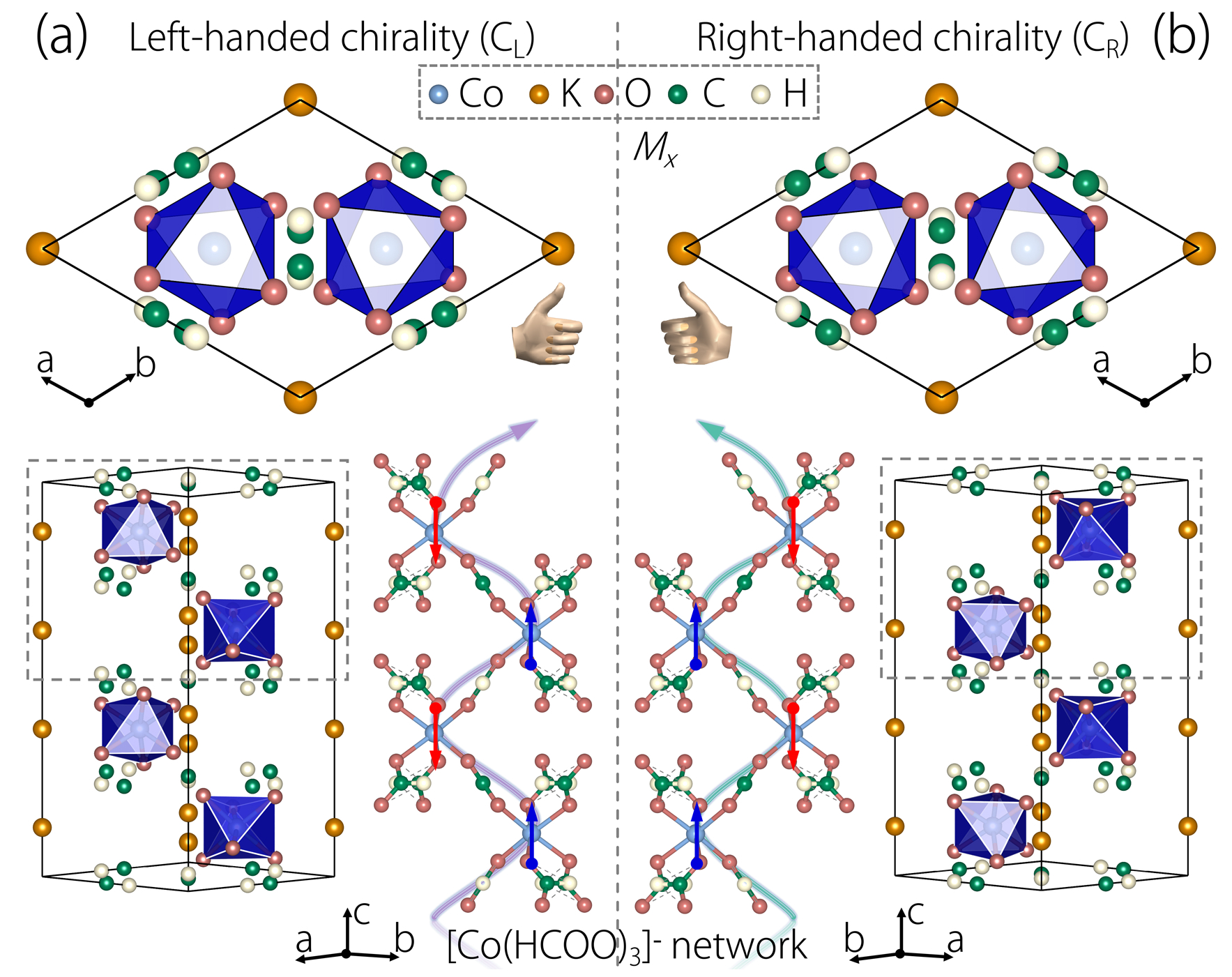
a representative material platform. Specifically, the 3D MOF K[Co(HCOO) 3 ] with a hexagonal chiral lattice exhibits chirality-locked altermagnetic semiconducting properties in
wave spin splitting in 3D momentum space. Moreover, reorientation of the out-of-plane Néel vector generates a finite in-plane polarization P y in this nonpolar AM, following a sin(2θ) dependence on the rotation angle θ. Remarkably, this polarization can be switched in two distinct ways:
2
FIG. 1. Band structures of the (a) C L model and (b) C R model. Wilson loop of the occupied bands at k z = 0 for the (c) C L model and (d) C R model, with the Néel vector oriented along the z, x, and −x axis.
Néel-vector reorientation within a fixed enantiomer reverses its sign, while switching between opposite enantiomers produces an additional sign reversal. The associated anomalous Hall and magneto-optical responses provide effective readout channels for these switchable states. These results establish K[Co(HCOO) 3 ] as a promising platform for chiral altermagnetic magnetoelectrics with coupled chirality, altermagnetism, and magnetoelectricity.
Symmetry principle for chiral altermagnetic magnetoelectrics—To uncover the fundamental physics underlying the interplay among structural chirality, altermagnetism, and magnetoelectricity, one may first establish the symmetry conditions that permit these distinct degrees of freedom to coexist. Because macroscopic responses and their cross-couplings are fundamentally governed by the crystalline and magnetic symmetries, we begin by formulating a general symmetry framework before turning to specific electronic structures or transport properties. This framework provides a general criterion for identifying and understanding chiral altermagnetic magnetoelectrics.
The coexistence of structural chirality and Néel-vectordriven polarization imposes a specific hierarchy of constraints on the symmetry operations of the system. Specifically, structural chirality requires the absence of space inversion (P),
space inversion symmetry breaking is also a prerequisite for generating an electric polarization that can be tuned by reorienting the Néel vector. Although spin-orbit coupling (SOC) implies that Néel vector rotation leads to a redistribution of charge, the rotation itself does not inherently break P symmetry. Therefore, if the system preserves space inversion, the net polarization remains identically zero regardless of the magnetic orientation. By contrast, other rotation or mirror operations may be broken as the Néel vector aligns along different directions, thereby inducing a variation in polarization. Crucially, while all AMs are characterized by the breaking of the [C 2 ||P] operation—which connects two sublattices with opposite spins—they may still retain the [E||P] operation that relates sublattices with the same spin orientation. Therefore, the essential symmetry criterion for realizing chiral altermagnetic magnetoelectrics with Néel-vector-driven polarization is the simultaneous absence of both [C 2 ||P] and [E||P] symmetry operations.
To further elucidate the microscopic physical mechanisms underlying chiral altermagnetic magnetoelectrics, we construct a representative tight-binding (TB) model that captures the electronic structures and the magnetoelectric coupling properties of the system [see the details in the Supporting Information (SI)]. This model incorporates p z orbitals at the 2c and 6g Wyckoff positions of a hexagonal lattice with the magnetic space group P 6 ′ 3 22 ′ . The sublattices at the 2c positions host antiparallel magnetic moments, while the 6g sites remain nonmagnetic. Specifically, the opposite-spin sublattices are related by the {C 6z |(0, 0, 1/2)} screw operation, whereas the same-spin sublattices are connected by C 3z and C 2x rotations, naturally giving rise to the coexistence of g-wave altermagnetism and structural chirality. To investigate the chirality dependence, we further construct an enantiomorphic partner related by a mirror operation M x , denoted as the C L and C R models, respectively. The calculated band structures in Figures 1(a) and 1(b) exhibit characteristic g-wave altermagnetic features, where spin splitting emerges along the H-K-H ′ highsymmetry path and exhibits opposite signs in the two enantiomers.
Upon incorporating SOC, the electric polarization P becomes explicitly dependent on the orientation of the Néel vector. Taking the C L model as an example: when the Néel vector is aligned along the z-axis, the in-plane polarization vanishes due to the preserved in-plane C 3 symmetry, despite the absence of space inversion. Wilson loop calculations at k z = 0 confirm that the charge centers are pinned at the lattice centers under this configuration. However, reorienting the Néel vector away from the z-axis breaks the C 3 symmetry, thereby lifting the symmetry constraints on polarization. Specifically, rotating the Néel vector toward the x-direction induces a shift of the charge center, resulting in a finite in-plane polarization. Conversely, a rotation toward the −x-direction reverses the charge displacement and the corresponding polarization [Figure 1(c)]. For the C R model, while the polarization is likewise zero for a z-aligned Néel vector, its rotation induces a polarization with the same magnitude and opposite sign to that in the C L model [Figure 1(d)].
Emergent chiral altermagnetism in K[Co(HCOO) 3 ]— Chiral altermagnetism is a special subclass of altermagnetism, wherein the alternating spin splitting can be switched by reversing the structural chirality of the lattice 13 —analogous to multiferroic altermagnetism, where the spin splitting can be controlled via ferroelectric polarization 19,38–41 . Although chiral AMs are of considerable fundamental interest, their experimental realization remains elusive, mainly because suitable candidate materials are extremely scarce. The quasi2D chiral compounds XNb(Ta) 3 S 6 (X = V, Cr, Mn, Fe, Co, Ni) 46,47 have emerged as promising chiral candidates; however, they are typically either conventional collinear AFMs 48 , 3
FIG. 3. (a) and (b) Electronic band structures along the highsymmetry paths H-K-H ′ for the C L and C R enantiomers of K[Co(HCOO) 3 ], respectively. (c) and (d) The 3D dispersion bands (k z = 0.25 π) and Fermi surfaces (FSs) (E - E F = -2.53 eV) for the C L and C R enantiomers of K[Co(HCOO) 3 ], respectively.
Subsequently, the electronic band structures for the C L and C R enantiomers of the 3D MOF K[Co(HCOO) 3 ] are shown in Figure S3 in the SI. Although band degeneracy is main-
M, pronounced spin splitting emerges along the H-K-H ′ direction, as shown in Figures 3(a) and 3(b). Notably, chiral switching induces complete spin-channel conversion (from ↑ to ↓) between the C L and C R enantiomers, a characteristic feature of chiral altermagnetism. Furthermore, the 3D band dispersion and Fermi surface reveal pronounced altermagnetic spin splitting, providing a direct visualization of the gwave symmetry in momentum space, as shown in Figures 3(c) and 3(d).
Emergent altermagnetic magnetoelectricity in K[Co(HCOO) 3 ]—Next, we come to investigate the Néel-vector-driven polarization in the C L and C R enantiomers. With the Néel vector aligned along the z(x) axis
to the nonpolar magnetic point group 6 ′ 22 ′ (2 ′ 2 ′ 2), which forbids any spontaneous electric polarization, and therefore represents a nonpolar AM (see Figure 4). As the Néel vector rotates within the zx plane away from the high-symmetry z(x) direction, the magnetic symmetry is reduced from nonpolar magnetic point group to the polar magnetic point group 2 ′ for a generic orientation. Under this symmetry, only the P y component is allowed and is protected by the T C 2y symmetry, giving rise to a finite polarization perpendicular to the rotation plane. As shown in Figures 4(a) and 4(b), first-principles calculations reveal a clear Néel-vector-driven polarization in both enantiomers. The polarization follows
enantiomers carry exactly opposite signs. This behavior is strictly constrained by magnetic symmetry. For each fixed enantiomer, the states at θ and 180 ◦ − θ are related by T C 2x 4
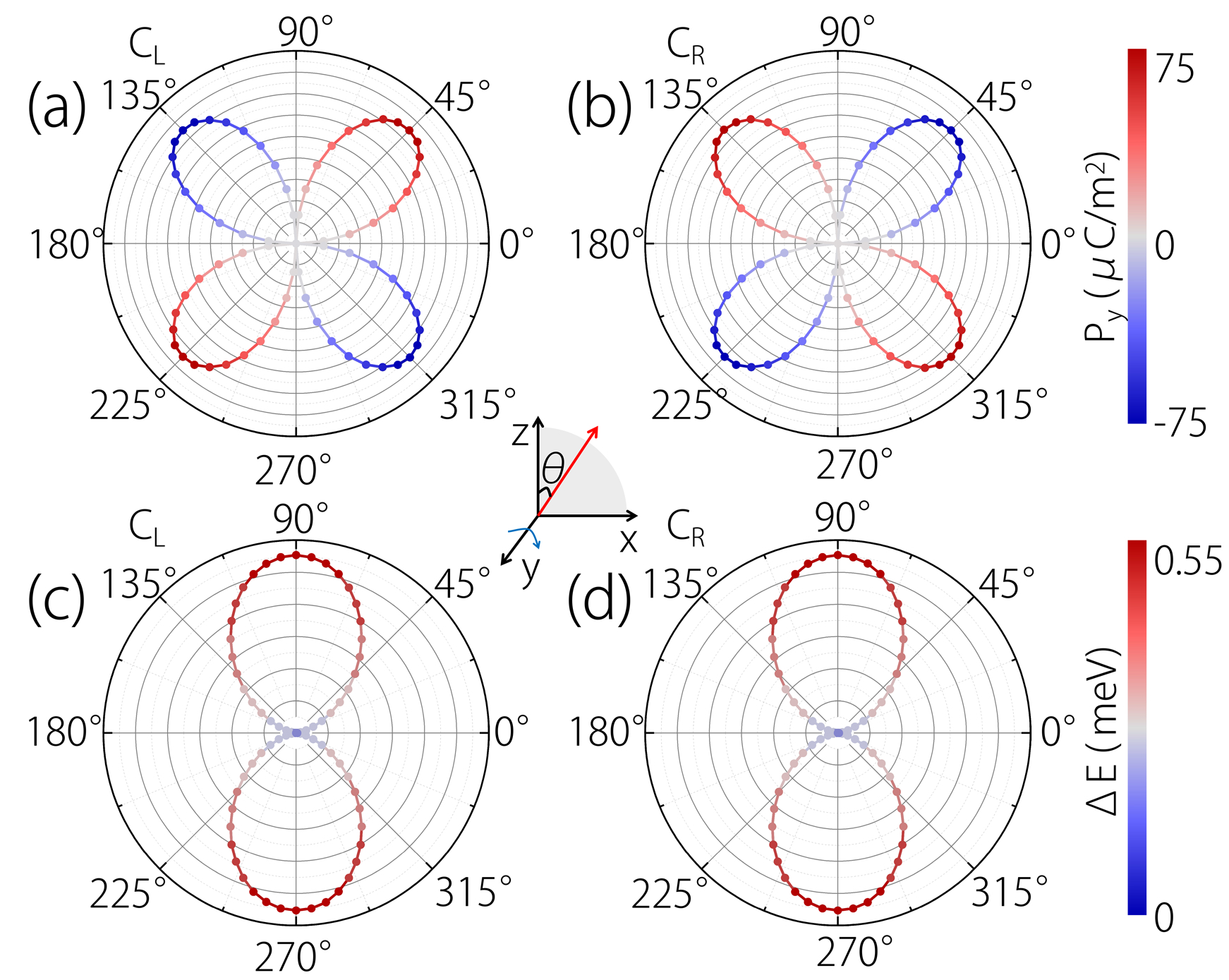
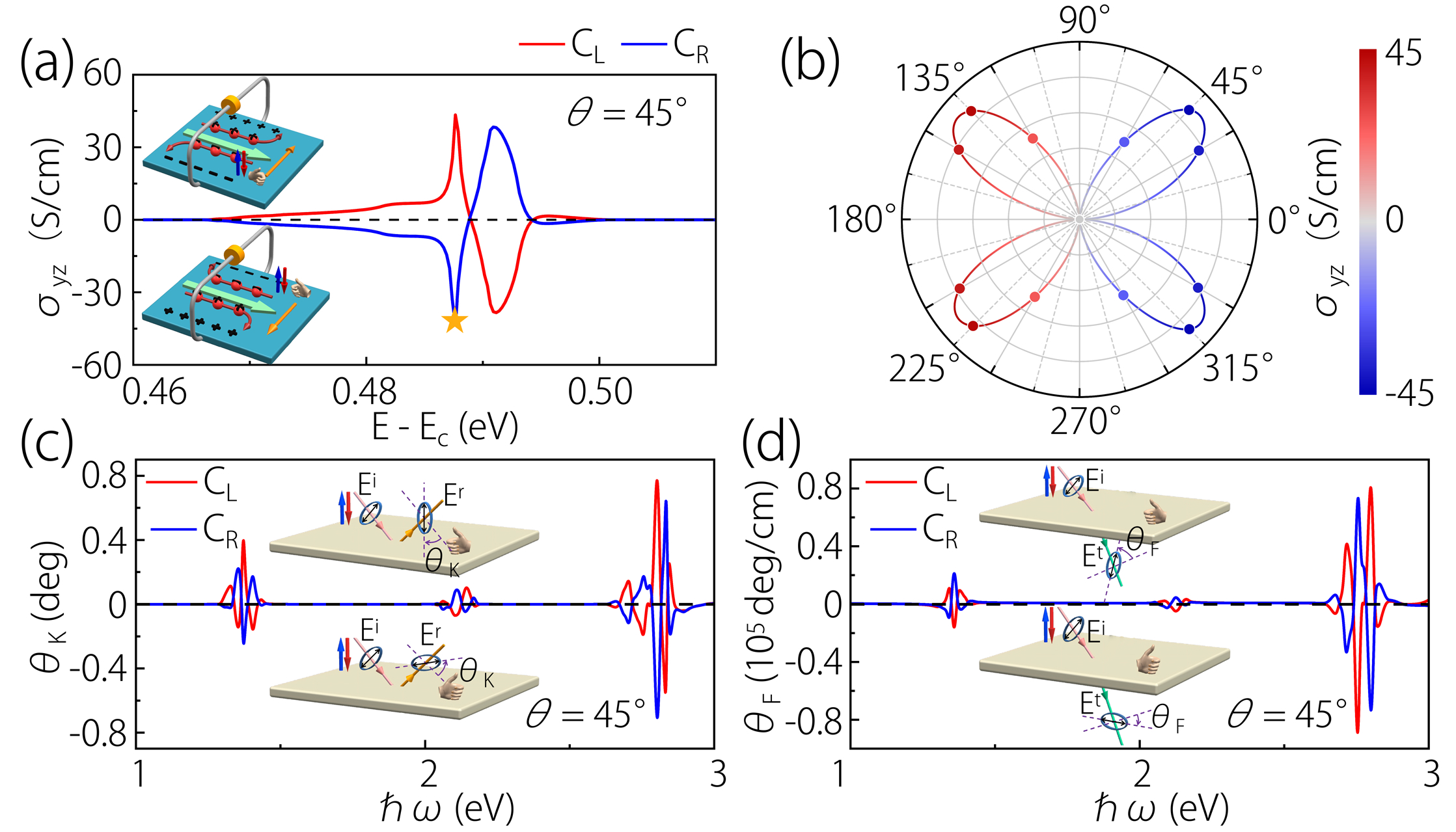
FIG. 4. P y as a function of the out-of-plane Néel-vector orientation θ within the zx plane (θ = 0 ◦ corresponds to the crystallographic [001] direction). (a,b) Results for the C L and C R enantiomers, respectively. (c,d) Energy difference ∆E as a function of θ for the C L and C R enantiomers, respectively, with θ = 0 ◦ corresponds to the ground state and is taken as the reference.
symmetry, under which P y is odd; therefore, they have equal magnitudes but opposite signs. By contrast, the states at θ and 180 ◦ + θ are related by time-reversal symmetry T , under which P y is even, and therefore carry the same polarization. In addition, opposite chiral enantiomers are related by T P symmetry, under which P y is odd, so they exhibit equal-magnitude but opposite-sign polarization for the same Néel-vector orientation.
π/4 + nπ/2, exceeding those reported for collinear antiferro-
and VX 2 (X = Cl, Br, I), whose values range from 12.2 to 2 64.8 µC/m 51 . Moreover, as the Néel vector rotates from 0 ◦ ◦ to 45 , P
y evolves from zero to its maximum value across a small energy barrier of only 0.259 meV [see Figures 4(c) and 4(d)], indicating that the polarization can be efficiently controlled through Néel-vector reorientation. Experimentally, the orientation of the Néel vector in AMs can be tuned by magnetic fields 52 . Recent experiments have demonstrated that 180 ◦ switching of the Néel vector can be achieved in AMs. Specifically, current-induced spin-orbit torque, assisted by a small magnetic field, has been shown to induce 180 ◦ switching of the Néel vector in Mn 5 Si 3 53 , with the anomalous Hall effect serving as a detection tool.
Electronic and optical probes of chiral magnetoelectric states—The same symmetry evolution that drives the magnetoelectric response also activates distinct electronic and optical signatures in K[Co(HCOO) 3 ], allowing the anomalous Hall and magneto-optical responses to serve as sensitive probes of the underlying chiral and Néel-vector states. When the Néel vector is aligned along the z axis, the magnetic point group is 6 ′ 22 ′ , which forbids all anomalous Hall conductivity FIG. 5. Dual sign-reversible anomalous transport properties in K[Co(HCOO) 3 ]. (a) Anomalous Hall conductivity σ yz for the C L and C R enantiomers. The Fermi levels E − E c are aligned with the conduction-band minimum. The star marks the representative peak energy at which the angular dependence in (b) is evaluated. (b) Angular dependence of σ yz as a function of the Néel-vector orientation θ within the zx plane. (c) Magneto-optical Kerr rotation angle θ K and (d) Faraday rotation angle θ F for the C L and C R enantiomers. In (a), (c), and (d), the Néel vector is oriented at θ = 45 ◦ within the zx plane.
components. For a generic Néel-vector orientation within the zx plane, however, the symmetry is reduced to the magnetic point group 2 ′ , under which both σ yz and σ xy are symmetry allowed. Therefore, the onset and sign evolution of these responses directly reflect the symmetry breaking induced by Néel-vector reorientation, providing effective readout channels for the switchable chiral magnetoelectric states.
To illustrate how these responses encode the underlying chiral and magnetic states, we consider the representative configuration at θ = 45 ◦ , for which the Hall response is symmetry allowed. Importantly, the two opposite chiral enantiomers are related by T P symmetry, under which the Hall response is odd. Therefore, opposite chiralities carry opposite σ yz for the same Néel-vector orientation, as shown in Figure 5(a). In this sense, the anomalous Hall response provides a direct electronic fingerprint of lattice chirality in the chiral altermagnetic regime.
Besides distinguishing opposite chiralities, the anomalous Hall response also serves as a sensitive probe of Néel-vector rotation within a fixed enantiomer. Its angular evolution is strictly dictated by symmetry (see Table S3 in the SI). The states at θ and 180 ◦ −θ are related by T C 2x , under which both the polarization and the Hall response are odd. They therefore form a pair of symmetry-related states with opposite polarization and opposite transport signals (σ yz ), but equal magnitudes, offering potential advantages for device applications such as nonvolatile binary-state encoding and robust electrical readout ? . Moreover, σ yz also reverses sign for the states at θ and 180 ◦ + θ due to the odd property of Hall effect under T symmetry. These symmetry relations fully determine the sign evolution of the transport responses during Néel-vector rotation in the zx plane, as summarized in Figure 5(b).
The same symmetry-governed sign reversal further extends from the dc anomalous Hall response to magneto-optical 5 probes in the ac regime (see Figure S4 in the SI), so that the Kerr and Faraday rotation angles also reverse sign between opposite enantiomers. As shown in Figures 5(c) and 5(d), both rotation angles exhibit mirrored spectral features for opposite chiralities, providing direct optical fingerprints of chirality-locked altermagnetic states. Quantitatively, the maximum Kerr and Faraday rotation angles in the 3D MOF K[Co(HCOO) 3 ] reach 0.77 deg and 0.89×10 5 deg/cm, respectively [see Figures 5(c) and 5(d)]. Notably, the Kerr rotation angle is comparable or even exceeds those of several representative traditional FMs, non-collinear AFMs, and AMs, including fcc Ni (∼0.15 deg) ? , Mn 3 Y (Y = Ge, Ga, Sn) (<
hcp Co (∼0.48 deg) ? , and RuO 2 (∼0.62 deg) 18 . These mirrored Kerr and Faraday spectra echo the sign-reversal behavior of the anomalous Hall response, confirming their common chiral origin. Together, the anomalous Hall and magnetooptical responses provide complementary electronic and optical probes of the coupled chirality and Néel-vector states in
Finally, we briefly discuss the experimental feasibility of preparing, switching, and probing the chiral magnetoelectric states in the 3D MOF K[Co(HCOO) 3 ] based on existing technologies. Selective chiral-domain growth (C L or C R enantiomer) can be achieved using the self-flux method with a chiral seed crystal, as demonstrated in the chiral topological semimetal PdGa 54 or driven in situ by circularly polarized light irradiation 55,56 . Once synthesized, chiral switching between the two enantiomers may be triggered by several established methods, such as photoexcitation-induced ligand rearrangements 57–61 , electron tunneling 62 , electric-field control 63 or temperature-driven phase inversion 64 . The resulting lattice chirality can be sensitively characterized by the x-ray diffraction with the Flack method 54 , circular photogalvanic effect 65,66 , or scanning transmission electron microscopy 67 . Our results further suggest that the anomalous Hall effect and magneto-optical effects provide two complementary probe channels for resolving both lattice chirality and Néel vector orientation in K[Co(HCOO) 3 ], through their characteristic sign-locking behavior for different enantiomers and magnetic states. These chirality- and Néel-vector-dependent signatures can therefore serve as effective electronic and optical readouts of the underlying chiral altermagnetic magnetoelectric states, complementing established probes of altermagnetic order such as spin- and angle-resolved photoemission spectroscopy 9,68 , as recently demonstrated by anomalous Hall effect and magneto-optical effects measurements in AMs RuO 2 , MnTe, CrSb, and FeS 14–16,22,23,69,70 . Remarkably, high-quality single crystals of MOF K[Co(HCOO) 3 ], encompassing both C L and C R enantiomers, have already been successfully synthesized 45 , providing an experimentally accessible platform for detecting these chirality- and Néel-vector-resolved probe signals in the altermagnetic regime. The feasibility of selective chiral-state preparation, reversible chirality tuning, and multi-channel electrical and optical detection highlights the experimental accessibility of chiral altermagnetic magnetoelectricity in K[Co(HCOO) 3 ] and points to a promising route toward chirality-programmable nonvolatile spintronic functionalities.
Conclusion—We theoretically uncover a previously unexplored form of chiral altermagnetic magnetoelectrics and, based on a general theoretical model, reveal a universal mechanism by which structural chirality and Néel-vector-driven polarization become intrinsically coupled in nonpolar altermagnetic systems. Using the 3D MOF K[Co(HCOO) 3 ] as a representative material platform, we further show that reorientation of the Néel vector induces a finite electric polarization in this otherwise nonpolar AM, while switching between opposite chiral enantiomers produces an additional sign reversal, thereby enabling dual-mode control of the magnetoelectric state by structural chirality and Néel-vector orientation. The coupled chiral and magnetic states further give rise to distinct electronic and optical probe signatures, including signreversible anomalous Hall and magneto-optical responses, which provide effective readout channels for both chirality and Néel-vector configurations. Crucially, high-quality single crystals of both left- and right-handed enantiomers of 3D MOF K[Co(HCOO) 3 ] have already been synthesized, and its antiferromagnetic order has been experimentally established, offering an experimentally accessible and tunable platform. Our work establishes K[Co(HCOO) 3 ] as a prototype chiral altermagnetic magnetoelectric and opens a promising route toward chirality- and Néel-vector-controlled magnetoelectric functionalities and probe schemes in altermagnetic materials.
Acknowledgments—This work is supported by the National Key R&D Program of China (Grant No. 2022YFA1402600), the Australian Research Council Discovery Early Career Researcher Award (Grant No. DE240100627), the Australian Research Council Discovery Project (Grant No. DP260102992), the National Natural Science Foundation of China (Grant No. 12304066, No. 12404073), the Hebei Natural Science Foundation (Grant No. A2024205006), and the Basic Research Program of Jiangsu (Grant No. BK20230684). We also acknowledge the computational resources from the National Computational Infrastructure (NCI), which were allocated from the National Computational Merit Allocation Scheme supported by the Australian Government.
[1] L. Šmejkal, J. Sinova, and T. Jungwirth, Beyond conventional
ferromagnetism and antiferromagnetism: A phase with nonrelativistic spin and crystal rotation symmetry, Phys. Rev. X 12, 031042 (2022). [2] L. Šmejkal, J. Sinova, and T. Jungwirth, Emerging research
landscape of altermagnetism, Phys. Rev. X 12, 040501 (2022).
[3] L. Bai, W. Feng, S. Liu, L. Šmejkal, Y. Mokrousov, and Y. Yao,
Altermagnetism: Exploring new frontiers in magnetism and spintronics, Adv. Funct. Mater. 34, 2409327 (2024). [4] C. Song, H. Bai, Z. Zhou, L. Han, H. Reichlova, J. H. Dil, J. Liu,
materials, Nat. Rev. Mater. 10, 473 (2025).
6 [5] H.-Y. Ma, M. Hu, N. Li, J. Liu, W. Yao, J.-F. Jia, and J. Liu,
Multifunctional antiferromagnetic materials with giant piezomagnetism and noncollinear spin current, Nat. Commun. 12, 2846 (2021). [6] R.-W. Zhang, C. Cui, R. Li, J. Duan, L. Li, Z.-M. Yu, and
Y. Yao, Predictable gate-field control of spin in altermagnets with spin-layer coupling, Phys. Rev. Lett. 133, 056401 (2024). [7] S. Lee, S. Lee, S. Jung, J. Jung, D. Kim, Y. Lee, B. Seok, J. Kim,
B. G. Park, L. Šmejkal, et al., Broken kramers degeneracy in altermagnetic MnTe, Phys. Rev. Lett. 132, 036702 (2024). [8] J. Ding, Z. Jiang, X. Chen, Z. Tao, Z. Liu, T. Li, J. Liu, J. Sun,
J. Cheng, J. Liu, et al., Large band splitting in g-wave altermagnet crsb, Phys. Rev. Lett. 133, 206401 (2024). [9] J. Krempaskỳ, L. Šmejkal, S. D’souza, M. Hajlaoui,
G. Springholz, K. Uhlı́řová, F. Alarab, P. Constantinou, V. Strocov, D. Usanov, et al., Altermagnetic lifting of kramers spin degeneracy, Nature 626, 517 (2024). [10] S. Reimers, L. Odenbreit, L. Šmejkal, V. N. Strocov, P. Con-
stantinou, A. B. Hellenes, R. Jaeschke Ubiergo, W. H. Campos,
altermagnetic band splitting in CrSb thin films, Nat. Commun. 15, 2116 (2024). [11] F. Zhang and Others, Crystal-symmetry-paired spin-valley
locking in a layered room-temperature metallic altermagnet candidate, arXiv (2025). [12] R. González-Hernández, L. Šmejkal, K. Vỳbornỳ, Y. Yahagi,
J. Sinova, T. Jungwirth, and J. ˇŽeleznỳ, Efficient electrical spin splitter based on nonrelativistic collinear antiferromagnetism, Phys. Rev. Lett. 126, 127701 (2021). [13] L. Šmejkal, R. González-Hernández, T. Jungwirth, and
J. Sinova, Crystal time-reversal symmetry breaking and spontaneous hall effect in collinear antiferromagnets, Sci. Adv. 6, eaaz8809 (2020). [14] Z. Feng, X. Zhou, L. Šmejkal, L. Wu, Z. Zhu, H. Guo,
R. González-Hernández, X. Wang, H. Yan, P. Qin, et al., An anomalous hall effect in altermagnetic ruthenium dioxide, Nat. Electron. 5, 735 (2022). [15] Z. Zhou, X. Cheng, M. Hu, R. Chu, H. Bai, L. Han, J. Liu,
F. Pan, and C. Song, Manipulation of the altermagnetic order in CrSb via crystal symmetry, Nature 638, 645 (2025). [16] R. Gonzalez Betancourt, J. Zubáč, R. Gonzalez-Hernandez,
K. Geishendorf, Z. Šobáň, G. Springholz, K. Olejnı́k,
lous hall effect arising from an unconventional compensated magnetic phase in a semiconductor, Phys. Rev. Lett. 130, 036702 (2023). [17] X. Zhou, W. Feng, R.-W. Zhang, L. Šmejkal, J. Sinova,
Y. Mokrousov, and Y. Yao, Crystal thermal transport in altermagnetic RuO 2 , Phys. Rev. Lett. 132, 056701 (2024). [18] X. Zhou, W. Feng, X. Yang, G.-Y. Guo, and Y. Yao, Crystal
chirality magneto-optical effects in collinear antiferromagnets, Phys. Rev. B 104, 024401 (2021). [19] W. Sun, C. Yang, W. Wang, Y. Liu, X. Wang, S. Huang, and
Z. Cheng, Proposing altermagnetic-ferroelectric type-iii multiferroics with robust magnetoelectric coupling, Adv. Mater. , 2502575 (2025). [20] W. Chen, X. Zhou, W.-K. Lou, and K. Chang, Magneto-optical
conductivity and circular dichroism in d-wave altermagnets, Phys. Rev. B 111, 064428 (2025). [21] C. Xinfeng, D. Ning, P. Barone, C. Rizza, S. Dong,
ventional magnetism, sliding ferroelectricity, and magnetooptical kerr effects in a multiferroic bilayer, arXiv:2507.06638 10.48550/arXiv.2507.06638 (2025).
[22] A. Hariki, A. Dal Din, O. Amin, T. Yamaguchi, A. Badura,
D. Kriegner, K. Edmonds, R. Campion, P. Wadley, D. Backes, et al., X-ray magnetic circular dichroism in altermagnetic α- mnte, Phys. Rev. Lett. 132, 176701 (2024). [23] O. Fedchenko, J. Minár, A. Akashdeep, S. W. D’Souza, D. Vasi-
lyev, O. Tkach, L. Odenbreit, Q. Nguyen, D. Kutnyakhov, N. Wind, et al., Observation of time-reversal symmetry breaking in the band structure of altermagnetic RuO 2 , Sci. Adv. 10, eadj4883 (2024). [24] M. Nespolo, M. I. Aroyo, and B. Souvignier, Crystallographic
shelves: space-group hierarchy explained, J. Appl. Crystallogr. 51, 1481 (2018). [25] Y. Zhang, Y. Sun, H. Yang, J. ˇŽeleznỳ, S. P. Parkin, C. Felser,
and B. Yan, Strong anisotropic anomalous hall effect and spin hall effect in the chiral antiferromagnetic compounds Mn 3 X
(2017). [26] N. J. Ghimire, A. Botana, J. Jiang, J. Zhang, Y.-S. Chen, and
J. Mitchell, Large anomalous hall effect in the chiral-lattice antiferromagnet CoNb 3 S 6 , Nat. Commun. 9, 3280 (2018). [27] Y. Fujishiro, N. Kanazawa, R. Kurihara, H. Ishizuka, T. Hori,
F. S. Yasin, X. Yu, A. Tsukazaki, M. Ichikawa, M. Kawasaki, et al., Giant anomalous hall effect from spin-chirality scattering in a chiral magnet, Nat. Commun. 12, 317 (2021). [28] X. Zhou, W. Feng, Y. Li, and Y. Yao, Spin-chirality-driven
quantum anomalous and quantum topological hall effects in chiral magnets, Nano Lett. 23, 5680 (2023). [29] K. Konishi, M. Nomura, N. Kumagai, S. Iwamoto, Y. Arakawa,
and M. Kuwata-Gonokami, Circularly polarized light emission from semiconductor planar chiral nanostructures, Phys. Rev. Lett. 106, 057402 (2011). [30] S. Jiang and N. A. Kotov, Circular polarized light emission
in chiral inorganic nanomaterials, Adv. Mater. 35, 2108431 (2023). [31] J. Crassous, M. J. Fuchter, D. E. Freedman, N. A. Kotov,
J. Moon, M. C. Beard, and S. Feldmann, Materials for chiral light control, Nat. Rev. Mater. 8, 365 (2023). [32] S. W. Im, H.-Y. Ahn, R. M. Kim, N. H. Cho, H. Kim, Y.-C.
Lim, H.-E. Lee, and K. T. Nam, Chiral surface and geometry of metal nanocrystals, Adv. Mater. 32, 1905758 (2020). [33] Q. Yang, G. Li, K. Manna, F. Fan, C. Felser, and Y. Sun, Topo-
logical engineering of pt-group-metal-based chiral crystals toward high-efficiency hydrogen evolution catalysts, Adv. Mater. 32, 1908518 (2020). [34] X. Wang, Q. Yang, S. Singh, H. Borrmann, V. Hasse, C. Yi,
Y. Li, M. Schmidt, X. Li, G. H. Fecher, et al., Topological semimetals with intrinsic chirality as spin-controlling electrocatalysts for the oxygen evolution reaction, Nat. Energy 10, 101 (2025). [35] H. Zheng, A. Ghosh, M. Swamynadhan, Q. Zhang, W. P. Wong,
Z. Wu, R. Zhang, J. Chen, F. Cimpoesu, S. Ghosh, et al., Chiral multiferroicity in two-dimensional hybrid organic-inorganic perovskites, Nat. Commun. 15, 5556 (2024). [36] W. Sun, W. Wang, C. Yang, R. Hu, S. Yan, S. Huang, and
Z. Cheng, Altermagnetism induced by sliding ferroelectricity via lattice symmetry-mediated magnetoelectric coupling, Nano Lett. 24, 11179 (2024). [37] W. Sun, W. Wang, C. Yang, S. Huang, N. Ding, S. Dong, and
Z. Cheng, Designing spin symmetry for altermagnetism with strong magnetoelectric coupling, Adv. Sci. , e03235 (2025). [38] X. Duan, J. Zhang, Z. Zhu, Y. Liu, Z. Zhang, I. ˇŽutić, and
T. Zhou, Antiferroelectric altermagnets: Antiferroelectricity alters magnets, Phys. Rev. Lett. 134, 106801 (2025). [39] Y. Zhu, M. Gu, Y. Liu, X. Chen, Y. Li, S. Du, and Q. Liu, 7 Sliding ferroelectric control of unconventional magnetism in stacked bilayers, Phys. Rev. Lett. 135, 056801 (2025). [40] M. Gu, Y. Liu, H. Zhu, K. Yananose, X. Chen, Y. Hu,
A. Stroppa, and Q. Liu, Ferroelectric switchable altermagnetism, Phys. Rev. Lett. 134, 106802 (2025). [41] Z. Zhu, X. Duan, J. Zhang, B. Hao, I. Zutic, and T. Zhou, Two-
dimensional ferroelectric altermagnets: From model to material realization, Nano Letters , 9456–9462 (2025). [42] X. Tu, D. Wang, H. Zhou, S. Yan, H. Liu, H. Xiang, and
in all point groups, Phys. Rev. Lett. 136, 046802 (2026). [43] Y. Zhang, L. Yu, Y. Tong, Y. Sun, X. Li, H. J. Zhao, and
Y. Ma, Spin orientation driven polarization in collinear magnets, arXiv:2512.10323 10.48550/arXiv.2512.10323 (2025). [44] W.-T. Guo, J. Xu, Y. Yang, H. Wang, and H. Zhang, Altermag-
netic type-ii multiferroics with néel-order-locked electric polarization, arXiv:2505.01964 10.48550/arXiv.2505.01964 (2025). [45] Z. Duan, Z. Wang, and S. Gao, Irreversible transformation of
chiral to achiral polymorph of K[Co (HCOO) 3 ]: synthesis, structures, and magnetic properties, Dalton Trans. 40, 4465 (2011). [46] K. Anzenhofer, J. Van Den Berg, P. Cossee, and J. Helle, The
crystal structure and magnetic susceptibilities of MnNb 3 S 6 , FeNb 3 S 6 , CoNb 3 S 6 and NiNb 3 S 6 , J. Phys. Chem. Solids 31, 1057 (1970). [47] S. Parkin and R. Friend, 3 d transition-metal intercalates of the
niobium and tantalum dichalcogenides. i. magnetic properties, Philosophical Magazine B 41, 65 (1980). [48] S. Parkin, E. Marseglia, and P. Brown, Magnetic structure of
Co 1/3 NbS 2 and Co 1/3 TaS 2 , J. Phys. C: Solid State Phys. 16, 2765 (1983). [49] H. Takagi, R. Takagi, S. Minami, T. Nomoto, K. Ohishi, M.-T.
Suzuki, Y. Yanagi, M. Hirayama, N. Khanh, K. Karube, et al., Spontaneous topological hall effect induced by non-coplanar antiferromagnetic order in intercalated van der waals materials, Nat. Phys. 19, 961 (2023). [50] H. Zhu, J. Li, X. Chen, Y. Yu, and Q. Liu, Magnetic geome-
try induced quantum geometry and nonlinear transports, Nat. Commun. 16, 4882 (2025). [51] C. Liu, W. Ren, and S. Picozzi, Spin-chirality-driven multi-
ferroicity in van der waals monolayers, Phys. Rev. Lett. 132, 086802 (2024). [52] C. Song, H. Bai, Z. Zhou, L. Han, H. Reichlova, J. H. Dil, J. Liu,
materials, Nat. Rev. Mater. 10, 473 (2025). [53] L. Han, X. Fu, R. Peng, X. Cheng, J. Dai, Y. Li, Y. Zhang,
W. Zhu, H. Bai, et al., Electrical 180 switching of néel vector in spin-splitting antiferromagnet, Sci. Adv. 10, eadn0479 (2024). [54] N. B. Schröter, S. Stolz, K. Manna, F. De Juan, M. G. Vergniory,
J. A. Krieger, T. Schmitt, P. Dudin, T. K. Kim, et al., Observation and control of maximal chern numbers in a chiral topological semimetal, Science 369, 179 (2020). [55] N. P. Huck, W. F. Jager, B. De Lange, and B. L. Feringa, Dy-
namic control and amplification of molecular chirality by circular polarized light, Science 273, 1686 (1996). [56] J. Yeom, B. Yeom, H. Chan, K. W. Smith, S. Dominguez-
Medina, J. H. Bahng, G. Zhao, W.-S. Chang, S.-J. Chang, A. Chuvilin, et al., Chiral templating of self-assembling nanostructures by circularly polarized light, Nat. Mater. 14, 66 (2015). [57] K. Murata, M. Aoki, T. Suzuki, T. Harada, H. Kawabata, T. Ko-
mori, F. Ohseto, K. Ueda, and S. Shinkai, Thermal and light control of the sol-gel phase transition in cholesterol-based organic gels. novel helical aggregation modes as detected by circular dichroism and electron microscopic observation, J. Am. Chem. Soc. 116, 6664 (1994). [58] N. Koumura, R. W. Zijlstra, R. A. van Delden, N. Harada, and
B. L. Feringa, Light-driven monodirectional molecular rotor, Nature 401, 152 (1999). [59] J. J. de Jong, L. N. Lucas, R. M. Kellogg, J. H. van Esch, and
B. L. Feringa, Reversible optical transcription of supramolecular chirality into molecular chirality, Science 304, 278 (2004). [60] K. Ikeda, W. Liu, Y. Ron Shen, H. Uekusa, Y. Ohashi, and S.-y.
Koshihara, Photo-induced chirality switching in a cobaloxime complex crystal, J. Chem. Phys. 122, 141103 (2005). [61] S. Zhang, J. Zhou, Y.-S. Park, J. Rho, R. Singh, S. Nam, A. K.
Azad, H.-T. Chen, X. Yin, A. J. Taylor, et al., Photoinduced handedness switching in terahertz chiral metamolecules, Nat. Commun. 3, 942 (2012). [62] V. Simic-Milosevic, J. Meyer, and K. Morgenstern, Chirality
change of chloronitrobenzene on Au (111) induced by inelastic electron tunneling, Angew. Chem. Int. Ed. 48, 4061 (2009). [63] R. Amaranatha Reddy, M. W. Schröder, M. Bodyagin,
H. Kresse, S. Diele, G. Pelzl, and W. Weissflog, Field-induced switching of chirality in undulated ferroelectric and antiferroelectric smcp phases formed by bent-core mesogens, Angew. Chem. Int. Ed. 44, 774 (2005). [64] T. Hasegawa, K. Morino, Y. Tanaka, H. Katagiri, Y. Furusho,
and E. Yashima, Temperature-driven switching of helical chirality of poly [(4-carboxyphenyl) acetylene] induced by a single amidine enantiomer and memory of the diastereomeric macromolecular helicity, Macromolecules 39, 482 (2006). [65] Y. Yang, R. C. Da Costa, M. J. Fuchter, and A. J. Campbell,
Circularly polarized light detection by a chiral organic semiconductor transistor, Nat. Photonics 7, 634 (2013). [66] Z.-J. Cheng, M. S. Hossain, Q. Zhang, S. Shao, J. Liu, Y. Zhao,
M. Yahyavi, Y.-X. Jiang, J.-X. Yin, X. Yang, et al., Broken symmetries associated with a kagome chiral charge order, Nat. Commun. 16, 3782 (2025). [67] Z. Dong and Y. Ma, Atomic-level handedness determination of
chiral crystals using aberration-corrected scanning transmission electron microscopy, Nat. Commun. 11, 1588 (2020). [68] Y.-P. Zhu, X. Chen, X.-R. Liu, Y. Liu, P. Liu, H. Zha, G. Qu,
splitting in a noncoplanar antiferromagnet, Nature 626, 523 (2024). [69] R. Takagi, R. Hirakida, Y. Settai, R. Oiwa, H. Takagi, A. Ki-
taori, K. Yamauchi, H. Inoue, J.-i. Yamaura, D. NishioHamane, et al., Spontaneous hall effect induced by collinear antiferromagnetic order at room temperature, Nat. Mater. 24, 63 (2025). [70] M. Weber, S. Wust, L. Haag, A. Akashdeep, K. Leckron,
All optical excitation of spin polarization in d-wave altermagnets, arXiv:2408.05187 10.48550/arXiv.2408.05187 (2024).