⬇ Download Markdown · ⬇ Download LaTeX · ⬇ original · view original · CSV: table 1, table 2, table 3, table 4, table 5
Yi Jiang, 1, 2, 3, ∗ Ziyin Song, 1, 2, ∗ Tiannian Zhu, 1, 2 Zhong Fang, 1 Hongming Weng, 1, 4 Zheng-Xin Liu, 5, † Jian Yang, 1, ‡ and Chen Fang 1, 4, 6, §
1 Beijing National Laboratory for Condensed Matter Physics, and Institute of Physics, Chinese Academy of Sciences, Beijing 100190, China
2 University of Chinese Academy of Sciences, Beijing 100049, China
3 Donostia International Physics Center (DIPC), Paseo Manuel de Lardizábal. 20018, San Sebastián, Spain 4 Songshan Lake Materials Laboratory, Dongguan, Guangdong 523808, China
5 Department of physics, Renmin University, Beijing 100876, China 6 Kavli Institute for Theoretical Sciences, Chinese Academy of Sciences, Beijing 100190, China
(Dated: September 2, 2024)
Symmetries of three-dimensional periodic scalar fields are described by 230 space groups (SGs). Symmetries of three-dimensional periodic (pseudo-) vector fields, however, are described by the spinspace groups (SSGs), which were initially used to describe the symmetries of magnetic orders. In SSGs, the real-space and spin degrees of freedom are unlocked in the sense that an operation could have different spacial and spin rotations. SSGs give a complete symmetry description of magnetic structures, and have natural applications in the band theory of itinerary electrons in magnetically ordered systems with weak spin-orbit coupling. Altermagnetism, a concept raised recently that belongs to the symmetry-compensated collinear magnetic orders but has non-relativistic spin splitting, is well described by SSGs. Due to the vast number and complicated group structures, SSGs have not yet been systematically enumerated. In this work, we exhaust SSGs based on the invariant subgroups of SGs, with spin operations constructed from three-dimensional (3D) real representations of the quotient groups for the invariant subgroups. For collinear and coplanar magnetic orders, the spin operations can be reduced into lower dimensional real representations. As the number of SSGs is infinite, we only consider SSGs that describe magnetic unit cells up to 12 times crystal unit cells. We obtain 157,289 non-coplanar, 24,788 coplanar-non-collinear, and 1,421 collinear SSGs. The enumerated SSGs are stored in an online database at https://cmpdc.iphy.ac.cn/ssg with a user-friendly interface. We develop an algorithm to identify SSGs for realistic materials and find SSGs for 1,626 magnetic materials. We also discuss several potential applications of SSGs, including the representation theory, topological states protected by SSGs, structures of spin textures, and refinement of magnetic neutron diffraction patterns using SSGs. Our results serve as a solid starting point for further studies of symmetry and topology in magnetically ordered materials.
4 4 5
D. 3D real representations of the quotient
group 7 7 7 8 ∗ These authors contributed equally to this study.
8 8
groups
crystallographic point groups
9 9 9 10 10
11 11 13
14 14 15 15 10 2 SSG 16
with SSG 20
| Acknowledgments | 23 |
|---|---|
| References | 23 |
| S1. Modular linear equations | 27 |
| S2. Finding isomorphisms between finite groups | 27 |
| S3. Isomorphic point groups | 28 |
| S4. Automorphism group of space groups | 28 |
| S5. Details in finding inequivalent supercells, | |
| subgroups, and 3D real representations | 29 |
| S6. Quotient groups isomorphic to abstract point | |
| groups | 30 |
| S7. Proof of the direct product group structure of | |
| spin-only groups | 34 |
| S8. Band representations of Mn3 Sn | 34 |
| S9. Comparison of notations in two related works | 35 |
| S10. SSG online Database | 36 |
| S11. Identifying SSG for magnetic materials | 36 |
magnetic materials 38
Crystallography is a long-lived and vibrant field that studies the symmetries of crystalline materials. With the help of group theory, the symmetries of three-dimensional (3D) crystals are classified into 230 space groups (SGs)[1, 2] when combining the translational symmetries with 32 3D crystallographic point groups (PGs). Theoretically, SGs describe the symmetries of any 3D periodic scalar fields, such as the crystal potential field V (r).
Magnetism is another century-old realm, where magnetic materials are classified according to their various magnetic orders including ferromagnetic (FM), ferrimagnetic, anti-ferromagnetic (AFM), spiral magnetic, and even more complicated orders. In magnetic materials, the magnetic moments arrange into periodic 3D pseudovector fields in the spin space on top of the crystals formed by atoms in real space. The pseudo-vector field is of even parity under space inversion P and is odd under the time-reversal symmetry (TRS) T .
Historically, by combining TRS with 230 SGs, 1651 (double) Shubnikov magnetic space groups (MSGs)[2–8] were introduced in order to describe the symmetries of magnetic materials. Shubnikov MSGs are classified into four types. The 230 Type-II Shubnikov SGs describe non-magnetic materials while the rest 1421 of type-I, III, and IV describe magnetic ones. In Shubnikov MSGs, the rotations of the magnetic moments are locked with the lattice operations. For instance, a C 4z symmetry operation stands for a π 2 rotation of the lattice along the z-axis together with the rotation of the magnetic moments for the same angle π 2 along the z-direction. In later discussion, we will call the actions on the magnetic order as “spin operations”.
MSGs, although widely used, fail to give a complete description of the symmetries of the magnetic moment fields. This is because there also exist symmetry operations that have unlocked real-space and spin rotations. Such enlarged groups were introduced as spinspace groups (SSGs)[9, 10], which are the natural generalizations of Shubnikov MSGs and contain Shubnikov MSGs as a subset. For instance, a real-space C 4z rotation may accompany a C 2z spin rotation. In Fig.1, we illustrate the difference between SGs, MSGs, and SSGs. In Fig.1(a), we show an atomic configuration generated by a C 4 rotation, leading to a C 4 -symmetric crystal field V (r). In Fig.1(b), a C 4 -symmetric magnetic order is added to the atoms. We use the notation {R s ||R l } to denote an operation with space rotation R l (the space translation part omitted for simplicity) and spin rotation R s . The MSG symmetry {C 4 ||C 4 } is used to describe the symmetry of the magnetic moment field M(r) in Fig.1(b). In Fig.1(c), a different magnetic order is shown, where the C 4 -related atoms have C 2 -rotated spin orientations, characterized by an SSG symmetry {C 2 ||C 4 }, lying out of the scope of MSGs. This example demonstrates the incompleteness of MSGs in describing the symmetry of magnetic orders, and the necessity for introducing SSGs.
SGs, Shubnikov MSGs, and SSGs also have important applications in describing the symmetries of electronic structures. Non-magnetic periodic electronic structures p̂ 2 characterized by a single-particle Hamiltonian Ĥ =
2m + V (r) have their crystal potential field V (r) respecting certain spacial symmetries, which form a (single) SG. The spin degree of freedom can be introduced in the Hamiltonain when the spin-orbit coupling (SOC) is present, i.e., a third term 2m 1 2 c 2 ∇V (r) × p̂ · ŝ is added to the 3
Space group Magnetic space group Spin-space group (a) (b) (c)
FIG. 1. Illustration of space groups (SGs), magnetic space groups (MSGs), and spin-space groups (SSGs). (a) A C 4 - symmetric atomic configuration, generated by the SG operation C 4 . (b) A magnetic order generated by the MSG operation {C 4 ||C 4 }, where the real-space C 4 is accompanied by the same C 4 spin rotation. The notation {R s ||R l } denotes an operation with space rotation R l and spin rotation R s . (c) A magnetic order generated by the SSG operation {C 2 ||C 4 }, where the C 4 lattice rotation is accompanied by a C 2 spin rotation. MSGs, in which the spin and lattice rotation are locked, fail to give a complete symmetry description of this magnetic order.
Hamiltonian, where ŝ is the electron-spin operator. The symmetries of the (non-magnetic) spinful Hamiltonians are described by double SGs together with the TRS, i.e., type-II (double) MSGs. The SOC term locks the spacial symmetries with the corresponding spin rotations in double MSGs. Only the lattice rotations associated with corresponding spin rotations are symmetries of the Hamiltonian. When the system is magnetically ordered, an effective “Zeeman term” M(r) · ŝ is generated. The effective Zeeman field may come from the mean-field decoupling of the electron interaction in the spin channel, where M(r) is the static mean-field representing the magnetization, like in the spin-density-wave state. Alternatively, this Hamiltonian also describes the motion of an electron in the background of ordered, static magnetic moments, like in the Kondo lattice. The classifications of gapped topological states and unconventional quasiparticles protected by SGs[11–26] and MSGs[27–46] have been widely studied.
However, for itinerant electrons coming from light atoms or low angular momentum orbitals in magnetic materials, the SOC term is usually negligible or much smaller compared with the effective Zeeman term. Such systems are characterized by the single-particle Hamiltonian[47, 48]
In these systems, the spin rotations are not necessarily always locked with lattice rotations due to the absence of the SOC, and the system may contain pure lattice rotation symmetries, pure spin rotation symmetries, and general symmetries with different lattice and spin rotations. Once the spin and the lattice operations are (partially) unlocked, the symmetries of the Hamiltonian form SSGs. Hence, spin-space groups not only describe the symmetries of magnetic structures, but also apply to electrons in magnetically ordered material having weak spin-orbit coupling, and magnon Hamiltonian of spin systems[49] with weak Dzyaloshinskii-Moriya interactions.
It is worth mentioning that, SSG can always be used to describe the symmetries of the magnetic structure of a material, regardless of whether SOC is strong or not in the material. When SOC is non-negligible, the electronic structure of the material cannot be described by the SSG, and only MSG symmetries can be used. Nonetheless, SSG symmetries could serve as approximate symmetries for systems where SOC is weak or much smaller compared with the effective Zeeman term.
In 1977, Litvin tabulated 598 non-coplanar spin-point groups (SPGs)[50]. Very recently, 252 SPGs for coplanar and 90 SPGs for collinear magnetic orders have been listed[48]. A new concept, altermagnetism, has also been raised recently by the authors in Ref.[51–53], which describes a special type of collinear symmetry-compensated magnetic order that has non-relativistic spin splitting or spin splitting with negligible SOC [54, 55] in the Brillouin zone (BZ), breaking the Kramers degeneracy. The authors distinguished altermagnetic and AFM orders from symmetries using spin Laue point groups which are unlocked with the lattice point-group operations[51]. Therefore, altermagnetic materials[56–68] are naturally applicable systems of SSGs. An increasing number of experimental and theoretical studies on magnetic materials with weak SOC, among which many adopted the concept of SSGs, have been performed, including Mn 5 Si 3 [56], RuO 2 [57–62], MnTe[63, 64], MnTe 2 [69], CoNb 3 S 6 [70, 71], and the so-called “low-Z” antiferromagnetic compounds[72], together with many new quasiparticle types[47, 48, 70, 71, 73, 74] being theoretically predicted, which can only be realized in SSGs.
Despite the wide applications of SSGs, the systematic enumeration of SSGs is mathematically incomplete as of today. Compared with spin-point groups, the enumeration of SSGs has the following difficulties: (i) The number of symmetry operations in an SSG is infinite due to the translation group. (ii) The number of SSGs is infinite as the size of the magnetic unit cell could be arbitrary times of the original crystal unit cell, and even incommensurate magnetic orders exist. (iii) The spin rotations in SSGs could be non-crystallographic, such as a C n rotation with arbitrary integer n. These difficulties hinder the enumeration of SSGs in literature.
In this work, we enumerate SSGs systematically in order to give a complete symmetry description of all magnetic orders. We first exhaust invariant subgroups of 230 SGs and then compute the corresponding quotient groups that are isomorphic to point groups. The SSGs are constructed by assigning the 3D real representations of point 4 groups as spin rotations to quotient group operations. 2D
and an SSG operation {U ||R|τ } acts on M(r) as
To understand the group structure of SSG G (S) defined in Eq. (8), it is convenient to introduce four key groups associated with G (S) [10]: (i) the group G formed by the lattice parts {R|τ }; (ii) the group S formed by the spin parts {U }; (iii) the group H formed by pure-lattice symmetry operations {E||R|τ } ∈ G (S) ; (iv) the group S 0 formed by pure-spin symmetry operations {U ||E|0} ∈ G (S) , which is called the ‘spin-only group’ 5 (If U is an improper rotation with det U = −1, then
it acts non-trivially on the lattice wave vector. In this case, we still call {U ||T |0} a ‘spin-only’ operation). From these definitions, it follows immediately that: (a) both G and H are SGs; (b) H is an invariant subgroup of G, i.e., H ◁ G; (c) S 0 is an invariant subgroup of S, i.e., S 0 ◁ S. According to the isomorphism theorem[10](or the Goursat’s lemma[80]), the following quotient groups are isomorphic:
For non-magnetic systems, the spin-only group S 0 = O(3), while for non-trivial magnetic orders, the pure-spin symmetries in S 0 can only appear in two special types of magnetic orders[10]:
• Collinear magnetic orders, where M(r) =
(0, 0, M z (r)) are set along z-direction without loss of generality. In this case, the spin-only group
where C θ denotes the rotation with an arbitrary angle θ along the z-axis, and M x the mirror normal to the x-axis. M x C θ generates all mirrors with mirror planes passing the z-axis. Note that M x , being improper, actually denotes the anti-unitary
C θ rota2 group formed by the pure 2
• Coplanar magnetic orders, where M(r) =
(M x (r), M y (r), 0) are set to lie on the z = 0 plane without loss of generality. In this case,
where M z denotes the mirror along z-axis. When an SSG G (S) has a non-trivial spin-only group S 0 , G (S) can always be decomposed into a direct product group by properly choosing group element, i.e.,
where G = G /S 0 is ‘spin-only-free’ and is still an SSG. In Supplementary Material section S7, we give rigorous proof for the direct product group structure. For collinear and coplanar magnetic orders, the spinoperations in G (S)′ can only form uni-axial point groups, but not polyhedral point groups including T, T h , T d , O, and O h [48], as the spin-only group S 0 must be an invariant subgroup of G (S) .
We remark that one can also define 1651 single Shubnikov MSGs, where each operation only has a real-space part (combined with the TRS) but no spin part. Single Shubnikov MSGs are isomorphic to certain SSGs, as trivial spin rotations can be assigned to each spacial operation.
(S)′ (S)
In this work, we first construct SSGs with trivial spinonly groups S 0 = {E} which describe the symmetries of general magnetic orders. For collinear and coplanar magnetic orders, the spin-only group S 0 has group structures shown in Eq. (12, 13) with the whole SSG being a direct product group of Eq. (14), and we construct the ′ ‘spin-only-free’ groups G (S) for them.
To construct SSGs, first notice that the pure-lattice symmetries in an SSG G (S) , i.e.,
form an invariant subgroup of G (S) . The quotient group Q = G/H is a finite group and must be isomorphic to a subgroup of O(3), i.e., a point group. By assuming the spin-only group S 0 is trivial, Q is isomorphic to the group formed by spin rotations:
This relation gives insight into how to construct SSGs, as shown in the following.
For a given SG G with translation group T and PG P , assume H ◁ G is an invariant subgroup of G, with T H ◁ T
The elements of Q = G/H are generated from the set products of Q T and Q P , where the rotations from Q P have to recover their possible fractional translation parts τ in non-symmorphic G. As Q T is an invariant subgroup of Q, the following short exact sequence holds:
where i maps Q T to Q, and π is surjection of Q onto Q P , which induces an isomorphism
namely Q is a group extension of Q T by Q P . If Q P is also a subgroup of Q (which is not always the case), the group extension becomes a semi-direct product Q = Q T ⋊ Q P .
Choose the representatives of the cosets in G with re-
t α = τ α + R n is the original translation part τ α associated with R α plus a possible lattice translation. Assume Q has a 3D real representation D, with representation matrix D(q α ) = U α ∈ O(3). Then an SSG G (S) is constructed by
where U α denotes the rotation in spin space, and operations in H are assigned with trivial spin rotations. The algorithm is schematically illustrated in Fig. 2.
6 Step 2
Input Step 1 A space group Find an invariant
subgroup H of , with and Compute translation quotient group Step 3 Step 4 Output
Identify quotient group Find a 3D real representation of Q Construct spin-space group
Compute point quotient group FIG. 2. Flowchart of the algorithm for constructing spin-space groups. We use {R α |t α } to represent operations in the quotient group Q, where the translation part t α = τ α + R n is the original translation part τ α associated with R α in G plus a possible lattice translation. For collinear (coplanar) SSGs, 1D (2D) real representations are used.
For magnetic orders with non-trivial spin-only group S 0 , the general construction in Eq. (18) is applicable but the existence of spin-only groups leads to additional equivalence relations between SSGs, and the construction of their corresponding SSGs can be simplified.
In the enumeration of SSGs, the involvement of a nontrivial spin-only group S 0 effectively reduces the dimensionality of the spin space to be considered due to the imposed equivalence relations. For the three types of SSGs that have non-trivial S 0 , i.e., the non-magnetic, collinear, and coplanar, this dimensionality reduction allows us to focus solely on 0D, 1D, and 2D representations, respectively. As a result, this refinement in the enumeration process simplifies the procedure by limiting it to lower-dimensional representations, thereby reducing the breadth of groups that necessitate consideration.
tains only pure-lattice operations as spin operations can be absorbed into S 0 , and is thus equivalent to one of the SG G, hence G (S) = G × S 0 . Thus there are 230 inequivalent SSGs for non-magnetic orders, i.e., 230 SGs. Mathematically, the trivial real-representation is used to construct all spin operations in Eq. (18), i.e., U α ≡ E.
For collinear magnetic orders with M(r) = (0, 0, M z (r)), we have S 0 ∼ = O(2). There are two possibilities for the group G (S) , namely G (S) ∼ = O(2) or
with two trivial representations (s.t U α ∈ O(3)). The SSGs for collinear magnetic orders can be further classified into three types
collinear SSGs. These SSGs describe FM orders with spin splitting.
′ G (S) = H + {T ||T |0, 0, 1}H). In this case, one also
G (S) ), which leads to spin degeneracy over BZ. These SSGs describe conventional AFM with nonrelativistic spin degeneracy.
(1) If R = P is the real-space inversion, then there
exist a combined spatial inversion and time reversal symmetry PT which leads to spin degeneracy (both non-relativistic and relativistic) in the whole BZ. These SSGs also describe conventional AFM orders.
(2) If R is not the real-space inversion, then
there is no symmetry that can protect spin degeneracy over the whole BZ. These SSGs describe the so-called “altermagnetism”[51– 53] that differ from the conventional collinear AFM orders by the non-relativistic spin splitting together with many other differences in transport properties.
For coplanar magnetic orders with M(r) =
axis x), C n , C nv (main axis z) respectively. The opera′ tions in the spin-only-free group G (S) are constructed by a direct sum of a 2D real representation in the xy plane and one trivial representation in the z direction.
Using this algorithm, we first compute the invariant subgroups in 230 SGs and then derive the quotient groups and their 3D real representations. SSGs are constructed by assigning the 3D real representation to the quotient group elements as spin operations. In the following section, we give more detailed descriptions of each step.
7
Before diving into the details of the enumeration of SSGs, it is instructive to consider how to enumerate 230 SGs. Suppose we have 32 crystallographic point groups and 14 Bravais lattices, the latter of which give the bases of translation group T . Then constructing SGs is a group extension problem, i.e., an extension of the translation group T by the PG P .
In practice, the problem can be transformed into solving a set of linear equations. For a given PG P and translation group T , suppose the SG G constructed from
the translational part to be solved. The following two equations must be satisfied for G to form a group:
The first equation means T is invariant under all p ∈ P , which is equivalent to requiring all p ∈ P are integer O(3) matrices in the primitive bases. The second equation is nothing but the group multiplication rule in G. By iterating over 32 point groups and their compatible Bravais lattices, these equations can be solved to give all possible SGs.
However, the resultant number of SGs is larger than 230, as many of them are equivalent. To obtain inequivalent SGs, one has to define the equivalent relation between SGs. Two SGs G 1 and G 2 are equivalent if there exists a coordinate transformation W = {A|t}, where
Notice that the length of the primitive cell bases in T and the angles between them are inessential in defining equivalent SGs. In literature[1], there are 230 (crystallographic) space-group types if requiring A ∈ SL(3, Z), and 219 affine space-group types if A ∈ GL(3, Z).
called klassengleiche subgroup (k-subgroup) 1 .
We then consider how to enumerate subgroups of SGs. When I k ≥ 2, i.e., the translational bases of the subgroup are enlarged and form a supercell, the subgroup is more complicated, because an integer translation in G may become a fractional translation in H, which means the subgroup of a symmorphic SG could be a non-symmorphic SG.
is a lattice translation and τ̃ p̃ is the fractional translation associated with p̃ in G, written in the bases of T H . Symbols with a tilde always represent operations in H. The fractional translation in H can be expressed as τ̃ p̃ = τ p̃ + t p̃ , where τ p̃ is the fractional translation associated with p̃ in T and t p̃ a lattice translation in T . The following equations must be satisfied for H to form
The first equation requires the translation group to be invariant under P H , and the second equation is the multiplication rule that the translation part of each element must satisfy in the subgroup. The second equation can be reformulated as a modular linear equation M · v = w mod T H , where v has the dimension 3N H , and M has dimension 3N H N H × 3N H , with N H being the number of elements in P H . The Smith normal form can be adopted to solve the modular equation, the details of which can be found in Supplementary Material section S1.
In practice, we first find all possible P H and T H of given I t and I k , and then solve Eq. ( 21) to obtain all possible subgroups. T H is generated by a supercell matrix S = (s 1 , s 2 , s 3 ) ∈ GL(3, Z) with det = I k , where s i denotes a primitive basis, which consists of the integer combination coefficients of the primitive bases of T .
B.
Assume an SG G with PG P and translational group T has a subgroup H with sub-PG P H and sub-translational group T H . Define the t-index I t = |P/P H | and k-index I k = |T /T H |, which denote the number of elements in the point and translation quotient group. Remark that although both T and T H are infinite Abelian groups, their quotient group is a finite group when the translation basis in T and T H are commensurate, determined by the transformation between their translation basis, i.e., original unit cell basis given by T and the supercell basis given by T H . In literature[1], subgroups with I t ≥ 2 and I k = 1 are called translationengleiche subgroup (tsubgroup), and subgroups with I t = 1 and I k ≥ 2 are Invariant subgroups of space groups For an invariant subgroup H ◁ G, the invariant condition, i.e., gHg −1 = H, ∀g ∈ G, must be satisfied apart from Eq. (21). This leads to the following equations:
1 Translationengleiche means “with the same translations”, and
klassengleiche means “of the same (crystal) class” 8 In practice, the second equation in Eq. (22) can be transformed into another modular linear equation M ′ · v = w ′ mod T H , where v has dimension 3N H and M ′ has dimension 3N G N H × 3N H , with N G and N H being the number of elements in P and P H . Each subgroup is checked using Eq. (22) to determine if it is an invariant subgroup. In this way, we obtain all invariant subgroups of SGs within a given supercell range.
Given an invariant subgroup H of G, the quotient group Q = G/H can be computed by first computing the translation quotient group Q T = T /T H and point quotient group Q P = P/P H .
The translation quotient group Q T is a finite Abelian group of the structure Z n 1 × Z n 2 × Z n 3 , where n 1 n 2 n 3 = I k is the supercell k-index. The point quotient group Q P is obtained from the coset representatives of P H in P . The whole quotient group Q is a finite group, with elements being the set product of Q T and Q P , where the rotations from Q P have to recover their possible fractional translation parts τ in non-symmorphic G. The group structure of Q is determined by both G and H, which is the group extension of Q T by Q P .
We compute the multiplication table of Q and then identify the isomorphic abstract group. An algorithm to obtain isomorphism between finite groups is given in Supplementary Material section S2.
D. 3D real representations of the quotient group The 3D real (unitary) representations of the quotient group can be used to construct SSGs. This is because the spin operations belong to O(3), and the representation matrix of a 3D real representation can always be transformed into a O(3) matrix. A finite group with 3D real (unitary faithful) representations must be isomorphic to a PG. Thus we consider the quotient groups that are isomorphic to point groups, either crystallographic or non-crystallographic.
Point groups are classified into the following abstract point groups that are not isomorphic to each other:
2Z), T, O, I, T h , O h , I h . The equivalent relations between point groups are summarized in Supplementary Material section S3. The irreducible representations (IRREPs) of 32 crystallographic point groups are tabulated in Ref.[81], and IRREPs of non-crystallographic point groups can be found in Mathematica[82].
IRREPs of a finite group G can be classified into three types, i.e., real, pseudo-real, and complex[2]. 3D real representations are constructed from IRREPs of each abstract PG, which have three possible constructions:
• from three 1D IRREPs, if all three 1D IRREPs are
real, or one of them is real and the other two are complex and conjugated; • from a 1D and a 2D real IRREP; • directly from a 3D real IRREP. Moreover, we require that the 3D real representations are faithful, i.e., only the identity element in the PG has the identity representation matrix. This is because otherwise, the corresponding SSG can also be constructed using a larger invariant subgroup, extended by the elements with the identity representation matrix.
To obtain the correct number of inequivalent SSGs, equivalent relation between SSGs must be defined. There are three levels of equivalence, i.e., equivalent supercells (translation subgroups), equivalent (invariant) subgroups, and equivalent 3D real representations of the quotient groups.
Before moving on to the formal definition, we first give an example to gain some insights into the problem of equivalence. Consider SG 16 P 222, which has C 2x , C 2y , and C 2z rotations. For a system with P 222 symmetry, there is some arbitrariness in choosing three coordinate axes. For example, one can permute the x, y, z axis to the y, z, x axis, or change the x and y axis to y and −x axis, respectively. These two coordinate transformations can be represented by C 3,111 and C 4z . Using them as two generators, a transformation group of point group O can be generated. As three axes are equivalent under C 3,111 , one can choose C 2y rotation to form a subgroup P 2 y , and the other two subgroups P 2 x and P 2 z are equivalent to P 2 y . Also, a n-fold supercell along any axis is equivalent. This example shows the importance of finding the transformations that leave the SG invariant, which can be described by the automorphism group of the SG.
For a given SG G, its automorphism group, which is the set of coordinate transformations that leave G invariant,
Here A ∈ SL(3, Z) is a recombination of three coordinate bases, that must have det(A) = 1 s.t. the volume and chirality of the unit cell is unchanged. t ∈ R 3 is a shift of the origin point, which can take an infinite number of values for a given A. Notice that the ordering of operations in G under W may change, but their matrix forms must remain unchanged. The automorphism groups of SGs are summarized in Supplementary Material section S4. We remark that for the triclinic and monoclinic crystal systems, the number of automorphisms with different rotation parts is infinite, while the number for other crystal systems is finite.
9 The equivalence between supercells is defined as follows. For two supercells S 1 and S 2 of an SG G, where S i is a 3 × 3 matrix with each column being a basis vector of the supercell, they are equivalent if there exists an automorphism W = {A|t} of G and an elementary column transformation C with det(C) = 1, s.t.
C serves as a recombination of bases which is necessary.
After obtaining inequivalent supercells, we then define equivalent (invariant) subgroups under a given supercell. Two subgroups H 1 and H 2 of a given supercell S of SG G are equivalent if there exists an automorphism W =
where C is an elementary column transformation with det(C) = 1, and the second equation means that the supercell S is invariant under the automorphism, or equivalently, the automorphism A −1 is an integer matrix in
For a given invariant subgroup H with supercell T H of SG G, consider two 3D real representations D 1 and D 2 of the quotient group Q. We use the notation (Q|D) to explicitly show the mapping from Q to D. (Q|D 1 ) and (Q|D 2 ) are equivalent if there exists an automorphism
elementary column transformation), and
where W only acts on the quotient group operations, and ∼ = means the transformed representation (W QW −1 |D 1 ) is equivalent to (Q|D 2 ), which does not require their representation matrix to be the same, but only their characters to be the same.
Based on the aforementioned equivalent relations, we are able to find all inequivalent invariant subgroups and 3D real representations of the quotient group. The SSGs constructed from them are thus all inequivalent. We leave more technical details in Supplementary Material section S5.
• 10, 439 quotient groups isomorphic to crystallo-
graphic point groups, and 68, 922 SSGs constructed by their 3D real representations. • 7, 994 quotient groups isomorphic to non-
crystallographic point groups with maximal operation rank less equal than 24, and 88, 367 SSGs constructed from them. • The total number of inequivalent SSGs with I k = 1
is 8, 505. • The total number of inequivalent non-coplanar
SSGs is 157, 289. • The number of inequivalent collinear SSGs is 1, 421,
and the number of coplanar-non-collinear SSGs is 24, 788. We use the following serial number to label (noncoplanar) SSGs:
where N SG is the SG number, I k = |T G /T H | is the supercell k-index, I t = |P G /P H | is the t-index, and N 3Drep denotes the N-th 3D representation of given I k and I t . For collinear and coplanar SSGs, we add extra .L and .P to the SSG label, i.e., N SG .I k .I t .N 1Drep .L for collinear SSGs and N SG .I k .I t .N 2Drep .P for coplanar SSGs.
In order to exhibit the vast number of SSGs, we develop a user-friendly online database[75], enabling easy searching of SSGs based on given information. On the search page, one can specify the desired SSG in the format N SG .I k .I t .N rep (.L or .P) or the first three numbers N SG .I k .I t which will retrieve all eligible SSGs. A sidebar allows users to narrow down the search by selecting the space group number, SSG types, and equivalent quotient group label and specifying the range of I k and I t . On the website of each SSG, we give SSG operations in Q, the pure-lattice operations in H, and other basic information about the SSG.
In the following, we compare our results with the literature and summarize some general rules for the construction of SSGs.
B.
IV.
A.
(27)
Comparison with SPGs and MSGs
RESULTS Summary of enumeration results Using the algorithm introduced in the Sec.III, we obtain a vast number of SSGs. There are
• 331, 661 subgroups with k-index I k ≤ 12 and 2, 443
subgroups with I k = 1 (i.e., without supercell). • 27, 197 invariant subgroups with k-index I k ≤ 12
and 1, 708 invariant subgroups with I k = 1.
Litvin enumerated 598 spin-point groups (SPGs) in 1977[50]. SPGs are constructed using PGs, which do not have translational symmetries. The automorphism group
which does not require A to be an integer matrix. For example, a π/4 rotation along the z axis is an automorphism of PG D 4 (422), but not an automorphism of SG P 422.
For 32 symmorphic SGs that correspond to 32 PGs, we found 736 SSGs without considering supercells by restricting I k = 1. Compared with 598 SPGs, there are 6 10
P 6/mmm, that have extra SSGs, which all result from the difference in the definition of automorphism groups of SG and PG.
For 1651 Shubnikov MSGs, 230 type-II non-magnetic SGs have the time-reversal symmetry, which can be constructed using 230 SGs with spin-only groups S 0 = O(3).
230 type-I single Shubnikov MSGs can be constructed from 230 SGs by considering I k = 1, H = G, and Q = 1, i.e., all symmetries have no spin rotation part. If we consider I k = 1, H = P 1, then Q = P G . In this case, if G contains no symmetry with det = −1, then the corresponding SSG is isomorphic to the corresponding type-I double Shubnikov MSGs. On the other hand, if G contains symmetries with det = −1, then the SSG is isomorphic to certain type-III double Shubnikov MSGs.
674 type-III single Shubnikov MSGs can be constructed from 230 SGs by considering all index-2 invariant subgroups of SGs with I t = 2, I k = 1. In this case, the quotient group Q = G/H ∼ = C i . The inversion symmetry assigned to the quotient group is equivalent to the
517 type-IV single Shubnikov MSGs can be constructed from 230 SGs by considering all I k = 2, I t = 1 invariant subgroups, which have the quotient group Q = G/H ∼ = C i . The inversion symmetry is assigned to one ∼ H + τ · T H. The resultant num- translation, and G (S) = ber of SSGs is exactly the same number of the type-IV Shubnikov MSGs under OG setting for each SG.
Despite the vast number of SSGs, many of them have quotient group structures that can be exhausted for arbitrary supercell indexes I k . In the following, we list several examples of such constructions of quotient groups, and a more detailed discussion can be found in Supplementary Material section S6.
pq = n, and p and q are not necessarily mutually prime. For example, for G = P 4 1 , P H = 1, and T /T H ∼ = Z 6 , with the supercell along z-direction, the quotient group Q ∼ = C 24 is generated by {C 4z |0, 0, 14 +1}, which has rank 24.
2, and C 2 must commute with the generator of T /T H . For example, for G = P 2, P H = 1, P/P H = C 2 , and
3, but C 2 must not commute with the generator of T /T H .
{P|0}, which do not commute with each other.
point groups We claim that we exhaust all SSGs that have spin parts isomorphic to crystallographic point groups, with reasons given below.
The translation quotient group Q T is a finite Abelian group. For abstract point groups, only the followings
fact that a C n rotation with n > 2 does not commute with rotations along other axes. Among these abstract point groups, only C n (n = 1, 2, 3, 4, 6), C nh (n = 2, 4, 6), and D 2h are crystallographic point groups.
As a result, to exhaust all quotient groups that are isomorphic to crystallographic point groups, we only need to consider the supercell of k-index I k ∈ {1, 2, 3, 4, 6, 8, 12}. Their isomorphisms are tabulated in Table.I. Supercells with other k-indexes have translation quotient groups that are not isomorphic to any crystallographic point groups, and so are the whole quotient groups. This is because the translation quotient group is an invariant subgroup of the whole quotient group, and the whole quotient group cannot be isomorphic to a crystallographic PG if it has a subgroup that is not isomorphic to any crystallographic point groups. This means that by considering all invariant subgroups of SGs with I k ≤ 12, we are able to find all SSGs with spin part isomorphic to crystallographic point groups.
k-index Translation quotient group Isomorphic PG
TABLE I. Translation quotient groups that are isomorphic to crystallographic point groups.
Our approach also applies to constructing the SSGs for incommensurate magnetic structures. For example, consider the simplest incommensurate spiral magnetic
11 structure along z-direction. In this case, the translational quotient group T /T H is isomorphic to the noncrystallographic point group C n with n going to infinity
tice translation a 3 is accompanied by an incommensurate spin rotation C 2πα , where α is an irrational number. We can approximate α as a rational number, i.e., α ≈ m n , which leads to |T /T | ≈ Z n . n will go to infinity when α is approximated more accurately.
An interesting question arises concerning why noncrystallographic operations could appear in periodic systems. The key lies in understanding that the noncrystallographic rotations are confined only to the spin part in SSGs. These rotations do not influence the r or k, but exclusively act on the magnetic moments M (r) or spinor Bloch states ψ σ (k). This distinction allows for the incorporation of non-crystallographic symmetries within the periodic framework of SSGs.
We also discuss briefly the relation of SSGs with superspace groups[83, 84]. Superspace groups are conventionally employed in the realm of incommensurate crystallography and are generalized later to magnetic systems[85]. In superspace groups, a basic (periodic) structure is described by an SG or an MSG, together with a modulation function A µR defined on atom µ in unit cell R, which characterizes the atomic displacements (e.g., charge density waves), the magnetic moments (e.g., spin density waves), fractional occupancy of atoms, or other possible local physical quantities. The modulation function A µR (x 4 ) has a variable x 4 = q · (r µ + R) with q being the propagation vector, either commensurate or incommensurate. x 4 is introduced as a higher dimension besides the three-dimensional real space and describes the aperiodicity of the system. Multiple propagation vectors are also supported in superspace groups.
Compared with (magnetic) superspace groups, SSGs are more powerful in describing complicated magnetic structures, where symmetries with unlocked spin and real-space rotations are allowed. This type of symmetry is uniquely described in SSGs. It is worth mentioning that SSGs inherently restrict to a single principal axis around which non-crystallographic spin rotations occur. Multiple principal axes of the non-crystallographic spin operations are not allowed in SSGs. This is because the non-crystallographic spin rotations are generated by the translation quotient group T /T H = Z n 1 × Z n 2 × Z n 3 , which is an abelian group. Thus the non-crystallographic spin operations assigned to the elements in T /T H must also commute, which means they share the same princi-
system with g 1,2 is enforced to be non-magnetic because g 1 g 2 ̸ = g 2 g 1 , which will generate a non-trivial spin-only group that enforces zero magnetization.
However, a single principal axis in the spin part does not necessarily indicate a single propagation vector in SSGs. An extra propagation vector could be given by the twofold spin operations perpendicular to the principal axis. For example, a SSG generated by {C nz ||E|0, 0, 1} and {M z ||E|0, 1, 0} (n > 6 is even) has propagation vector Q 1 = (0, 0, n 1 ), Q 2 = (0, 12 , 0). Note that if n is odd, C nh is isomorphic to C 2n , and a single propagation vector describes the corresponding magnetic order.
When the magnetic order is generated by two spin rotations along the same axis in two real-space directions,
scribed by a single propagation vector. This is because (i) when m and n are coprime, one can adopt a single gener-
the unit cell volume is maintained; (ii) when m and n are not coprime but have a greatest common divider w, one
However, we remark that if there are multiple propagation vectors along the same direction, the magnetic moments in general cannot have the same magnitude. SSGs cannot describe this type of magnetic structure because the spin rotations in SSG are O(3) matrices that maintain the length of magnetic moments.
For incommensurate magnetic structures, they can be approximated by commensurate magnetic structures, and the discussion above still applies. Thus, we conclude that SSGs can effectively describe incommensurate magnetic structures using non-crystallographic spin operations, which only have a single principal axis resulting from the group structure of the non-crystallographic point groups. In this case, multiple propagation vectors are still allowed.
Both SSGs and superspace groups have their unique strengths and are useful in the realm of crystallography and magnetism. It is also possible to integrate SSGs in the superspace group formalism by replacing MSGs with SSGs for the basic periodic structure.
In this section, we give several pedagogical examples to show the construction of SSGs.
First, for each symmorphic SG, a special type of SSG can be constructed using invariant subgroups H with
z-axis. Then the SSG is generated by a n-fold operation
12
FIG. 3. Examples of magnetic orders and their spin-space groups. (a) A schematic show of spiral magnetic phase, where a lattice translation along the z-axis is associated with a C 4z rotation in spin space, i.e., {C 4z ||E|001}. (b)-(d) Three possible magnetic orders generated from the same space group P 4/m, where (b) is a coplanar order, (c) a collinear order, and (d) a general non-coplanar order, yielding SSGs 83.1.4.1.P , 83.2.1.1.L, and 83.2.4.1, respectively. In (d), we use blue arrows to denote three generators of the corresponding SSG 83.2.4.1, which includes a pure lattice operation {E||M z |000}, a spin-lattice locked operation {C 4z ||C 4z |000}, and a spin-
where E is the identity operation. This operation means a lattice translation in the z-axis is accompanied by a C n rotation in spin space, which can be used to describe the spiral magnetism. In Fig.3(a), we show a possible spiral
Next, we show that different 3D real representations can construct different SSGs. As an example, consider SG 10 P 2/m and a trivial invariant subgroup H with P H = 1, T H = T . The quotient group Q ∼ = C 2h has four ± real IRREPs Γ ± and Γ , as shown in Table.II. These IR1 2 REPs can be combined to form ten 3D real representations, as shown in Table.III. Note that the ordering of the three 1D IRREPs in a 3D real representation is inessential, as it only changes the main axis of the equivalent PG which corresponds to the main axis in spin space and can be chosen arbitrarily. These ten 3D real representations give ten inequivalent SSGs. For example, the − − SSG formed by Γ −
2 ⊕ Γ 1 ⊕ Γ 2 has elements
which is nothing but the double SG P 2/m, with the realspace part and spin-space part being locked. The SSG
which is an SSG with real-space and spin-space parts unlocked.
TABLE II. Irreducible representations (IRREPs) of point group C 2h .
3D real rep E C 2 P M Eqv PG
TABLE III. 3D real representations of point group C 2h , where the first column gives ten 3D real representations, the second to fifth columns give the representation matrix of each operation in C 2h , and the last column gives the equivalent PG of the 3D real representation.
Lastly, we present a sophisticated example to demonstrate the construction of collinear, coplanar, and general non-coplanar SSGs from a single SG. Consider SG 83 P 4/m, which can be generated using PG operations C 4z and M z together with the three lattice translations. A generic atomic configuration of P 4/m is shown in Fig.3(b), which has eight atoms in the unit cell. We first consider a coplanar magnetic order as shown in Fig.3(b), which has a pure spin reflection symmetry {M z ||E|0} owned by all coplanar orders. The magnetic moments of the four atoms on the same layer have C 4z -related directions, resulting in a spin-lattice locked operation {C 4z ||C 4z |0}. The atoms in two layers, however, share the same magnetic configuration, yielding a pure lattice symmetry {E||M z |0}. Thus the coplanar SSG for this magnetic order is identified as SSG 83.1.4.1.P in our database.
We then consider a collinear magnetic order in Fig.3(c), which has a twofold supercell along the z-axis. The magnetic moments in two unit cells have reversed directions, leading to the {M z ||E|001} operation and the 13
non-coplanar magnetic order are beyond MSGs. Within MSG, only the spin-lattice locked generator {C 4z ||C 4z |0} remains, while the pure-lattice operation {E||M z |0} and the spin-lattice unlocked operation {M z ||E|001} lie out of the scope of MSGs.
In this work, we also develop an algorithm that can identify SSGs for realistic materials, with details given in Supplementary Material section S11. We apply the algorithm to more than 2,000 magnetic materials in Bilbao Crystallographic server[6, 76–79], and find the corresponding SSGs for all 1,626 commensurate magnetic materials without partial occupation, with results summarized in Supplementary Material section S11 B. Before starting, we would like to remark on the usage of SSG on magnetic materials: (i) SSGs serve as a fine-grained tool to describe symmetry and refine magnetic structures. (ii) SSGs describe the electronic structures of magnetic materials when SOC is negligible or weak compared to the spin splitting induced by the effective Zeeman term.
In the following, we present four examples of realistic materials with collinear, coplanar, and non-coplanar magnetism. We identify their corresponding SSGs and MSGs and show that SSGs have richer symmetries than MSGs.
Fig.4(a) depicts the collinear magnetic structure of RuO 2 , a recently proposed typical altermagnetic material[57–62]. We take it as an example to demonstrate how to determine the SSG of collinear antiferromagnetic materials. RuO 2 has SG 136 P 4 2 /mnm symmetry when magnetic moments are ignored. The pure lattice symmetry group H can be identified by considering the spin-up and spin-down atoms as different types of atoms, which is P mmm in RuO 2 . The quotient group is then computed as C 4 with the generator g = {M 001 ||4 001 | 12 , 12 , 2 1 }. The collinear spin-only group S 0 defined in Eq. (12) is also present. The SSG FIG. 4. Realistic material examples of SSGs. (a) RuO 2 features a tetragonal lattice and a collinear antiferromagnetic order. (b) Mn 3 X (X=Rh, Ir, and Pt) exhibits a face-centered cubic (FCC) crystal structure with a coplanar magnetic order where all magnetic moments reside on the (111) plane (highlighted in green). A, B, and C are used to label three Mn atoms located on the same plane. (c) Mn 3 Y (Y=Ga, Ge, and Sn) has a hexagonal lattice where Mn atoms form two Kagome layers and develop a coplanar magnetic order. (d) A deformed non-coplanar magnetic structure of (c), where the magnetic moments of Mn are rotated in xy plane and acquire
is thus determined as 136.1.2.6.L in our database. The MSG of RuO 2 is 136.499 P 4 ′ 2 /mnm ′ , which forms a subgroup of the SSG. For example, {4 001 ||4 001 | 12 , 12 , 2 1 } · T ∼ {4 001 · P||4 001 | 2 1 , 12 , 12 } in MSG can be obtained by combining g with the pure-spin operation {4 −1 001 ||E|0}.
Fig.4(b) and (c) display the coplanar magnetic structures of Mn 3 X (X=Rh, Ir, and Pt) and Mn 3 Y (Y=Ga, Ge, and Sn), respectively, which have been reported to exhibit strong anisotropic anomalous Hall effects and spin Hall effects[86, 87]. In the following, we determine their corresponding SSGs separately.
As shown in Fig.4(b), Mn 3 X (X=Rh, Ir, and Pt) has a face-centered cubic (FCC) crystal structure with three inequivalent face-centered Mn atoms having different magnetic orientations, but all residing on the same (111) plane. The SG without considering magnetic moments is SG 221 P m 3̄m. The pure lattice symmetry group H is determined to be P mmm. The quotient group is thus isomorphic to C 3v , but the spin rotations are not straightforward to obtain. To clarify each SSG operation, we label three Mn atoms by A, B, and C in Fig.4(b), and show the permutation of Mn atoms by the real-space rotations in Table.IV. The spin rotations can then be determined by comparing the orientations of magnetic moments. For example, the real-space 2 110 acts on Mn atoms as
14 The accompanied spin operation should also switch the magnetic moments at B and C while leaving A unchanged, which is identified as M 11̄0 with the mirror plane perpendicular to the line connecting B and C. The SSG operation {3 111 ||3 111 } can be identified similarly. The SSG is then determined as 221.1.6.1.P in the database, with all SG 221 operations maintained by assigning proper spin rotations. The MSG of Mn 3 X is 166.101 R 3̄m ′ , with the main C 3 axis along (111). Two generators of SG 221 are broken in this MSG, i.e., 4 100 and M 100 , with the former having an unlocked spin rota-
real-space operation A B C spin operation
3 111 B C A 3 111 −1 3 111 C A B 3 −1
TABLE IV. Elements of the quotient group of 221.1.6.1.P, i.e., symmetries of the magnetic structure in Fig.4(b). The first column is the real-space operations, the second to fourth columns the permutation of positions A ( 12 , 2 1 , 1), B (1, 12 , 12 ), and C ( 12 , 1, 2 1 ) under these operations, and the last column the corresponding spin operations.
In Fig.4(c), we show the structure of Mn 3 Y (Y=Ga, Ge, and Sn), which has a hexagonal lattice with Mn atoms forming two Kagome sublayers stacked along the c-axis. The magnetic moments of Mn atoms are oriented in the (1, 1, 0), (−1, 0, 0) and (0, −1, 0) directions, respectively, written under a 1 , a 2 , a 3 axes. The SG of this structure is SG 194 P 6 3 /mmc, and the pure lattice group is P 2 1 /m, generated by the inversion P and {M z | a 2 3 }. The quotient group is isomorphic to the pre-
the former generator, its real-space operation is a 23 π rotation while the spin operation is a − 23 π rotation, which is not allowed in MSG. The SSG is then identified as 194.1.6.1.P in our database, with a coplanar spin-only group given in Eq. (13). The MSG of this material
3 Sn on Bilbao Crystallographic server[6, 79], which come from the same Ref.[88] and differ by an overall C 4z spin rotation. These two magnetic structures share the same SSG but with different conventions of spin rotations.
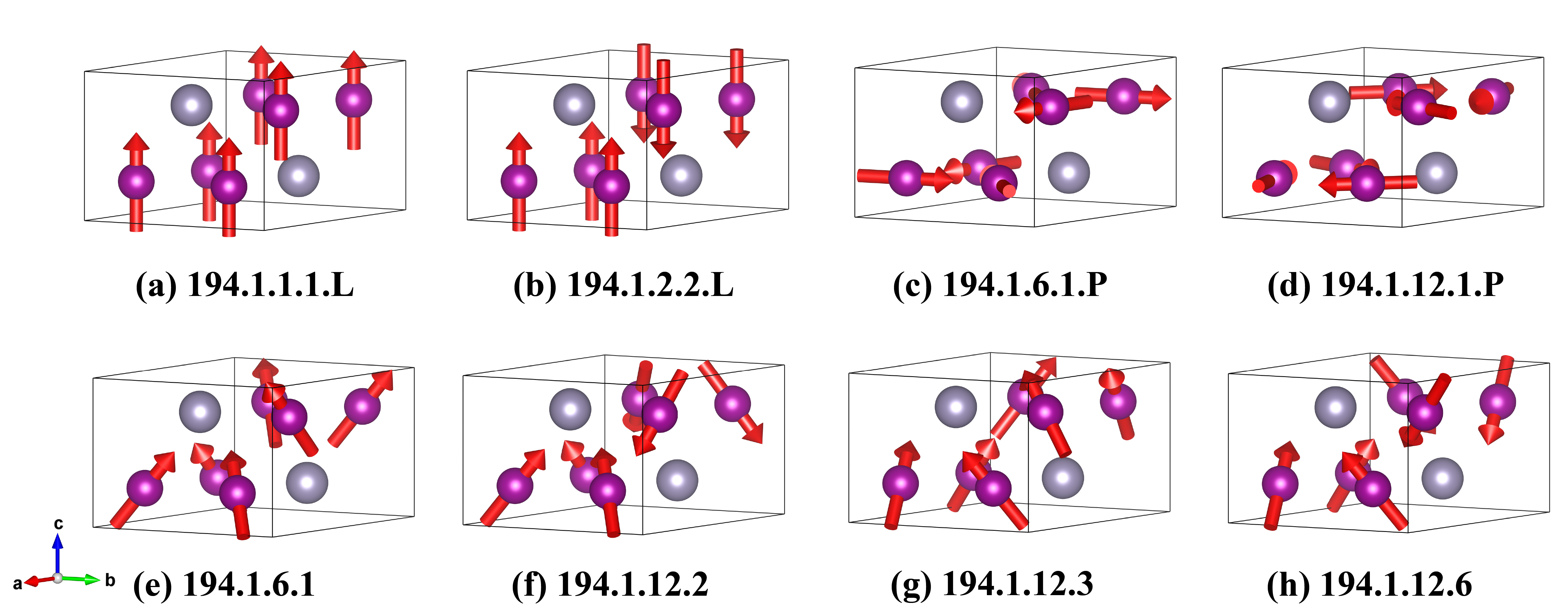
At last, we introduce a non-coplanar magnetic structure of Mn 3 Y (Y=Ga, Ge, and Sn) depicted in Fig.4(d), which can be obtained by imposing a hydrostatic pressure up to 5 GPa to the coplanar magnetic structure in Fig.4(c) according to Ref.[89]. The magnetic moments of Mn atoms are along (1, −1, m z ), (1, 2, m z ), and (−2, −1, m z ) directions. The specific value of the zcomponent m z (̸ = 0) is inessential as it does not affect the SSG. To demonstrate how to obtain the SSG of this novel magnetic structure, we divide the transition from coplanar to non-coplanar order into two stages. In the first stage, the coplanar magnetic moments in Fig.4(c) are rotated by π 2 in z-direction in spin space, which leaves the SSG (i.e., 194.1.6.1.P) unchanged, as the spin and real space are unlocked. We remark that in SSGs the axes of the spin space can be chosen arbitrarily, while in MSG can not. In the second stage, the magnetic moments obtain a z-component of equal magnitude, leading to a non-coplanar order that breaks the coplanar spinonly group symmetries. The SSG is then identified as 194.1.6.1, with generators of the quotient group being − {3 + 001 ||3 001 } and {M 210 ||M 010 } (note that {2 010 ||M 010 } is broken). This non-coplanar SSG has the same number of operations as the coplanar SSG 194.1.6.1.P by breaking the coplanar spin-only group, while the spin rotations undergo a spin space coordinate transformation of π 2 rotation in z-direction. The MSG of this non-coplanar structure is 12.62 C2 ′ /m ′ , with generators being inversion and {M 100 ||2 100 }. It can be seen that this MSG contains a significantly smaller number of operations compared with the SSG 194.1.6.1.
We remark that in these four examples, all SG operations (obtained by ignoring magnetic moments) are maintained in the SSGs by assigning proper spin rotations, and the first number in the label of the identified SSG (i.e., N SG in N SG .I k .I t .N 3Drep ) is the same as the SG. However, this not necessarily holds for all magnetic structures. For example, consider a material with randomly generated magnetic moments. Then no proper spin rotation could be assigned to SG operations and thus the SSG has only the identity operation.
In this section, we discuss potential applications of SSGs. It contains four main parts: (1) the representation theory in SSGs with band representations of Mn 3 Sn as a concrete example; (2) topological states protected by SSG symmetries; (3) Spin texture structures under SSGs; and (4) refining neutron scattering patterns using SSG symmetries.
The representation theory of SGs and MSGs has been pivotal in advancing the study of materials, including the topological quantum chemistry[18, 39] and symmetrybased indicators[25, 44, 90] for diagnosing topological 15 crystalline phases. The introduction of SSGs significantly expands the symmetry landscape, potentially unveiling a richer array of physical phenomena in magnetic materials, particularly those characterized by weak spinorbit coupling (SOC). In Ref.[47], the authors (including several authors of the current manuscript) study the co-representation of non-coplanar SSGs with supercell k-index I k = 2, where the little co-group is P × Z 2 T , with P being one of 32 crystallographic point groups and Z 2 T = {E, T }. A 12-fold fermion and 13 Dirac nodal lines nexus are discovered which are topological band nodes that can only be realized in SSGs. In Ref.[91], the representation theory in SSG is studied using the Complete Sets of Commuting Operators (CSCO).
In the following, we give a brief introduction to the representation theory in SSGs, with a more thorough investigation left in future work. We use Mn 3 Sn as an example and compute the irreducible representations (IRREPs) for its electronic bands. We show the superiority of SSGs over MSGs by correctly capturing the multiple high-dimensional degeneracy in the band structure of Mn 3 Sn.
We first provide a brief introduction to the projective co-representation theory in SSGs. We restrict ourselves to the spinful representations for electron systems for the little groups in the BZ. The spinless representations can also be constructed similarly.
To begin with, denote the representation of an SSG operation as D(g) if g is unitary, and D(g)κ if antiunitary, where D(g) is the representation matrix and κ the complex conjugation operator that satisfies κ 2 = 1 and κu = u ∗ κ for any matrix u. Define the multiplicity relationship of the representation matrices as
We consider the factor system of an SSG at a highsymmetry point k in the BZ of an SSG, which is constructed by two parts: the SU(2) factor from spin rotations and the non-symmorphic translation factor. The SU(2) factor ω 1 originates from the two-to-one homomorphic relationship between SU(2) and SO(3) matrices and can only take the values of 1 or −1. The non-symmorphic translation factor ω 2 , however, is only non-trivial at the non-Γ momentum of the BZ in non-symmorphic SSGs. For two group elements g 1 = {U 1 ||R 1 |τ 1 } and g 2 = {U 2 ||R 2 |τ 2 }, their translation factor is chosen as
where s(g 1 ) = 1 or −1 when g 1 is unitary or anti-unitary, respectively. It can be proven that the factor system, composed of these two parts, satisfies the combination relations required for projective representations. In the representation theory of SSGs, fixing the choice of this factor system can avoid the arbitrariness of the overall phase in the representation.
Based on the method, we construct the factor system for the little group of SSG at all high-symmetry points. The factor system is crucial for the representation of groups. We remark that although an SSG is isomorphic to an MSG[92] when governed by the same multiplication relations and anti-unitary parts, they do not share the same factor system. Thus the IRREPs in SSGs are in general different from those in MSGs. This subtlety can be exemplified by the difference between the single- and double-group representations of an SG, where the double group has non-trivial spin factor systems.
With the multiplication relations and factor systems of SSGs derived, the IRREPs can then be constructed. In particular, we first consider the regular anti-unitary projective corepresentations. Regular representations are in general reducible. It can be proven that such regular representations always encompass all IRREPs. Moreover, there are mathematical methods for reducing group representations, including the use of Complete Sets of Commuting Operators (CSCO)[91, 93] and Hamiltonian methods[94]. By following the Hamiltonian method, we construct all the irreducible representations of the little groups at all high-symmetry points for SSGs, which we leave in future work.
We use Mn 3 Sn as an example to show the application of IRREPs of SSGs in the electronic band structures. We consider the coplanar-ordered Mn 3 Sn. Its band structure with and without SOC is shown in Fig. 5(a). SOC only has minor effects on the bands of Mn 3 Sn, confirming its weak SOC nature and justifying the usage of SSGs.
In Fig. 5(b), we show the enlarged bands near E f along Γ − A − L. We first use MSG to compute the
(double) IRREPs, which cannot explain the 2D degeneracies at Γ. We use symtopo[95] to identify the characters of unitary operations of these bands, with results summarized in Supplementary Material section S8.
Next, we consider SSG 194.1.6.1.P of coplanar Mn 3 Sn. + This SSG has a unitary generator {3 −
001 ||3 001 } and a pure z lattice operation {E||2
001 | 2 } besides the three generators in MSG Cmc ′ m ′ . Utilizing the method described in the
16 55-56 53-54
52 50-51 53-56 53-54 48-49 49-52 49-50 47-48 55-56 51-52 47 47-48 (a) (b)
FIG. 5. Band structure and degeneracy of Mn 3 Sn. (a) Band structure of Mn 3 Sn near the Fermi level E f , where the red lines represent the bands with SOC and the black lines represent the bands without SOC. SOC only has minor effects on the band structure of Mn 3 Sn. (b) Enlarged band structure near E f of Mn 3 Sn along the Γ − A − L path for bands 47-56. Two-fold degeneracies (red dots) at Γ and four-fold degeneracies (blue dots) at A are observed. There are also 3D crossing points (green dots) along the Γ − A path. These high-dimensional degenerate points can only be captured by the representation theory of SSGs (see table V and table VI), but cannot by MSG.
previous section for constructing anti-unitary projective representations, we obtain all the irreducible representations of this group. At the Γ point, 194.1.6.1.P has 12
lent factor systems. The character table of IRREP at A is listed in table VI, showing the existence of one 2D and two 4D IRREPs. This gives a satisfying match to the DFT band structure. Along the A−L path, the SSG only has 2D irreducible representations, which is also consistent with the behavior of the bands along this path in Fig. 5(b).
Moreover, along the Γ − A path, two three-fold degeneracies are observed, protected by the symmetries of the SSG. While the MSG only has 1D representations along this path, SSG has four 1D and two 2D representations. Therefore, these two three-fold degeneracies, resulting from the crossing of doubly degenerate bands with non-degenerate bands, are uniquely captured by the SSG.
We remark that the MSG of a specific material is always a subgroup of its SSG, thus the IRREPs of the SSG can be decomposed into IRREPs of the MSG, either reducible or irreducible. For instance, the S Γ̄ 11 IRREP in the SSG is reduced to Γ̄ 5 , Γ̄ 6 in the MSG. With the IRREPs of MSG, the 2D, 3D, and 4D degeneracies in Mn 3 Sn can only be explained as accidental (except for the 2D IRREPs at A). Only with SSG can we faithfully identify the high-dimensional degeneracies in the band structures of magnetic materials with weak SOC.
TABLE V. The band representations of Mn 3 Sn at Γ us-
are generators of SSG. The 2D degenerate points cannot be captured by IRREPs of the MSG.
At the boundaries of BZ, non-symmorphic operations could lead to higher degeneracies. As can be seen in Fig. 5(b), the bands at the A point exhibit both two-fold and four-fold degeneracies. The MSG Cmc ′ m ′ only has IRREPs of up to 2D at A, thus failing to explain the 4D degeneracy. This necessitates the introduction of SSG. Compared with the little group at Γ, the little group at A has the same group elements but possesses inequivaIn this section, we propose two new gapped topological states protected by SSG symmetries. We explicitly construct the IRREPs in these two SSGs and identify the topological surface states protected by the bulk topological states. We show that the non-trivial spin rotations in SSGs have important consequences in the IRREPs and topology.
Before starting, we discuss briefly some key aspects of the real-space recipe[25, 26, 44, 96] in SSGs, which could be used to construct the complete topological classifications. The real-space recipe converts the problem of topological classification (i.e., exhausting all inequivalent topological states for a given symmetry group) into a “LEGO” puzzle, where one uses lower-dimensional topological building blocks to construct (gapped) 3D topological states. The lower-dimensional building blocks have gapless edge states, which need to be combined properly 17 so that the resultant 3D states are gapped (i.e., the no open-edge condition). The obtained 3D states are subject to the so-called “bubble equivalence”, a process that removes equivalent states. A simplified case in the realspace recipe is the layer construction[25], where the 3D topological states are built from 2D infinitely large layers. Generic 3D topological states are formed by small pieces of finite lower-dimensional states.
We then discuss some unique properties of the realspace recipe in SSGs and compare those in MSGs. First, unlike MSGs where only 2D Chern or mirror Chern insulators can be used as the lower-dimensional building blocks, SSGs could also host 2D topological insulators (TIs)[48, 92] protected by effective TRS symmetry
ror reflection along a certain direction. Second, there exists effective TRS on 1D lines in SSG, which could protect helical edge modes. These effective TRS include
square to -1. Third, there exist two types of mirror symmetries in SSG, i.e., the pure mirror without spin rotation {E||M |0} which has eigenvalue ±1, and the mirror with
rotation), which has eigenvalue ±i. We leave a complete real-space construction of topological states in SSGs for further work.
In the following, we consider two simple but novel examples of gapped topological states in SSGs. We will start with a detailed discussion of the IRREPs of the SSG, which can be derived from the IRREPs of a corresponding MSG through a folding and shifting process of the BZ. The topological states in the SSG are then constructed using the real-space recipe.
We first consider SSG 1.4.1.2 with generator g = {C 4 ||E|0, 0, 14 } · T , where the translation is written under magnetic unit cell bases (i.e., (0, 0, 1) is a lattice translation). We drive the (spinful) IRREPs in this SSG and then build a Z 2 topological state protected by the anti-unitary operation g, similar to the antiferromagnetic topological insulator[97, 98].
a. IRREPs. Based on the algorithm introduced in section VI A, we obtain the IRREPs at eight timereversal-invariant momenta (TRIMs), with results summarizing in table VII. There is only one 2D IRREP for TRIMs on the k z = 0 plane, while one 1D and one 2D IRREP for TRIMs on the k z = π plane. These IRREPs can be understood from the IRREPs of MSG 1.3 P S 1 with generator g M = {E||E|0, 0, 12 } · T . The unit cell of SSG 1.4.1.2 can be seen as a doubled one of MSG 1.3. In MSG 1.3, there are 2D IRREPs (i.e., Kramers’ pairs) on k z = 0 TRIMs and 1D IRREPs on k z = π TRIMs. In the following, we show that the IRREPs of SSG 1.4.1.2 can be obtained from the IRREPs of MSG 1.3 through a folding process of the BZ, together with a subtle shifting of BZ in the k z direction resulting from the non-trivial spin rotation.
Define h = {C 2 ||E|0, 0, 2 1 } which have representation matrix satisfying D(h) = −D(g 2 ), where the minus sign comes from T 2 = −1. This unitary operation h can serve as a new translation group generator, as h commutes with g and all other translations. Denote the BZ defined from h as mBZ. In the mBZ, the TRIMs on k z = 0 plane have D(g 2 ) = −1 which give Kramers’ pair, while on k z = π plane D(g 2 ) = +1 and gives only 1D IRREPs. This is the same result as in MSG 1.3.
Then we turn to the real BZ of the SSG defined by {E||E|0, 0, 1}. The SSG BZ is the folded version of the
(U R denotes the corresponding SU(2) spin rotation of R). We consider TRIMs on k z = 0 and π planes separately:
are mapped to the k z = π TRIMs in the SSG BZ. Thus the 1D and 2D IRREPs coexist for the k z = π TRIMs. They are characterized by D(h) = +1 (for
spectively. The eigenvalue of h separates the states on the k z = π plane into two independent sectors. The 2D IRREP sector could protect Z 2 topological flow[99, 100] and give rise to the surface Dirac cone, while the 1D IRREP sector is an ‘audience’ that does not hybridize with the states having the 2D IRREP. • For TRIMs with k z = 0, we have D(h 2 ) = −1 and
thus D(h) = ±i. This corresponds to the k z = ± π 2 planes in the mBZ, which only host 1D IRREPs. After folding into the SSG BZ, 2D IRREPs are formed at TRIMs with k z = 0, as k z = ± π 2 planes are related by g. Moreover, these 2D IRREPs on the k z = 0 TRIMs in the SSG BZ must be part of a nodal line, as a result of folding from mBZ. The Dirac cone and nodal lines in the SSG BZ can also be verified from the k · p theory. For the 2D IRREPs
The k · p effective Hamilontians constructed from these representation have the form:
• For a TRIM on the k z = 0 plane, the k · p Hamilto-
nian has the form (a 1 δk 1 + a 2 δk 2 + a 3 δk 3 )σ z , where δk = k − k 0 is the deviation from TRIM k 0 , and a i=1,2,3 are free parameters. A nodal line is given by a 1 δk 1 +a 2 δk 2 +a 3 δk 3 = 0 that passes the TRIM.
18 • For a TRIM on the k z = π plane, the k · p Hamilto-
nian has 9 independent terms, i.e., all combinations
crossings are allowed.
(a) SSG 1.4.1.2
z=3/4 z=2/4 z=1/4
In the second example, we consider SSG 1.4.1.3, with two anti-unitary operations
This SSG also has unitary operations with non-trivial
(c) (d) z
We also briefly mention the IRREPs in spinless systems, e.g., magnon bands. For spinless IRREPs in the mBZ, 2D Kramers pairs appear on the k z = π TRIMs, as T 2 = +1. Then h 2 = {E||E|0, 0, 1} in the SSG BZ. Thus on the k z = 0 TRIMs, there are both 2D Kramers’ pairs and 1D IRREPs, while on the k z = π TRIMs there are 2D IRREPs from folding k z = ± π 2 in the mBZ. It can be seen that the IRREPs on k z = 0 and π planes are reversed for spinless and spinful systems.
b. Topological states. This SSG protects a layer construction (LC) with a Z 2 classification, as shown in Fig. 6(a). This LC (denoted as LC S ) consists of Chern layers with Chern number C = 1 on z = 2n 4 planes and 2n+1 Chern layers with C = −1 on z = 4 , n ∈ Z planes. Adjacent layers are related by
g and thus have opposite Chern number. This state is topological because the Chern layers can be deformed but cannot be eliminated as long as g is maintained. Its doubled state, however, can be trivialized as Chern layers with C = ±1 can then be moved together and canceled, leading to the Z 2 classification.
LC S can be understood from the layer construction of
number C = ±1 on z = 0, 12 planes in the unit cell. In MSG 1.3, TRIMs on the k z = 0 plane host Kramers’ pairs. For an open boundary along the z direction that preserves g M , a single Dirac (or more generally, an odd number) cone will appear on TRIMs with k z = 0 in the surface BZ, which can be verified from the 2D IRREPs on k z = 0 TRIMs. LC S can be seen as the doubled LC M along the z direction. As LC M holds a single Dirac cone in the surface BZ, LS S also hosts a single Dirac cone. Doubling of the unit cell leads to the folding of the BZ in LC M , which maintains the number of surface Dirac cones.
Remark that similar topological states also exist in
(b) SSG 1.4.1.3 x x FIG. 6. (a) A layer construction protected by SSG 1.4.1.2. (b)(c) A non-layer construction protected by SSG 1.4.1.3. (b) is from the top view, where arrows denote the direction of chiral edge modes when the boundary is open. (c) is from the side view, in which we only show the four Chern patches inside a unit cell and omit the patches on the boundary. (d). The layer construction deformed from the non-layer construction in (b), which has four Chern layers in a unit cell with alternating Chern numbers.
SSG 1.4.1.2 k z = 0 TRIMs
one 2D IRREP
(nodal line) SSG 1.4.1.3 (0, 0)
IRREP two 1D
one 1D, one 2D (Dirac point)
two 2D one 2D (Dirac point) (nodal line)
TABLE VII. The summary of irreducible representations (IRREPs) at time-reversal-invariant momenta (TRIMs) in SSG 1.4.1.2 and SSG 1.4.1.3. In the table, “Dirac point” means the 2D IRREP forms a Dirac crossing point, while “nodal line” means the 2D IRREP is part of a nodal line in the BZ. In SSG 1.4.1.3, the k z is omitted in the coordinate of TRIMs.
a. IRREPs. We start from the IRREPs in SSG 1.4.1.3, with results summarizing in table VII. The unit cell basis in xy-plane of SSG 1.4.1.3 can be taken as A 1 = (1, 0), A 2 = (0, 1). Denote the corresponding momentum in the SSG BZ as (k 1 , k 2 ). We have omitted the z-direction for simplicity. In SSG 1.4.1.3, the representation of operations satisfy
(38)
(39)
where minus sign comes from the spin rotation as U C 2 2z = −1. Similar to the previous SSG 1.4.1.2, we take s 1 , s 2 as the translation group generators, and denote the BZ thus defined as mBZ. The IRREPs of this SSG can also be built from the mBZ through a folding and shifting process. A subtle difference here is these two operations do not commute with g x,y T and will modify the coordinates of TRIMs and their IRREPs in the mBZ, which we show in the following.
We first identify the TRIMs in the mBZ. By definition, TRIMs are the momenta that are invariant under the anti-unitary operation (but not necessarily always have 19
where the minus sign comes from the spin rotations,
s i are treated as the translation group generators, and k m is defined in the mBZ). Thus TRIMs have coordinate k m = (± π 2 , ± π 2 ) in the mBZ. We then identify which TRIMs host Kramers’ degeneracy by requiring D((g x,y T ) 2 ) = −1. Direct computation shows the TRIMs at ±( π 2 , − π 2 ) satisfy. The other two TRIMs have D((g x,y T ) 2 ) = +1 and thus only host 1D IRREP.
With IRREPs at TRIMs in the mBZ, we then construct those in the SSG BZ. As shown in Eq. (38), we have
This relation is used to map the TRIMs between SSG BZ and the mBZ:
• For the (0, 0) TRIM, there are two 1D IR-
host one 1D IRREP, they give two 1D IRREPs at (0, 0) in the SSG BZ. • For the (π, π) TRIM, there are two 2D IRREPs
that protect Dirac crossings. Because at this TRIM, D(A 1 ) = D(A 2 ) = −1, and can be mapped from the ±( π 2 , − π 2 ) TRIMs in the mBZ, which host 2D Kramers’ pairs. • For the (0, π) TRIMs, there is one 2D IRREP com-
ing from folding. This is because at this TRIM D(A 1 ) = +1, D(A 2 ) = −1, and can be mapped from the (0, 0), (π, π) in the mBZ. In the mBZ, (0, 0), (π, π) are generic points with only 1D trivial IRREP, and are related by g x,y T . The 2D IRREP at (0, π) in the SSG BZ cannot support Dirac crossings but must be part of a nodal line due to the folding of BZ. • The (π, 0) TRIM is similar to (0, π), which host
one 2D IRREP from folding the 1D IRREPs at the
b. Topological states. SSG 1.4.1.3 protects a Z 2 non-layer construction, as shown in Fig. 6(b)(c). This non-layer construction is an axion insulator with a vanishing net Chern number, protected by the antiunitary SSG translations g x,y T . It can be deformed into a layer construction as shown in Fig. 6(d). This state is topological because the Chern layers can be deformed but cannot be removed when g x,y T is maintained. Two copies of the states are topologically trivial as the Chern layers can then be eliminated, validating the Z 2 classification.
We then consider the surface states of this topological state. Surface Dirac cones could only appear on surface BZ that supports the partner-switching Z 2 topological flow of the surface Dirac cone[99, 100], which normally requires an even number of TRIMs that can host Kramers’ pair. From the IRREPs, the xz or yz surface hosts two TRIMs with Kramers’ pairs and thus can host a single (or odd number of) surface Dirac cone. The xy surface has only one TRIM at (π, π) that hosts Kramers’ pair. Surprisingly, this surface can still protect the topological surface Dirac cone, as the mBZ has two TRIMs with Kramer’s pair on this surface and supports the Z 2 flow. The folding process will not change the topological nature of the flow. In the SSG BZ, the topological Z 2 -flow starts from a Dirac cone at (π, π) and connects to the nodal line (which passes (π, 0) and (0, π)), and then goes bask to (π, π). This surface state is unique in SSG, resulting from the modified group structure given by the spin rotations.
The spin texture S(k) is defined as the expectation value of the spin operator on a Bloch state[92], i.e.,
surface. Ref.[92] gives a detailed discussion on the properties of the spin textures based on the SSG BZ. Motivated by Ref.[92], we give a brief discussion on the symmetry properties of the spin textures in SSGs, focusing on the dimension of the spin textures constraint by the SSG operations.
where s g = ±1 for det(U R ) = ±1, i.e., when det(U R ) = −1, g is antiunitary and reverse k. We first consider the effects of spin-only group S 0 on S(k).
When the SSG also has PT or antiunitary translation T · τ , spin degeneracy is guaranteed over the whole BZ, which will enforce S(k) = 0. Without these two types of symmetries, spin splitting is expected and the magnetic order is described as altermagnetism [51–53] recently, which allows for non-trivial spin texture.
on TRIMs. • For the non-magnetic case, S 0 = O(3) will enforce
S(k) = 0. Remark that in the presence of SOC, 20 the O(3) spin-only group is broken and the spin texture is in general non-vanishing. We then consider general SSGs. The following SSG operations will reduce the dimension of S(k):
enforced to be zero.
along the C n direction. • When the SSG contains {M ||P |0} where M is a
must be coplanar on the mirror plane. We then argue that the non-crystallographic spin rotations in SSGs will enforce S(k) to be collinear to vanishing. For SSGs with non-crystallographic spin rotations, there always exist spin rotations C p (p ̸ = 2, 3, 4, 6). We argue that in such SSG S, there exists at least one operation with the form g = {C n ||E|τ }, i.e., a non-crystallographic spin rotation accompanied by a pure translation. This operation enforces the collinear spin texture as discussed in the previous paragraph. We then prove the existence of g. Suppose the noncrystallographic C p spin rotation in S has some real-space rotation R and translation τ part, i.e., h = {C p ||R|τ }. As R can only be crystallographic with rank m =
has the same form as g, i.e., a non-crystallographic spin rotation C p m with no real-space rotation but only a translation. The translation part must be nonzero because otherwise, h m belongs to the spin-only group S 0 , which contradicts the assumption that the spin-only group and the spin-only free group only have a trivial intersection.
with SSG In this section, we consider the application of SSGs to facilitate the refinement of magnetic orderings from magnetic neutron diffraction. We first review the refinement algorithm based on MSGs in the literature[101, 102] and then extend it to SSGs. We use Mn 3 Sn as a realistic example to demonstrate the advantage of SSG in the refinement by reducing the number of refining parameters.
In literature, a commonly used software for refining neutron diffraction is FullProf [101], which has a representational analysis module ‘simulated annealing and representational analysis’ (SARAh)[102]. SARAh could list all possible MSGs and corresponding magnetic structures for a given non-magnetic SG and propagation vector. Our algorithm based on SSG has the same spirit and could be integrated into their workflow by extending MSGs to SSGs.
We start with the necessary experimental information that can be measured before refining magnetic structures: (i) The non-magnetic SG G of the material refined based on X-ray diffraction (XRD) measurements in the magnetic phase, or neutron diffraction measurement in the paramagnetic phase if assuming there is no atomic displacement during the magnetic transition. G gives the symmetries of the crystal structure by ignoring the magnetic moments. (ii) The magnetic unit cell (propagation vector) obtained from new Bragg peaks shown in neutron diffraction patterns compared with the paramagnetic pattern, which could either be the same as the non-magnetic unit cell (propagation vector q = 0) or an enlarged supercell (propagation vector q ̸ = 0). (iii) The neutron diffraction patterns used for fitting in the refinement. (iv) The net magnetic moment and its direction. Zero net magnetic moment indicates the AFM order. One can also distinguish collinear (together with the direction of moments), coplanar noncollinear (together with the plane of moments), and noncoplanar magnetic configurations by for example measuring anisotropic magnetization, e.g., magnetic susceptibility measurements on single crystals.
With the aforementioned experimental data, the following algorithm can be adopted for refinement based on MSG[101, 102]:
magnetic SG G and magnetic unit cell (propagation vector). In the case of multiple propagation vectors, the magnetic unit cell can also be constructed, where different combination coefficients of propagation vectors give different symmetry groups.
magnetic atoms and the symmetry-allowed components of magnetic moments. The moment could be (i) free (non-coplanar), parameterized by (m x , m y , m z ); (ii) restricted on a certain plane (coplanar non-collinear), for example, on (m x , m y , 0); or (iii) restricted along a certain direction (collinear), for example, along (0, 0, m z ). This step can also be done mathematically by decomposing the representations of the little group G q operations on the magnetic moments into IRREPs of G q , and the bases of these IRREPs gives symmetry-independent magnetic moments[101].
symmetry-independent magnetic atoms. Assume there are N such atoms. Then the number of fitting parameters is between N and 3N . Fit the parameters to the neutron data and find the magnetic configuration with minimal error.
are repeated by considering the subgroups of G and
21 their corresponding MSGs, as magnetic order could break the symmetry. Specially, when the propagation vector already breaks some symmetries in G, we could start from the corresponding subgroup at the beginning. The refinement algorithm based on MSGs can be extended to SSGs straightforwardly. SSGs have the advantage of richer symmetry operations compared with MSGs and thus could reduce the number of fitting parameters.
To facilitate the usage of SSGs in the refinement, we also give an algorithm to determine the symmetryallowed directions of magnetic moments for a given SSG. Consider an SSG S and a Wyckoff position with representative point s 0 . The algorithm has the following steps:
• First determine the site symmetry group G s 0 of
s 0 + R}, where R is a lattice translation. Denote the spin-only site group as G 0 s 0 = {U }, where U is the spin rotations from all operations in Gs 0 . • We then consider the symmetry-allowed magnetic
moments M 0 at s 0 , which should satisfy U i M 0 = M 0 , ∀U i ∈ G 0 s 0 . In practice, this equation can be transformed into finding the intersection of eigenspaces where all U i have eigenvalues 1, or more
Sconveniently, finding the common null space of i (U i − 1 3 ). This eigenspace is classified into the following three scenarios:
not host nonzero magnetic moments. In this case, when the magnetic atom is at this Wyckoff position, SSG S should be excluded in the refinement.
restricted to a specific direction. The magnitude of the magnetic moment is used as the sole refinement parameter.
is restricted to a plane and is parameterized by two parameters, i.e., the combination coefficients of two eigenvectors.
free and has three parameters. • Once M 0 at s 0 is determined, we use other opera-
tions of the SSG to generate the magnetic moments at other sites s i in this Wyckoff position. With the algorithm above, we can parameterize the magnetic moments on Wyckoff positions for a given SSG S. These parameters are used as input for the refinement of the neutron diffraction pattern.
We remark on one possible issue with SSGs, i.e., the spin space and real space are decoupled in SSGs, and thus the spin orientations could differ by an overall rotation without breaking any symmetry. This means the symmetry-independent moments are in principle all free under SSGs. This problem could be partly overcome as the direction of moments in collinear orders and the plane of moments in coplanar orders could be predetermined from experiments. We also remark that in our database[75], the spin space has a fixed orientation, e.g., all collinear SSGs have the spin axis along the zdirection in spin space. The convention may need to be tailored for realistic materials.
We take Mn 3 Sn[88] as an example to exemplify the advantage of SSG in neutron diffraction refinement. As shown in Fig. 4(c), Mn 3 Sn has non-magnetic SG 194 P 6 3 /mmc, with magnetic Mn atoms on the kagome 6h Wyckoff position and Sn atoms on the 2c position.
We start from a general consideration of how many SSGs could support nonzero magnetic moments on the 6h Wyckoff position from SG 194 without involving enlarged supercells, i.e., magnetic propagation vector q = (0, 0, 0). From our enumeration results, there are 8 collinear, 40 (non-collinear) coplanar, and 152 non-coplanar SSGs constructed from SG 194 with I k = 1. Despite the large number of SSGs, only two collinear, two coplanar, and four non-coplanar SSGs can support nonzero and inequivalent magnetic moments on the 6h position. The resultant magnetic structures from these 8 SSGs are shown in Figure. 7, with the detailed directions of magnetic moments on each site of 6h tabulated in table VIII. We discuss these SSGs in more detail.
• For the collinear case, SSG 194.1.1.1.L and
194.1.2.2.L both correspond to FM order inplane, but FM and AFM out-of-plane, respectively. The magnetic configurations are parameterized by only
that connects two Mn layers, which is altermagnetic with spin-splitted electronic bands. • For the coplanar case, SSG 194.1.6.1.P enforces
the same magnetic moments on two Mn layers, while 194.1.12.1.P has opposite directional moments. These two magnetic configurations are also parameterized by only one parameter. The coplanar configuration described in Fig. 4(c) has SSG 194.1.6.1.P. We remark that in Ref.[88], the authors did not consider the magnetic configuration given by 194.1.12.1.P, which only has a subtle difference compared with 194.1.6.1.P and might give a comparable error of refinement. • For the non-coplanar case, there are four SSGs:
194.1.6.1, 194.1.12.2, 194.1.12.3, and 194.1.12.6, each parameterized by 2 parameters. Among them, 22
FIG. 7. The of symmetry-allowed magnetic configurations on the 6h Wyckoff position in eight SSGs induced from SG 194 with I k = 1. (a)(b) are collinear orders. (c)(d) are coplanar orders. (e)-(h) are non-coplanar orders. With SSGs, these magnetic configurations could be parametrized by only a few parameters.
SSG number (−x, −2x, 14 ) (2x, x, 14 ) (−x, x, 14 ) (x, 2x, 4 3 ) (−2x, −x, 34 ) (x, −x, 34 )
TABLE VIII. SSGs from SG 194 with I k = 1 and their symmetry-allowed magnetic moments on the 6h Wyckoff position of SG 194. There are 2 allowed collinear, 2 coplanar, and 4 non-coplanar SSGs. SSGs have the advantage of fewer free parameters in the magnetic moments compared with MSGs and could facilitate the refinement of magnetic structures from neutron diffraction patterns.
SSG 194.1.6.1 has two Mn layers sharing the same direction of magnetic moments, which describes the experimental structure of Mn 3 Sn reported in Ref.[89]. The other three possible non-coplanar SSGs give two inequivalent Mn layers.
Note that among the large number of SSGs given by SG 194 with I k = 1, many of them only allow magnetic moments with higher symmetries on Wyckoff position 6h, and can be omitted. For example, some noncoplanar SSGs only allow collinear orders on 6h and thus are equivalent to a collinear SSG. Moreover, the directions of magnetic moments in each SSG tabulated in table VIII could change by an overall rotation, due to the decoupled nature of spin and real spaces in SSGs.
For comparison, we also consider magnetic moments restricted by the MSG of Mn 3 Sn in coplanar and noncoplanar order, i.e., MSG 63.463 Cmc ′ m ′ and 12.62 C2 ′ /m ′ . For MSG 63.463, the 6h position splits into two symmetry-independent Wyckoff positions 8g and 4c, which gives 4 parameters. For MSG 12.62, 6h splits into 8j and 4i, which gives 5 parameters. These two MSGs have much lower symmetry compared with the SSGs in the same table, and the 6h Wyckoff position splits into multiple symmetry-independent Wyckoff positions. Thus the independent components of the magnetic moments are increased and is detrimental for the neutron refinements.
In this work, we give an invariant subgroup-based algorithm to enumerate SSGs systematically. We implement the algorithm and find a vast number of SSGs. With the enumerated SSGs, the representation theory[94, 103], new types of magnetic topological states, and novel quasiparticles protected by SSG symmetries can be readily explored in the future.
In addition to the applications of SSGs discussed in our work, it is noteworthy that SSGs offer valuable insights into the transport properties of magnetic materials with weak SOC. The enhanced symmetry framework provided by SSGs is instrumental in categorizing potential 23 responses to various external fields. For instance, SSGs offer a deeper understanding of the anomalous Hall effect (AHE) in different magnetic materials. Collinear and coplanar magnetic materials have pure-spin operations that can be seen as effective time-reversal symmetry, which enforces the AHE to be zero when SOC is negligible[104, 105]. With the inclusion of SOC, the degenerate points protected by SSG symmetries are lifted and could lead to large AHE. For non-coplanar magnetic materials, AHE could exist even without SOC[106], and SSGs can be used to further classify the symmetry conditions for AHE to exist.
In conclusion, the vast number of SSGs we enumerated systematically in the work greatly enlarge the symmetries that could be used for describing magnetic materials and their band structures and could promote research in related fields.
Note added. Upon completing our enumeration of SSGs, we became aware of parallel studies conducted by Zhi-Da Song’s group and Qihang Liu’s group, which are documented in their respective works (see Refs.[92] and [91]). These groups have also explored the enumeration and applications of SSGs, albeit through distinct methodologies. In Supplementary Material section S9, we provide a comparative analysis of our results with those of Song’s and Liu’s groups. We also give a brief discussion on how to effectively map these different notational systems. The manuscript is revised according to the referees’ reports and has been published in Ref.[107].
[1] T. Hahn, International Tables for Crystallography,
Space-Group Symmetry, International Tables for Crystallography (Wiley, 2005). [2] C. Bradley and A. Cracknell, The Mathematical Theory
of Symmetry in Solids: Representation Theory for Point Groups and Space Groups, EBSCO ebook academic collection (OUP Oxford, 2010). [3] C. J. BRADLEY and B. L. DAVIES, “Magnetic groups
and their corepresentations,” Rev. Mod. Phys. 40, 359– 379 (1968). [4] Ron Lifshitz, “Magnetic point groups and space
groups,” (2004). [5] Daniel B. Litvin, Magnetic Group Tables: 1-, 2- and 3-
dimensional magnetic subperiodic groups and magnetic space groups (2013). [6] Samuel V. Gallego, J. Manuel Perez-Mato, Luis Elcoro,
Emre S. Tasci, Robert M. Hanson, Koichi Momma, Mois I. Aroyo, and Gotzon Madariaga, “MAGNDATA: towards a database of magnetic structures. i.the commensurate case,” Journal of Applied Crystallography 49, 1750–1776 (2016). [7] Javier González-Platas, Nebil A Katcho, and Juan
Rodríguez-Carvajal, “Extension of hall symbols of crystallographic space groups to magnetic space groups,” Journal of Applied Crystallography 54, 338–342 (2021). [8] Gui-Bin Liu, Zeying Zhang, Zhi-Ming Yu, and Yugui
Yao, “MSGCorep: A package for corepresentations of magnetic space groups,” Computer Physics Communications 288, 108722 (2023). [9] W. F. Brinkman and R. J. Elliott, “Theory of spin-space groups,” Proceedings of the Royal Society of London. Series A, Mathematical and Physical Sciences 294, 343– 358 (1966). [10] D.B. Litvin and W. Opechowski, “Spin groups,” Physica
76, 538–554 (1974). [11] Robert-Jan Slager, Andrej Mesaros, Vladimir Juričić,
and Jan Zaanen, “The space group classification of topological band-insulators,” Nature Physics 9, 98–102 (2013). [12] S. M. Young, S. Zaheer, J. C. Y. Teo, C. L. Kane,
three dimensions,” Physical Review Letters 108 (2012), 10.1103/physrevlett.108.140405. [13] Bohm-Jung Yang and Naoto Nagaosa, “Classification
of stable three-dimensional dirac semimetals with nontrivial topology,” Nature Communications 5 (2014), 10.1038/ncomms5898. [14] Chen Fang, Yige Chen, Hae-Young Kee, and Liang Fu,
“Topological nodal line semimetals with and without spin-orbital coupling,” Physical Review B 92 (2015), 10.1103/physrevb.92.081201. [15] Haruki Watanabe, Hoi Chun Po, Michael P. Zale-
tel, and Ashvin Vishwanath, “Filling-enforced gaplessness in band structures of the 230 space groups,” Physical Review Letters 117 (2016), 10.1103/physrevlett.117.096404. [16] Barry Bradlyn, Jennifer Cano, Zhijun Wang,
fermions: Unconventional quasiparticles in conACKNOWLEDGMENTS Y.J. and Z.S. thanks Zhenyu Xiao, Yupeng Wang, Jie Ren, Zhen-Yuan Yang, Bingrui Peng, and Yuting Qian for helpful discussions. C.F., H.W., and J.Y. are supported by Chinese Academy of Sciences under grant number XDB33000000, National Key Research and Development Program of China (Grant No.2022YFA1403800), and Natural Science Foundation of China (Grant No. 12188101). C.F. is supported by National Natural Science Foundation of China (NSFC) under grant number 12325404. Z.-X.L. is supported by the NSF of China (Grants No.12134020 and No. 12374166), National Key Research and Development Program of China (Grant No.2022YFA1405301, 2023YFA1406500), and the Fundamental Research Funds for the Central Universities and the Research Funds of Renmin University of China (Grant No. 19XNLG11). H.W has been supported by the New Cornerstone Science Foundation through the XPLORER PRIZE.
24 ventional crystals,” Science 353, aaf5037 (2016), https://www.science.org/doi/pdf/10.1126/science.aaf5037. [17] Jorrit Kruthoff, Jan de Boer, Jasper van Wezel,
Charles L. Kane, and Robert-Jan Slager, “Topological classification of crystalline insulators through band structure combinatorics,” Physical Review X 7 (2017), 10.1103/physrevx.7.041069. [18] Barry Bradlyn, L. Elcoro, Jennifer Cano, M. G.
Vergniory, Zhijun Wang, C. Felser, M. I. Aroyo, and B. Andrei Bernevig, “Topological quantum chemistry,” Nature 547, 298–305 (2017). [19] N. P. Armitage, E. J. Mele, and Ashvin Vishwanath,
“Weyl and dirac semimetals in three-dimensional solids,” Rev. Mod. Phys. 90, 015001 (2018). [20] Zhida Song, Tiantian Zhang, and Chen Fang, “Diag-
nosis for nonmagnetic topological semimetals in the absence of spin-orbital coupling,” Physical Review X 8 (2018), 10.1103/physrevx.8.031069. [21] Tiantian Zhang, Yi Jiang, Zhida Song, He Huang,
Yuqing He, Zhong Fang, Hongming Weng, and Chen Fang, “Catalogue of topological electronic materials,” Nature 566, 475–479 (2019). [22] M. G. Vergniory, L. Elcoro, Claudia Felser, Nicolas Reg-
nault, B. Andrei Bernevig, and Zhijun Wang, “A complete catalogue of high-quality topological materials,” Nature 566, 480–485 (2019). [23] Feng Tang, Hoi Chun Po, Ashvin Vishwanath, and
Xiangang Wan, “Comprehensive search for topological materials using symmetry indicators,” Nature 566, 486– 489 (2019). [24] Jennifer Cano and Barry Bradlyn, “Band representa-
tions and topological quantum chemistry,” Annual Review of Condensed Matter Physics 12, 225C246 (2021). [25] Zhida Song, Tiantian Zhang, Zhong Fang, and Chen
Fang, “Quantitative mappings between symmetry and topology in solids,” Nature Communications 9 (2018), 10.1038/s41467-018-06010-w. [26] Zhida Song, Chen Fang, and Yang Qi, “Real-space
recipes for general topological crystalline states,” Nature Communications 11 (2020), 10.1038/s41467-020- 17685-5. [27] Jian Yang, Zheng-Xin Liu, and Chen Fang, “Unlock-
ing of time reversal, space-time inversion and rotation invariants in magnetic materials,” (2020). [28] Peizhe Tang, Quan Zhou, Gang Xu, and Shou-
Cheng Zhang, “Dirac fermions in an antiferromagnetic semimetal,” Nature Physics 12, 1100–1104 (2016). [29] Long Liang and Yue Yu, “Semimetal with both rarita-
schwinger-weyl and weyl excitations,” Phys. Rev. B 93, 045113 (2016). [30] Haruki Watanabe, Hoi Chun Po, and Ashvin Vish-
wanath, “Structure and topology of band structures in the 1651 magnetic space groups,” Science Advances 4 (2018), 10.1126/sciadv.aat8685. [31] Guiyuan Hua, Simin Nie, Zhida Song, Rui Yu, Gang Xu,
and Kailun Yao, “Dirac semimetal in type-iv magnetic space groups,” Phys. Rev. B 98, 201116 (2018). [32] R Matthias Geilhufe, Francisco Guinea, and Vladimir
Juričić, “Hund nodal line semimetals: The case of a twisted magnetic phase in the double-exchange model,” Physical Review B 99, 020404 (2019). [33] Jennifer Cano, Barry Bradlyn, and M. G.
Vergniory, “Multifold nodal points in magnetic materials,” APL Materials 7, 101125 (2019), https://doi.org/10.1063/1.5124314. [34] Yuanfeng Xu, Luis Elcoro, Zhi-Da Song, Benjamin J.
Wieder, M. G. Vergniory, Nicolas Regnault, Yulin Chen, Claudia Felser, and B. Andrei Bernevig, “Highthroughput calculations of magnetic topological materials,” Nature 586, 702–707 (2020). [35] Adrien Bouhon, Gunnar F. Lange, and Robert-Jan
Slager, “Topological correspondence between magnetic space group representations and subdimensions,” Physical Review B 103 (2021), 10.1103/physrevb.103.245127. [36] Jian Yang, Chen Fang, and Zheng-Xin Liu, “Symmetry-
protected nodal points and nodal lines in magnetic materials,” Phys. Rev. B 103, 245141 (2021). [37] Feng Tang and Xiangang Wan, “Exhaustive construc-
tion of effective models in 1651 magnetic space groups,” Phys. Rev. B 104, 085137 (2021). [38] Yi Jiang, Zhong Fang, and Chen Fang, “A k·p ef-
fective hamiltonian generator,” Chinese Physics Letters 38, 077104 (2021). [39] Luis Elcoro, Benjamin J. Wieder, Zhida Song, Yuanfeng
Xu, Barry Bradlyn, and B. Andrei Bernevig, “Magnetic topological quantum chemistry,” Nature Communications 12 (2021), 10.1038/s41467-021-26241-8. [40] Gui-Bin Liu, Zeying Zhang, Zhi-Ming Yu, Shengyuan A.
Yang, and Yugui Yao, “Systematic investigation of emergent particles in type-iii magnetic space groups,” Phys. Rev. B 105, 085117 (2022). [41] Zeying Zhang, Gui-Bin Liu, Zhi-Ming Yu, Shengyuan A.
Yang, and Yugui Yao, “Encyclopedia of emergent particles in type-iv magnetic space groups,” Phys. Rev. B 105, 104426 (2022). [42] Patrick M Lenggenhager, Xiaoxiong Liu, Titus Neu-
pert, and Tomáš Bzdušek, “Triple nodal points characterized by their nodal-line structure in all magnetic space groups,” Physical review B 106, 085128 (2022). [43] Feng Tang and Xiangang Wan, “Complete classifica-
tion of band nodal structures and massless excitations,” Phys. Rev. B 105, 155156 (2022). [44] Bingrui Peng, Yi Jiang, Zhong Fang, Hongming Weng,
and Chen Fang, “Topological classification and diagnosis in magnetically ordered electronic materials,” Phys. Rev. B 105, 235138 (2022). [45] B. Andrei Bernevig, Claudia Felser, and Haim Bei-
denkopf, “Progress and prospects in magnetic topological materials,” Nature 603, 41–51 (2022). [46] Dongze Fan, Xiangang Wan, and Feng Tang, “All hour-
glass bosonic excitations in the 1651 magnetic space groups and 528 magnetic layer groups,” Phys. Rev. Mater. 6, 124201 (2022). [47] Jian Yang, Zheng-Xin Liu, and Chen Fang, “Symmetry
invariants in magnetically ordered systems having weak spin-orbit coupling,” (2021). [48] Pengfei Liu, Jiayu Li, Jingzhi Han, Xiangang Wan, and
Qihang Liu, “Spin-group symmetry in magnetic materials with negligible spin-orbit coupling,” Phys. Rev. X 12, 021016 (2022). [49] A. Corticelli, R. Moessner, and P. A. McClarty, “Spin-
space groups and magnon band topology,” Phys. Rev. B 105, 064430 (2022). [50] D. B. Litvin, “Spin point groups,” Acta Crystallograph-
ica Section A 33, 279–287 (1977). [51] Libor Šmejkal, Jairo Sinova, and Tomas Jungwirth,
“Beyond conventional ferromagnetism and antiferromagnetism: A phase with nonrelativistic spin and crys25 tal rotation symmetry,” Physical Review X 12, 031042 (2022). [52] Libor Šmejkal, Jairo Sinova, and Tomas Jungwirth,
“Emerging research landscape of altermagnetism,” Physical Review X 12, 040501 (2022). [53] Igor Mazin (The PRX Editors), “Editorial:
Altermagnetism—a new punch line of fundamental magnetism,” Phys. Rev. X 12, 040002 (2022). [54] Satoru Hayami, Yuki Yanagi, and Hiroaki Kusunose,
“Momentum-dependent spin splitting by collinear antiferromagnetic ordering,” journal of the physical society of japan 88, 123702 (2019). [55] Satoru Hayami, Yuki Yanagi, and Hiroaki Kusunose,
“Bottom-up design of spin-split and reshaped electronic band structures in antiferromagnets without spin-orbit coupling: Procedure on the basis of augmented multipoles,” Phys. Rev. B 102, 144441 (2020). [56] Helena Reichlová, Rafael Lopes Seeger, Rafael
González-Hernández, Ismaila Kounta, Richard Schlitz, Dominik Kriegner, Philipp Ritzinger, Michaela Lammel, Miina Leiviskä, Václav Petříček, et al., “Macroscopic time reversal symmetry breaking by staggered spin-momentum interaction,” arXiv preprint arXiv:2012.15651 (2020). [57] Zexin Feng, Xiaorong Zhou, Libor Šmejkal, Lei Wu,
Zengwei Zhu, Huixin Guo, Rafael González-Hernández, Xiaoning Wang, Han Yan, Peixin Qin, et al., “An anomalous hall effect in altermagnetic ruthenium dioxide,” Nature Electronics 5, 735–743 (2022). [58] Arnab Bose, Nathaniel J. Schreiber, Rakshit Jain,
Ding-Fu Shao, Hari P. Nair, Jiaxin Sun, Xiyue S. Zhang, David A. Muller, Evgeny Y. Tsymbal, Darrell G. Schlom, and Daniel C. Ralph, “Tilted spin current generated by the collinear antiferromagnet ruthenium dioxide,” Nature Electronics 5, 267–274 (2022). [59] H. Bai, L. Han, X. Y. Feng, Y. J. Zhou, R. X. Su,
Q. Wang, L. Y. Liao, W. X. Zhu, X. Z. Chen, F. Pan,
torque in a collinear antiferromagnet ruo 2 ,” Phys. Rev. Lett. 128, 197202 (2022). [60] Shutaro Karube, Takahiro Tanaka, Daichi Sugawara,
Naohiro Kadoguchi, Makoto Kohda, and Junsaku Nitta, “Observation of spin-splitter torque in collinear antiferromagnetic ruo 2 ,” Phys. Rev. Lett. 129, 137201 (2022). [61] Libor Šmejkal, Rafael González-Hernández, Tomáš
Jungwirth, and Jairo Sinova, “Crystal time-reversal symmetry breaking and spontaneous hall effect in collinear antiferromagnets,” Science advances 6, eaaz8809 (2020). [62] Rafael González-Hernández, Libor Šmejkal, Karel
Vỳbornỳ, Yuta Yahagi, Jairo Sinova, Tomáš Jungwirth, and Jakub Železnỳ, “Efficient electrical spin splitter based on nonrelativistic collinear antiferromagnetism,” Physical Review Letters 126, 127701 (2021). [63] RD Gonzalez Betancourt, Jan Zubáč, R Gonzalez-
Hernandez, Kevin Geishendorf, Zbynek Šobáň, Gunther Springholz, Kamil Olejník, Libor Šmejkal, Jairo Sinova, Tomas Jungwirth, et al., “Spontaneous anomalous hall effect arising from an unconventional compensated magnetic phase in a semiconductor,” Physical Review Letters 130, 036702 (2023). [64] I. I. Mazin, “Altermagnetism in mnte: Origin, predicted
manifestations, and routes to detwinning,” Phys. Rev.
B 107, L100418 (2023). [65] A. Hariki, A. Dal Din, O. J. Amin, T. Yamaguchi,
pion, P. Wadley, D. Backes, L. S. I. Veiga, S. S. Dhesi, G. Springholz, L. Šmejkal, K. Výborný, T. Jungwirth, and J. Kuneš, “X-ray magnetic circular dichroism in
(2024). [66] Michał Papaj, “Andreev reflection at the altermagnet-
superconductor interface,” Phys. Rev. B 108, L060508 (2023). [67] Sayed Ali Akbar Ghorashi, Taylor L Hughes, and
Jennifer Cano, “Altermagnetic routes to majorana modes in zero net magnetization,” arXiv preprint arXiv:2306.09413 (2023). [68] Charles RW Steward, Rafael M Fernandes, and Jörg
Schmalian, “Dynamic paramagnon-polarons in altermagnets,” Physical Review B 108, 144418 (2023). [69] Yu-Peng Zhu, Xiaobing Chen, Xiang-Rui Liu, Yun-
tian Liu, Pengfei Liu, Heming Zha, Gexing Qu, Caiyun Hong, Jiayu Li, Zhicheng Jiang, et al., “Observation of plaid-like spin splitting in a noncoplanar antiferromagnet,” Nature 626, 523–528 (2024). [70] Pengfei Liu, Ao Zhang, Jingzhi Han, and Qihang Liu,
“Chiral dirac-like fermion in spin-orbit-free antiferromagnetic semimetals,” The Innovation 3 (2022). [71] Ao Zhang, Ke Deng, Jieming Sheng, Pengfei Liu, Shiv
Kumar, Kenya Shimada, Zhicheng Jiang, Zhengtai Liu, Dawei Shen, Jiayu Li, et al., “Chiral dirac fermion in a collinear antiferromagnet,” Chinese Physics Letters 40, 126101 (2023). [72] Lin-Ding Yuan, Zhi Wang, Jun-Wei Luo, and Alex
Zunger, “Prediction of low-z collinear and noncollinear antiferromagnetic compounds having momentumdependent spin splitting even without spin-orbit coupling,” Phys. Rev. Mater. 5, 014409 (2021). [73] Peng-Jie Guo, Yi-Wen Wei, Kai Liu, Zheng-Xin Liu,
and Zhong-Yi Lu, “Eightfold degenerate fermions in two dimensions,” Phys. Rev. Lett. 127, 176401 (2021). [74] Peng-Jie Guo, Zheng-Xin Liu, and Zhong-Yi Lu,
“Quantum anomalous hall effect in collinear antiferromagnetism,” npj Computational Materials 9, 70 (2023). [75] “The spin-space group database,” https://cmpdc.
iphy.ac.cn/ssg. [76] Mois Ilia Aroyo, Juan Manuel Perez-Mato, Cesar
Capillas, Eli Kroumova, Svetoslav Ivantchev, Gotzon Madariaga, Asen Kirov, and Hans Wondratschek, “Bilbao crystallographic server: I. databases and crystallographic computing programs,” Zeitschrift für Kristallographie-Crystalline Materials 221, 15–27 (2006). [77] Mois I Aroyo, Asen Kirov, Cesar Capillas, JM Perez-
Mato, and Hans Wondratschek, “Bilbao crystallographic server. ii. representations of crystallographic point groups and space groups,” Acta Crystallographica Section A: Foundations of Crystallography 62, 115–128 (2006). [78] Mois I Aroyo, JM Perez-Mato, Danel Oroben-
goa, EMRE Tasci, Gemma de la Flor, and Asel Kirov, “Crystallography online: Bilbao crystallographic server,” Bulg. Chem. Commun 43, 183–197 (2011). [79] Samuel V Gallego, J Manuel Perez-Mato, Luis Elcoro,
Emre S Tasci, Robert M Hanson, Mois I Aroyo, and Gotzon Madariaga, “Magndata: towards a database of
26 magnetic structures. ii. the incommensurate case,” Journal of Applied Crystallography 49, 1941–1956 (2016). [80] Édouard Goursat, Cours d’analyse mathématique, Vol. 2
(Gauthier-Villars, 1921) Chap. IX, pp. 123–126. [81] S.L. Altmann and P. Herzig, Point-group Theory Tables,
Oxford science publications (Clarendon Press, 1994). [82] Wolfram Research, Inc., “Mathematica, Version 13.1,”
Champaign, IL, 2022. [83] Ao Janner and T Janssen, “Symmetry of incommensu-
rate crystal phases. i. commensurate basic structures,” Acta Crystallographica Section A: Crystal Physics, Diffraction, Theoretical and General Crystallography 36, 399–408 (1980). [84] Sander Van Smaalen, Incommensurate crystallography,
Vol. 21 (OUP Oxford, 2007). [85] JM Perez-Mato, JL Ribeiro, V Petricek, and MI Aroyo,
“Magnetic superspace groups and symmetry constraints in incommensurate magnetic phases,” Journal of Physics: Condensed Matter 24, 163201 (2012). [86] Yang Zhang, Yan Sun, Hao Yang, Jakub Železný, Stuart
P. P. Parkin, Claudia Felser, and Binghai Yan, “Strong anisotropic anomalous hall effect and spin hall effect in the chiral antiferromagnetic compounds mn 3 x (x = Ge, sn, ga, ir, rh, and pt),” Phys. Rev. B 95, 075128 (2017). [87] Hua Chen, Qian Niu, and A. H. MacDonald, “Anoma-
lous hall effect arising from noncollinear antiferromagnetism,” Phys. Rev. Lett. 112, 017205 (2014). [88] PJ Brown, V Nunez, F Tasset, JB Forsyth, and P Rad-
hakrishna, “Determination of the magnetic structure of mn3sn using generalized neutron polarization analysis,” Journal of Physics: Condensed Matter 2, 9409 (1990). [89] A. S. Sukhanov, Sanjay Singh, L. Caron, Th. Hansen,
A. Hoser, V. Kumar, H. Borrmann, A. Fitch, P. Devi,
pressure-induced change in the magnetic structure of the noncollinear antiferromagnet mn 3 Ge,” Phys. Rev. B 97, 214402 (2018). [90] Hoi Chun Po, Ashvin Vishwanath, and Haruki Watan-
abe, “Symmetry-based indicators of band topology in the 230 space groups,” Nature communications 8, 50 (2017). [91] Xiaobing Chen, Jun Ren, Yanzhou Zhu, Yutong Yu,
Ao Zhang, Pengfei Liu, Jiayu Li, Yuntian Liu, Caiheng Li, and Qihang Liu, “Enumeration and representation theory of spin space groups,” Phys. Rev. X 14, 031038 (2024). [92] Zhenyu Xiao, Jianzhou Zhao, Yanqi Li, Ryuichi Shin-
dou, and Zhi-Da Song, “Spin space groups: Full classification and applications,” Phys. Rev. X 14, 031037 (2024). [93] Jin-Quan Chen, Mei-Juan Gao, and Guang-Qun Ma,
“The representation group and its application to space groups,” Rev. Mod. Phys. 57, 211–278 (1985). [94] Zhen-Yuan Yang, Jian Yang, Chen Fang, and Zheng-
Xin Liu, “A hamiltonian approach for obtaining irreducible projective representations and the kp perturbation for anti-unitary symmetry groups,” Journal of Physics A: Mathematical and Theoretical 54, 265202 (2021). [95] Yuqing He, Yi Jiang, Tiantian Zhang, He Huang, Chen
Fang, and Zhong Jin, “Symtopo: An automatic tool for calculating topological properties of nonmagnetic crystalline materials,” Chinese Physics B 28, 087102 (2019).
[96] Zhida Song, Sheng-Jie Huang, Yang Qi, Chen Fang,
and Michael Hermele, “Topological states from topological crystals,” Science advances 5, eaax2007 (2019). [97] Roger SK Mong, Andrew M Essin, and Joel E Moore,
“Antiferromagnetic topological insulators,” Physical Review B 81, 245209 (2010). [98] Chen Fang, Matthew J Gilbert, and B Andrei Bernevig,
“Topological insulators with commensurate antiferromagnetism,” Physical Review B 88, 085406 (2013). [99] Liang Fu, Charles L Kane, and Eugene J Mele, “Topo-
logical insulators in three dimensions,” Physical review letters 98, 106803 (2007). [100] Liang Fu and Charles L Kane, “Topological insula-
tors with inversion symmetry,” Physical Review B 76, 045302 (2007). [101] Juan Rodríguez-Carvajal, “Fullprof,” CEA/Saclay,
France 1045, 132–146 (2001). [102] AS Wills, “A new protocol for the determination of mag-
netic structures using simulated annealing and representational analysis (sarah),” Physica B: Condensed Matter 276, 680–681 (2000). [103] Jian Yang and Zheng-Xin Liu, “Irreducible projective
representations and their physical applications,” Journal of Physics A: Mathematical and Theoretical 51, 025207 (2017). [104] Libor Šmejkal, Allan H MacDonald, Jairo Sinova,
Satoru Nakatsuji, and Tomas Jungwirth, “Anomalous hall antiferromagnets,” Nature Reviews Materials 7, 482–496 (2022). [105] M.-T. Suzuki, T. Koretsune, M. Ochi, and R. Arita,
“Cluster multipole theory for anomalous hall effect in antiferromagnets,” Phys. Rev. B 95, 094406 (2017). [106] Ryuichi Shindou and Naoto Nagaosa, “Orbital ferro-
magnetism and anomalous hall effect in antiferromagnets on the distorted fcc lattice,” Phys. Rev. Lett. 87, 116801 (2001). [107] Yi Jiang, Ziyin Song, Tiannian Zhu, Zhong Fang, Hong-
ming Weng, Zheng-Xin Liu, Jian Yang, and Chen Fang, “Enumeration of spin-space groups: Toward a complete description of symmetries of magnetic orders,” Phys. Rev. X 14, 031039 (2024). [108] Naftali Harris, “Finding isomorphisms between fi-
nite groups,” https://www.naftaliharris.com/blog/ groupiso/ (2012). [109] Atsushi Togo and Isao Tanaka, “Spglib: a software
library for crystal symmetry search,” arXiv preprint arXiv:1808.01590 (2018). [110] Shyue Ping Ong, William Davidson Richards, Anubhav
Jain, Geoffroy Hautier, Michael Kocher, Shreyas Cholia, Dan Gunter, Vincent L Chevrier, Kristin A Persson, and Gerbrand Ceder, “Python materials genomics (pymatgen): A robust, open-source python library for materials analysis,” Computational Materials Science 68, 314–319 (2013) .
27
S1. MODULAR LINEAR EQUATIONS In this section, we introduce the Smith normal form method to solve modular linear equations of the form
meaning that each entry of w in the equation is modular n.
The Smith normal form of an integer matrix M is
where L m×m , R n×n are the left and right matrix that are integral and invertible, and Λ m×n = Diag(λ 1 , ..., λ n ) has the same shape as M and is diagonal with integral elements.
For homogeneous equations,
first find the smith normal form M = L −1 ΛR −1 , where Λ = Diag(λ 1 , ..., λ n ) is a diagonal matrix. Denote v = R −1 · x, which satisfies a simplified equation, Λ · v = 0 mod [1], with straightforward solutions: v i = λ j
i , where j ∈ {0, 1, ..., λ i − 1}. Notice that if some λ i = 0, then the corresponding v i can take arbitrary values. The solution of
For homogeneous equations,
the method is similar with v i = n λ j i .
For inhomogeneous equations,
For inhomogeneous equations,
S2. FINDING ISOMORPHISMS BETWEEN FINITE GROUPS For two finite groups G 1 and G 2 with the same number of elements N , the following method can be used to check if they are isomorphic[108].
isomorphic. If so, proceed to the next step. 2. Find a set of generators of G 1 (do not need to find the minimal set of generators). Assume there are n generators.
G 1 and G 2 are isomorphic.
28 S3. ISOMORPHIC POINT GROUPS Point groups can be enumerated into the following groups with isomorphic relations:
∼ S 2(2n+1) , where n ∈ N. • S n , with S 2n ∼ = C 2n , S 2n+1 ∼ = C (2n+1)h ∼ = C 2(2n+1) =
Using the isomorphic relations, only the following point groups are not isomorphic to each other, which can be used as abstract point groups:
where N denotes positive integers.
S4. AUTOMORPHISM GROUP OF SPACE GROUPS In this section, we discuss the automorphism group Auto(G) of each SG G. We first enumerate the automorphism group of primitive symmorphic SGs.
• For triclinic lattice, i.e., SG 1, 2, Auto(G) = {W = (A, t)|A ∈ SL(3, Z), t ∈ R 3 }, where A can take any SL(3, Z)
matrix. • For monoclinic lattice (assuming the main axis is b), A can take any SL(2, Z) matrix at a, c direction and identity
• For trigonal lattice, Auto(G) = D 3 (32). • For hexagonal lattice, Auto(G) = D 6 (622).
For non-primitive Bravais lattices, the aforementioned automorphisms of the primitive Bravais lattice of the same crystal system are used as candidates. The candidates satisfying W GW −1 = G in the corresponding primitive unit cell are automorphisms of the non-primitive SG G.
For non-symmorphic SGs, the method is similar, and automorphisms may contain nontrivial translation parts.
29 S5. DETAILS IN FINDING INEQUIVALENT SUPERCELLS, SUBGROUPS, AND 3D REAL
REPRESENTATIONS For a given SG G with primitive cell basis a G i and a subgroup H with primitive cell basis a H i , the supercell matrix of H is defined as the transformation of primitive cell basis:
To find inequivalent supercells of a give SG G, we first reduce the infinite number of GL(3, Z) supercell matrices of k-index I k to finite by considering all possible column transformations, which is the simplest equivalent relations, and simplify the supercell matrices to the form
number of supercells to a few hundred. We then use the automorphism group Auto(G) = {W = (A, t)} to find all inequivalent supercells among them by using
Note that as supercell matrices are written in the primitive basis of G, the automorphism W = (A, t) should also be written in the primitive cell.
To find inequivalent subgroups of a given SG G and supercell S, we first find all automorphisms W = (A, t) that
If so, we then solve the translation part of the automorphism using:
which is equivalent to where (R 1,2 , τ 1,2 ) ∈ G, (R 3 , τ 3 ) ∈ H 1 , (R 4 , τ 4 ) ∈ H 2 are operations written in the primitive cell of G and H 1,2 , (A ′ = S −1 AS, t ′ = S −1 t) is the automorphism written in the primitive cell of H 1,2 , and T G , T H denotes the primitive translation basis of G and H 1,2 . This equation can be solved using the Smith normal form method. If there exist solutions of t, then subgroups H 1 and H 2 are equivalent. We remark that to solve t, one has to combine G and H 1,2 .
To find inequivalent 3D real representations of a given SG G, invariant subgroup H with supercell S, and a quotient group Q, we first find automorphisms W = (A, t) that leaves S invariant, i.e.,
We then check if the translation part of the automorphism has solutions by combining G and H:
where W ′ = S −1 W S is the automorphism in the primitive cell of H, and is equivalent to Eq. (S13) by taking H 1 = H 2 = H. In practice, we first check if the rotation part A of W gives an automorphism of the rotation parts of 30 G and H, and then solve the translation part t of W . Notice that t may not be unique, and it is necessary to exhaust all possible translation parts t of W that give all inequivalent mappings of elements in Q = G/H, i.e., to exhaust the
For a given A, the solutions of t are infinite, i.e., t added by lattice translations of H are solutions, but they can only give a finite number of inequivalent mappings of elements in G, H, and Q. Thus by exhausting all solutions of the modular equation Eq. (S15), one obtains the automorphism group Auto(Q). We remark that for uni-axial SGs (including triclinic SGs), any arbitrary translation in the direction of the main axis is a solution of Eq. (S15), as it acts the same as identity. This means the diagonal elements of the Smith normal form of Eq. (S15) have a zero. We set such translations to zero as they do not give new automorphisms of Q.
For two 3D real representations (Q|D 1 ) and (Q|D 2 ) of Q, we check if there exist such H-invariant automorphisms that
By exhausting the elements in Auto(Q) for all pairs of 3D real representations, we obtain inequivalent 3D real representations. We remark that when D is constructed by multiple 1D or 2D IRREPs of Q, they can be permuted, which may change the direction of the main axis of the equivalent PG of D, but give equivalent 3D representations.
For triclinic crystal systems, the rotation part of automorphisms A ∈ SL(3, Z), while for monoclinic crystal systems, A ∈ SL(2, Z) and take the form
whose number is infinite. In practice, we reduce the number to finite by using a truncation of 24, i.e., a ij ≤ 24. The step greatly reduces the number of SSGs, and the resultant SSGs are all inequivalent by increasing the truncation to 50.
S6. QUOTIENT GROUPS ISOMORPHIC TO ABSTRACT POINT GROUPS We give general rules to determine the structure of quotient groups Q when they are isomorphic to abstract point groups. In Table.S1, we give a summary of quotient groups with I k ≤ 12 that are isomorphic to abstract point groups.
We first list the abstract point groups that are not isomorphic to each other: C n (n ∈ Z), C nh (n ∈ 2Z), D n (n ∈
a. Q ∼ = C n There are three possible constructions:
• P/P H ∼ = Z p , T /T H ∼ = Z q , where pq = n (p, q ≥ 2). Note that p and q are not necessarily mutually prime.
– Example: When G = P 4 1 , P H = 1, and T /T H ∼ = Z 6 , with supercell along z-direction, the quotient group
Q ∼ = C 24 is generated by {C 4z |0, 0, 14 + 1}, which has rank 24. b. Q ∼ = C nh (n ∈ 2Z, n ≥ 2) There are several possible constructions:
∼ C n , T /T H ∼ • P/P H = = Z 2 , where n = 3, 4, 6, and C n must commute with the generator of T /T H .
31
c. Q ∼ = D n (n ∈ Z, n ≥ 3) Note that D n is not an Abelian group, in which C n,z rotation does not commute with the C 2x rotation. There are several possible constructions:
• P/P H ∼ = C 2 , T /T H ∼ = Z n , where n ≥ 3, and C 2 must not commute with the generator of T /T H .
We also enumerate several constructions that can not give Q ∼ = D n :
• P/P H ∼ = C n , T /T H ∼ = Z 2 , where n = 3, 4, 6. This is because if the subgroup with k-index 2 is invariant, the
doubled supercell must be along the main rotation axis, and thus the generator of T /T H commute with the rotation. • P/P H ∼ = C m , T /T H ∼ = Z 2 × Z 2 , where n = 2m, m = 3, 4, 6. This is because if the subgroup with k-index 4 is
invariant, the supercell must be S = Diag(2, 2, 1) (assume the main rotation axis of G is z), and the quotient group cannot be isomorphic to D n . d. Q ∼ = D nh (n ∈ 2Z, n ≥ 2) D nh = D n ⊗ {1, P} can be generated by a n-fold rotation and two 2-fold operations. There are several possible constructions:
– Example: When G = P 1, P/P H ∼ = C 1 , and T /T H ∼ = Z 2 ×Z 2 ×Z 2 , the quotient group Q ∼ = D 2h is generated
∼ D 4h is generated – Example: When G = P 4, P/P H ∼ = C 2 , and T /T H ∼ = Z 2 ×Z 2 ×Z 2 , the quotient group Q =
– Example: When G = P 222, P/P H ∼ = D 2 , and T /T H ∼ = Z 4 , the quotient group Q ∼ = D 4h .
32
∼ C 2 , and T /T H ∼ ∼ D 6h . – Example: When G = P 2/m, P/P H = = Z 6 × Z 2 , the quotient group Q =
∼ ∼ – Example: When G = P 4/mmm, P/P H = D 2h , and T /T H = Z 12 , the quotient group Q ∼ = D 24h .
– Example: When G = P 422, P/P H = D 4 , and T /T H ∼ = Z 6 , the quotient group Q ∼ = D 12h . ∼ – Example: When G = P 4mm, P/P H = C 4v , and T /T H = Z 2 , the quotient group Q ∼ = D 4h . – Example: When G = P 4m2, P/P H = D 2d , and T /T H ∼ = Z 2 , the quotient group Q ∼ = D 4h .
– Example: When G = P 622, P/P H = D 6 , and T /T H ∼ = Z 8 , the quotient group Q ∼ = D 24h . – Example: When G = P 6mm, P/P H = C 6v , and T /T H ∼ = Z 2 , the quotient group Q ∼ = D 6h . ∼ ∼ – Example: When G = P 6m2, P/P H = D 3h , and T /T H = Z 2 , the quotient group Q = D 6h . – Example: When G = P 3m, P/P H = D 3d , and T /T H ∼ = Z 2 , the quotient group Q ∼ = D 6h . We remark that when P/P H ∼ = D 4h or D 6h , and T /T H ∼ = Z m with m ≥ 2, the quotient group cannot be isomorphic to D nh .
e. Q ∼ = T, T h , O, O h In the following, we consider the SSGs where Q ∼ = T, T h , O, O h , the number of which is finite.
T has 12 elements and can be generated by a 3 + 111 and 2 001 . There are several possible constructions:
– Example: When G = P 3, P/P H = C 3 , and T /T H ∼ = Z 2 × Z 2 , the quotient group Q ∼ = T is generated by
T h has 24 elements and can be generated by a 3 + 111 , 2 001 , and P. There are several possible constructions:
O has 24 elements and can be generated by a 3 + 111 , 2 001 , and 2 110 . There are several possible constructions:
O h has 48 elements and can be generated by 3 + 111 , 2 001 , 2 110 and P. There are several possible constructions:
33 TABLE S1: Summary of quotient groups with I k ≤ 12 that are isomorphic to abstract point groups.
34
TO T h O h I I h Total S7.
82 0 80 0 84 0 93 0 12 0 17 0 36 12 77 24 55 7 88 10 0 0 0 0 18433 1708 0 0 0 0 0 0 0 0 8 10 0 0 3198 0 0 0 0 0 0 0 0 0 0 0 0 1022 0 0 0 0 0 0 24 53 20 38 0 0 2837 0 0 0 0 0 0 0 0 0 0 0 0 896 0 0 2 0 0 0 0 0 0 0 0 0 1978 82 0 0 0 0 0 0 0 0 0 0 0 842 0 80 0 0 0 3 0 0 20 30 0 0 1948 0 0 82 0 0 0 0 0 0 0 0 0 845 0 0 0 93 0 0 0 0 0 0 0 0 1808 0 0 0 0 12 0 0 0 0 0 0 0 283 0 0 0 0 0 14 0 0 0 0 0 0 1068 PROOF OF THE DIRECT PRODUCT GROUP STRUCTURE OF SPIN-ONLY GROUPS There are three types of magnetic orders that have non-trivial spin-only groups S 0 , i.e., non-magnetic, collinear, and coplanar orders, with S 0 = O(3), O(2), and Z T 2 , respectively. For each type, the full SSG can be written as the direct product group G (S) = G (S)′ × S 0 , where G (S)′ = G (S) /S 0 is the spin-only free group. In the following, We show why the direct product group structure always holds.
Mathematically, a group G = A × B when (i) group A and B have no intersections except the identity operation; (ii) group elements in A and B are commutable; (iii) any elements in G can be expressed uniquely as a product of an element of A and an element of B.
We then consider three cases of spin-only groups in SSGs.
• In the non-magnetic case, S 0 = O(3), the direct product group structure is obvious because all elements in
G (S) = G (S)′ have no spin rotation.
possible due to the collinear configuration (assume the moments are along the z direction in spin space). In this case, spin M z is commutable with S 0 , and they together form the O(3) group. Thus G (S) = G (S)′ × S 0 .
M z , thanks to the coplanar magnetic configuration (assume the moments are in xy plane in spin space). Then the direct product group structure is straightforward to verify.
S8. BAND REPRESENTATIONS OF MN 3 SN In this section, we provide additional information about the IRREPs of the bands in Mn 3 Sn. In Table. S2, we show the character table of IRREPs at Γ of MSG 63.463. There only exist 1D IRREPs. In Table. S3, we show the IRREPs of Mn 3 Sn at Γ computed from MSG 63.463. In Table. S4, we give the character table of Γ IRREPs in SSG 194.1.6.1.P.
Γ̄ 3 1 1 -i Γ̄ 4 1 1 i Γ̄ 5 1 -1 i Γ̄ 6 1 -1 -i TABLE S2. Character table of MSG Cmc ′ m ′ at Γ point.
35
TABLE S3. Irreducible representations (IRREPs) for bands at Γ of Mn 3 Sn, computed with IRREPs of MSG Cmc ′ m ′ .
TABLE S4. Character table of Γ IRREPs in SSG 194.1.6.1.P.
S9. COMPARISON OF NOTATIONS IN TWO RELATED WORKS In this section, we give a brief comparison between the notations in our results, Xiao et al[92] and Ren et al[91]. Xiao et al construct SSGs by enumerating all inequivalent linear O(N ), N = 1, 2, 3 representations of space groups through induced representations from high-symmetry and generic k point in the Brillouin zone (BZ). They obtain 1421, 9542, and 56512 SSGs for collinear (N = 1), coplanar (N = 2), and non-coplanar (N = 3) magnetic orders. They classify the O(N ) representations into sixteen types and label an SSG with αI.J .K. α = L, P, N denotes collinear, coplanar, and non-coplanar orders, I from 1 to 230 denotes parent SGs, J denotes the representation type, and the last K denotes different O(N ) representation classes. Their classification is complete and includes all possible supercells, as the SSGs constructed from non-high-symmetry points correspond to an infinite number of supercells, and could cover incommensurate magnetic orders.
Our method, however, starts from the real-space supercells and exhausts all invariant subgroups of an SG. The operations in the invariant subgroup are pure lattice operations in the constructed SSG, which correspond to the SG operations with trivial representation in Xiao et al. The two approaches are equivalent, and the labeling can be converted. The SSG constructed from high-symmetry points in Xiao et al has a one-to-one mapping with our SSG, while the SSG from high-symmetry lines or generic points has a one-to-many mapping, as the q vector maps to an infinite number of supercells.
For example, consider the coplanar SSGs from SG 14 in Xiao et al. They construct 25 SSGs, of which 10 are derived from the representations at Γ, which corresponds to I k = 1 SSGs in our notation, i.e., without enlarging the unit cell. 12 SSGs originate from Y = (0.5, 0, 0), D = (0, 0.5, 0.5), A = (0.5, 0, 0.5), C = (0.5, 0.5, 0) or Z = (0, 0.5, 0), corresponding to I k = 2 in our notation. The remaining three SSGs are induced from three high-symmetry lines, i.e., LD = (0, v, 0), W = (0.5, v, 0), F = (u, 0, w). Taking I k = 3 as an example. The LD point yields I k = 3 when v = 13 or v = 3 2 , corresponding to the SSG with a threefold supercell along the y-axis. This maps to two inequivalent SSGs 14.3.2.2.P and 14.3.4.2.P in our notation. This one-to-two mapping originates from an extra equivalence relation used in Xiao et al, i.e., continuously varying the coordinates for non-high-symmetry points does not change the SSG. These two SSGs 14.3.2.2.P and 14.3.4.2.P have different pure-lattice groups and are considered inequivalent in our method.
36 The F point can also lead to SSGs with a threefold extension along the z direction when taking u = 0, w = ± 3 1 , corresponding to 14.3.2.1.P and 14.3.4.1.P in our notation. W can only induce SSGs with even I k . Thus we conclude the mapping in this SG 14 is fully established.
Ren et al adopt an enumeration method similar to ours. They also use a real-space-based method by considering supergroups of 230 SGs. They obtain 1421 collinear, 15050 coplanar, and 75136 inequivalent non-coplanar SSGs by restricting supercell multiplicity I k ≤ 8. Their method differs from ours in that they consider group-supergroup pairs, while we consider group-subgroup pairs. The two methods are equivalent and have a one-to-one mapping for the SSGs. In Ren et al, they categorize SSGs into three types: t-type consists of normal subgroups obtained solely from the point group part (corresponding to I k = 1), k-type consists of normal subgroups derived only from the translation group (corresponding to I t = 1), and g-type corresponds to the all the remainings. Their labeling also utilizes the parent SG, subgroups, and supercells. This corresponds to our labeling of G, H, and I k . Hence, a one-to-one mapping for converting two notations can be easily derived.
S10. SSG ONLINE DATABASE In this work, we develop an online database[75] showing all SSGs enumerated in this work with detailed information. We give a brief introduction of the usage of the database in this section.
On the main page of our website, there is a sidebar and a search box. One can enter information about the SSG to narrow down the search. The information one can input includes the types of SSG (collinear, coplanar, or general spacial SSG), the SG number, I k , I t , and the quotient group label of SSG. One can also input the N G , I k , I t in the search box to search for the required SSG. After clicking the search button, all SSGs that meet the conditions will be displayed with their basic information, including their quotient group label, spin part group, and the SG number of the pure lattice symmetry. Each SSG has a ‘Details’ button. After clicking the button, the website will navigate to the next page showing all the detailed information of the chosen SSG, including the basic information, non-trivial SSG operations, and pure-lattice operations in H.
S11. IDENTIFYING SSG FOR MAGNETIC MATERIALS In this section, we describe the algorithm for identifying SSG for magnetic materials. We apply the algorithm to 1,923 commensurate magnetic materials in Bilbao Crystallographic server[6, 76–79], and find the corresponding SSGs for 1,626 materials. The 297 failed materials are mainly due to partial occupations or incomplete information in the structural (mcif) file.
In the following, we first describe the algorithm and then summarize the results of materials.
For a given magnetic material, we first extract the structural information including the real-space unit cell basis, atomic positions, atomic number, and the magnetic moment of each atom. The algorithm to identify SSG is divided into two parts: (i) finding the SSG operations of the magnetic structure; (ii) identifying the corresponding SSG number in our database. We then describe each step.
To find all SSG operations of the material, the main idea of our algorithm is to extract all possible real-space operations and spin rotations separately, and then loop over all possible SSG operations given by the combinations of them. In this way, the SSG operations that leave the magnetic material invariant are kept and form the SSG of the material. To be specific,
the magnetic structure, which can be readily performed using the spglib[109] package. 2. All possible spin rotations are obtained by identifying the point group (PG) formed by the magnetic moments
in spin space. As each magnetic moment corresponds to a point in the spin space, the collection of all magnetic moments forms an effective “molecular” in spin space and the corresponding molecular PG can be readily identified using packages including pymatgen[110]. We mention a few technical details in this step:
• In order to fix the origin point in spin space to avoid redundant operations, we add an extra point at the
origin when identifying the PG.
37 • If the magnetic order is collinear or coplanar, we identify it at the beginning, and the corresponding spin-
only group is thus know and does not need to be identified in the molecular PG. For collinear orders, the spin-only-free group could only contain the identity and a mirror operation and can be identified easily. For coplanar orders, we manually shift the plane formed by magnetic moment to transform into non-coplanar orders (as we have placed an extra point at the origin), thus exclude the spin-only group formed by the mirror operation.
if they keep the material invariant. In this way, we are able to identify all SSG operations of the material.
With all SSG operations obtained, we then extract some key information:
• The SG number N G of G formed by all real-space operations is obtained by ignoring the spin rotations using
spglib. In this step, spglib will also give the coordinate transformation (W, τ ) (W is a rotation of coordinate axes and τ is a origin shift) that transform the SG operations into standard operations.
• The SG number N H of H formed by pure-lattice operations is obtained using spglib.
• The sub-PG index I t is obtained by definition I t = |P G /P H |.
• The PG P S formed by all spin rotations, which is the equivalent PG of the 3D real representation.
With all SSG operations of the magnetic material and the key information (N G , N H , I k , I t , P S ) extracted from these operations, we then identify the corresponding SSG number in our database. To be specific:
First, use the key information to identify all SSG candidates in the database, which could be more than one.
Second, use (W, τ ) to transform the SSG operations of the SSG candidates into the (real-space) coordinate
system of the material, the compare if they match operations of the material. We mention some technical details in this step:
• The operations in pure-lattice group H should match exactly. Note that three generators of the translation
group T H given by the supercell matrix should also match. • When match spin rotations in Q, we require the characters (i.e., trace of the rotation) should match, but
do not require spin rotations to match exactly. This is because the coordinate system of the spin space is free to choose which is equivalent to a similarity transformation of the 3D real representation. • The coordinate transformation (W, τ ) is not unique, and the transformation (W 0 , τ 0 ) given by spglib may
not be correct as we only use G when computing the transformation, and the operations in H may not be maintained under the transformation. To remedy this, we exhaust all possible coordinate transformations by combining (W 0 , τ 0 ) with all (W, τ ) in the automorphism group of G, as two difference coordinate transformations can only differ by an automorphism of G. The number of shift τ in automorphisms (W, τ ) can differ by a lattice shift and is thus infinite, and we only consider inequivalent ones. For triclinic and monoclinic lattices, i.e., from SG 1 to 15, the number of W is infinite, and we set a truncation s.t. |W ij | ≤ 2 which turns out to be adequate. • In the previous step, an extra shift τ ′ is sometimes needed. As there are translation operations in Q
given by the translational quotient group which are accompanied by non-trivial spin rotations, spglib may mistake them with pure translations in H and results in wrong (W 0 , τ 0 ). This mismatch cannot be fixed by the automorphism group. In practice, we use a truncated set of shift candidates τ ′ = 4 1 (n 1 , n 2 , n 3 ), n i ∈ {0, 1, 2, 3} which turns out to be adequate to find the correct coordinate transformation. In the following subsection, we will give an concrete example.
a. Example with extra origin shift τ ′ We give an example of material that require extra origin shift τ ′ when identifying SSG in the database.
For material CrReO 4 of SG 12 C2/m and MSG 12.8.73, the SSG operations identified for the material are
38 and
The identified SSG is 12.2.2.9.P , which has pure lattice group
where ( 2 1 , 12 , 0) is the translation given by the primitive cell basis. The quotient group has elements:
The coordinate transformation given by spglib is
0 0 2
When spglib computes (W 0 , τ 0 ), it only takes in the real-space operations, and thus cannot distinguish whether an operations has or has not a non-trivial spin-part. Thus the (W 0 , τ 0 ) computed for this material cannot be used directly, as it fail to transform the operations into standard operations in the SSG database. In the current example, there is a translation operation with non-trivial spin rotation, i.e., {C 2z ||E| 12 12 0}, which is mistakenly identified as the lattice translation by spglib and lead to τ 0 = 0.
To fix this, we add an extra shift τ ′ = (0, 0, 0.5) to τ 0 and an automorphism
2 0 1
The final transformation is
2 0 2 B.
Results of identified SSGs for commensurate magnetic materials Here we summarize the results of the algorithm for 1,626 commensurate materials without fractional occupancy, including their non-magnetic space groups (SGs), magnetic space groups (MSGs), and spin space groups (SSGs), as shown in Table.S5. We also remark on the usage of SSG on magnetic materials: (i) SSGs can be used as a fine-grained tool to describe symmetry and refine magnetic structures compared with MSGs. (ii) SSGs describe the electronic structures of magnetic materials when SOC is negligible or weak compared to the spin splitting induced by the effective Zeeman term.
Among these 1,626 materials, there are 1,142 materials (70.2%) whose SG number in the identified SSG is the same as the corresponding non-magnetic SG, which means all SG operations are maintained by assigning proper spin rotations. Moreover, the identified SSG is always larger than or equal to the MSG (i.e., the first number in the OG number) for each material, showing the advantage of the SSGs that contain MSGs as subgroups.
We remark that the SGs and MSGs of materials are identified using spglib with the tolerance set to 0.01 Å(i.e., the symprec parameter in spglib, which is the tolerance of two positions in Cartesian coordinate to be considered as the same, in the unit of Å). There is a trade-off in the setting of tolerance, which in principle should be consistent with the accuracy in the structural files of magnetic materials. A too-small tolerance may fail to identify all symmetry operations, while a too-large tolerance may lead to redundant symmetries. Here we set a universal tolerance of 0.01 for simplicity for ease of high-throughput computations of SSGs, and further fine-tuning of the tolerance is possible.
As mentioned in Sec.IV in the main text, we use the following serial number to label SSGs: N SG .I k .I t .N 3Drep , where N SG is the SG number, I k = |T G |/|T H | is the supercell k-index, I t = |P G |/|P H | is the sub-point group t-index, and N 3Drep denotes the N-th SSG of given I k and I t . For collinear and coplanar SSGs, we add extra .L and .P to the SSG label, i.e., N SG .I k .I t .N 1Drep .L for collinear SSGs and N SG .I k .I t .N 2Drep .P for coplanar SSGs.
39 TABLE S5: Results of the space groups (SGs), magnetic space groups (MSGs) (with BNS number and OG number both listed), and spin-space groups (SSGs). We also give the label of materials in MAGNDATA[6, 79] from Bilbao Crystallographic Server.
Material LaMnO 3 Cd 2 Os 2 O 7 Ca 3 LiOsO 6 NiCr 2 O 4 Cr 2 S 3 YMnO 3 ScMnO 3 ScMnO 3 GdB 4 DyFeO 3 DyFeO 3 U 3 Ru 4 Al 12 Ca 3 Co 2–x Mn x O 6
Gd 5 Ge 4 MnF 2 EuTiO 3 FePO 4 BaMn 2 As 2 MnTiO 3 MnTe 2 PbNiO 3 DyB 4 Ca 3 Mn 2 O 7 LiMnPO 4 NaOsO 3 TmAgGe YFe 4 Ge 2 LiFeSi 2 O 6 Er 2 Ti 2 O 7 YbMnO 3 HoMnO 3 HoMnO 3 HoMnO 3 Cu 2 OSeO 3
NiF 2 U 3 Al 2 Si 3 GaFeO 3 Nd 2 NaRuO 6 Mn 2 O 3 alpha Mn 2 O 3 alpha
HoMnO 3 HoMnO 3 YMnO 3 La 2 NiO 4 CaBaCo 4 O 7 Gd 2 Sn 2 O 7 Tb 2 Sn 2 O 7 Ho 2 Ru 2 O 7 MnTiO 3 Ho 2 Ru 2 O 7 KyFe 2–x Se 2 RbyFe 2–x Se 2 RbyFe 2–x Se 2 KyFe 2–x Se 2 Ba 2 CoGe 2 O 7
CoAl 2 O 4 MAGNDATA label SG MSG (BNS) MSG (OG) SSG
40 Material MAGNDATA label SG MSG (BNS) MSG (OG) SSG
41 Material Cu 3 Mo 2 O 9 Cu 3 Mo 2 O 9 Mn(N(CN 2 )) 2 Fe(N(CN 2 )) 2 Ni 3 B 7 O 13 Cl Mn 3 B 7 O 13 I Ni 3 B 7 O 13 Br Co 3 B 7 O 13 Br Cu 2 V 2 O 7 BiCrO 3 BiCrO 3 LuFe 4 Ge 2 Tb 5 Ge 4 Fe 2 TeO 6 Cr 2 TeO 6 Cr 2 WO 6 Co 3 TeO 6 EuZrO 3 EuZrO 3 La 2 LiRuO 6 Nd 3 Ru 4 Al 12
NiS 2 Tm 2 Mn 2 O 7 LiFePO 4 Er 2 Ru 2 O 7 CaMnGe 2 O 6 CaMnGe 2 O 6 Yb 2 Sn 2 O 7 Yb 2 Ti 2 O 7 DyCoO 3 TbCoO 3 CoSe 2 O 5 MnPS 3 Y 2 MnCoO 6 SrMn(VO 4 )(OH) Nd 3 Sb 3 Mg 2 O 14
NH 4 Fe 2 F 6
U 3 As 4 U 3 P 4 DyScO 3 Pr 3 Ru 4 Al 12 Pr 3 Ru 4 Al 12 Ca 2 CoSi 2 O 7 Mn 3 Ti 2 Te 6 Mn 3 GaN
CoF 2 MnPSe 3 Nd 15 Ge 9 C 0.39
KCrF 4 Nd 5 Si 4 Nd 5 Ge 4 CeMnAsO CeMnAsO CeMnAsO CeMn 2 Ge 4 O 12
BaCuF 4 RbFe 2 F 6 LiCoPO 4 UPt 2 Si 2 Co 4 Nb 2 O 9 MAGNDATA label SG MSG (BNS) MSG (OG)
SSG 19.1.4.1.P 26.1.2.3.P 58.1.2.5.L 58.1.2.9.P 29.1.2.5.P 29.1.4.2.P 29.1.4.2 29.1.4.2 43.1.2.1.L 15.1.1.1.L 15.1.1.1.L 58.1.4.5.P 62.1.8.6 136.1.2.3.L 136.1.2.3.L 136.1.2.2.L 15.1.4.5 62.1.2.2.L 62.1.2.2.L 14.1.2.3.L 63.1.1.1.L 205.1.12.1 141.1.8.33 62.1.4.8.P 141.1.2.6.L 15.1.2.2.L 15.1.2.2.L 141.1.8.33 141.1.8.33 62.1.4.8.P 62.1.4.8.P 60.1.2.4.L 12.1.2.2.L 14.1.2.5.P 19.1.2.1.P 166.1.6.1 62.1.4.67 220.1.6.1 220.1.6.1 62.1.4.8.P 63.1.1.1.L 63.1.1.1.P 18.1.2.3.P 163.1.1.1.L 221.1.6.1.P 136.1.2.6.L 148.1.2.1.L 186.1.12.3 62.1.4.17.P 92.1.8.1 62.1.4.61 129.1.2.1.L 59.1.2.2.L 59.1.2.4.P 125.1.2.6.L 36.1.2.3.P 62.1.4.21.P 62.1.2.3.L 129.1.2.3.L 165.1.2.2.P 42 Material Co 4 Nb 2 O 9 GdVO 4 Mn 3 Sn Mn 3 Sn Mn 3 Ge Ca 2 MnReO 6 Sr 2 MnReO 6 TlFe 1.6 Se 2 TlFe 1.6 Se 2 TlFe 1.6 Se 2 Sr 2 CoOsO 6 Ca 2 MnO 4 Sr 2 Mn 3 As 2 O 2 BaNi 2 P 2 O 8 SrEr 2 O 4 LiCrGe 2 O 6 Co 2 SiO 4 Co 2 SiO 4 Mn 2 SiO 4 Fe 2 SiO 4 CuMnAs Cu 0.95 MnAs
NdCo 2 NdCo 2 TbCo 2 Ba 2 MnSi 2 O 7 K 2 CoP 2 O 7 TmMn 3 O 6 TmMn 3 O 6 CaFe 4 Al 8 Er 2 Sn 2 O 7 Er 2 Pt 2 O 7 Ca 3 LiRuO 6 Er 2 Cu 2 O 5 Y 2 Cu 2 O 5 Tm 2 Cu 2 O 5 Li 2 Fe(SO 4 ) 2 Li 2 Co(SO 4 ) 2 Li 1.5 Fe(SO 4 ) 2 LiFe(SO 4 ) 2 [C(ND 2 ) 3 ]Cu(DCOO) 3 [C(ND 2 ) 3 ]Cu(DCOO) 3
Li 3 Fe 2 (PO 4 ) 3 Li 3 Fe 2 (PO 4 ) 3
CuFePO 5 NiFePO 5 CoFePO 5 Fe 2 PO 5 Fe 3 (PO 4 ) 2 YbMnBi 2 Tb 2 MnNiO 6 Tb 2 MnNiO 6 Tb 2 MnNiO 6 Tb 2 MnNiO 6
Mn 3 ZnN Mn 4 N Mn 3 AlN Mn 3 AlN MgMnO 3 Mn 3 As MAGNDATA label SG MSG (BNS) MSG (OG)
SSG 165.1.4.2.P 141.1.2.2.L 194.1.6.1.P 194.1.6.1.P 194.1.6.1 14.1.2.8 14.1.2.7 87.1.4.5.P 87.1.2.2.L 87.1.2.2.L 15.1.2.6.P 142.1.2.1.L 139.1.2.2.L 148.1.2.1.L 62.1.2.3.L 14.1.2.2.L 62.1.4.67 62.1.4.67 62.1.4.63 62.1.4.67 129.1.2.3.L 62.1.2.2.L 164.1.1.1.L 141.1.1.1.L 166.1.1.1.L 113.1.2.1.L 136.1.2.1.L 59.1.1.1.L 59.1.1.1.L 139.1.8.36 141.1.8.2.P 141.1.8.2.P 167.1.2.3.L 33.1.4.7 33.1.2.2.L 33.1.2.3.P 61.1.2.1.L 61.1.2.1.L 61.1.2.1.L 61.1.2.1.L 33.1.2.2.L 33.1.2.2.L 14.1.1.1.L 148.1.1.1.L 62.1.2.7.L 62.1.2.7.L 62.1.4.19.P 62.1.2.7.L 14.1.2.1.L 129.1.2.1.L
4.1.2.1 14.1.2.7 14.1.1.1.P 14.1.1.1.P 221.1.6.1.P 221.1.1.1.L 221.1.1.1.L 123.1.1.1.L 148.1.2.1.L 194.1.6.1.P 43 Material Mn 3 As Co 2 V 2 O 7 U 14 Au 51 U 14 Au 51 KOsO 4 KRuO 4 Mn 5 Ge 3 SrCo(VO 4 )(OH)
NdMnO 3 NdMnO 3 CeCu 2 NiTe 2 O 5 Cu 4 (OD) 6 FBr Cu 2 (OD) 3 Cl Cu 2 (OD) 3 Cl NaCrGe 2 O 6 Na 2 BaFe(VO 4 ) 2
Fe 2 O 3 Fe 2 O 3 Sr 2 CoTeO 6 BaCrF 5 ScCrO 3 InCrO 3 TlCrO 3 NaMnFeF 6 CoGeO 3 MnGeO 3 MnGeO 3 ZrCo 2 Ge 4 O 12 ZrMn 2 Ge 4 O 12 DyCrWO 6 Ho 2 CoMnO 6 Tm 2 CoMnO 6 Tm 2 CoMnO 6
U 2 Pd 2 In U 2 Pd 2 Sn LaCrO 3 CdYb 2 S 4 CdYb 2 Se 4 Nd 2 Sn 2 O 7 CsMnF 4 KMnF 4 RbMnF 4 ErGe 3 Fe 2 Mo 3 O 8 Co 2 Mo 3 O 8 Mn 2 Mo 3 O 8
CoF 3 FeF 3 NdFeO 3 NdFeO 3 Nd 2 Hf 2 O 7 Nd 2 Zr 2 O 7 DyGe 1.75 Tb 3 Ge 5 TbGe 2 ErGe 1.83 Tb 2 C 3 Tb 2 ReC 2 Er 2 ReC 2 MAGNDATA label SG MSG (BNS) MSG (OG) SSG
44 Material Bi 2 CuO 4 Nd 2 NiO 4 TbAlO 3 TbFeO 3 TbFeO 3 TbFeO 3 TbCrO 3 CaFe 5 O 7 CaFe 5 O 7 Sr 3 LiRuO 6 RbFeCl 5 (D 2 O) KFeCl 5 (D 2 O)
SrCr 2 As 2 BaCr 2 As 2 EuCr 2 As 2 (CH 3 NH 3 )(Co(COOH) 3 (CH 3 NH 3 )(Co(COOH) 3
NdMnO 3 NdMnO 3 DyCrO 4 YNi 4 Si La 2 CoIrO 6
Mn 3 Ge UBi 2 SmFeO 3 SmFeO 3 Co 6 (OH) 3 (TeO 3 ) 4 (OH) 0.9 (H 20 )
LiMnPO 4 LiCoPO 4 LiCoPO 4 LiCoPO 4 Fe 3 BO 5 Fe 3 BO 5 Co 3 Al 2 Si 3 O 12 Fe 3 (PO 4 ) 2 (OH) 2 Cu 4 (OH) 6 FBr Cu 2 CdB 2 O 6 MnPtGa MnPtGa Mn 3 Si 2 Te 6 Ca 2 RuO 4 FeOOH Sr 4 Fe 4 O 11 Sr 4 Fe 4 O 11 NdCo 2 Sr 3 NaRuO 6
CsCoF 4 GdNiSi 3 NdSi PrSi TmNi GdAlO 3 Tb 5 Ge 4 Tb 5 Ge 4 UGeSe AlFe 2 B 2 EuFe 2 P 2 LaCrO 3 LaCrO 3 Er 2 Ge 2 O 7 MAGNDATA label SG MSG (BNS) MSG (OG)
SSG 130.1.2.3.L 138.1.8.33 62.1.4.8.P 62.1.2.6.L 62.1.4.63 19.1.4.1.P 62.1.2.6.L 11.1.2.8 11.1.2.3.L 167.1.2.3.L 62.1.2.3.L 62.1.2.3.L 139.1.2.2.L 139.1.2.2.L 119.1.1.1.L 62.1.4.62 14.1.2.7 62.1.2.9.P 62.1.2.9.P 88.1.2.1.L 65.1.1.1.L 14.1.2.5.P 194.1.6.1.P 129.1.2.3.L 62.1.2.6.L 62.1.2.6.L 186.1.12.2 62.1.2.3.L 62.1.2.3.L 62.1.2.3.L 62.1.4.8.P 62.1.2.2.L 62.1.2.3.P 142.1.16.5 14.1.2.3.L 11.1.2.7 14.1.4.8 63.1.1.1.L 63.1.2.11.P 163.1.1.1.L 61.1.4.7.P 62.1.2.3.L 65.1.2.1.L 65.1.2.5.L 74.1.1.1.L 167.1.2.3.L 82.1.2.1.L 65.1.2.1.L 62.1.2.13.P 62.1.2.13.P 62.1.2.13.P 62.1.2.2.L 62.1.8.6 62.1.8.6 139.1.2.3.L 65.1.1.1.L 139.1.1.1.L 167.1.2.3.L 62.1.2.6.L 92.1.8.4 45 Material Sr 2 LuRuO 6 EuMnSb 2 EuMnSb 2 EuMnSb 2 EuMnSb 2 Na 2 CoP 2 O 7 EuMnBi 2 Sm 2 Ti 2 O 7 BaMn 2 Si 2 O 7
Yb 3 Pt 4 CuB 2 O 4 KMnF 3 K 2 ReI 6 TbNi 4 Si Pr 3 CoGe 2 Tb 3 NiGe 2 SrCuTe 2 O 6 Fe 4 Nb 2 O 9 Fe 4 Nb 2 O 9 Fe 4 Nb 2 O 9
YbCl 3 MnCoGe MnCoGeB 0.05 MnCoGeB 0.05
Ce 4 Ge 3 Tb 2 Pt Nd 5 Ge 4 DyRuAsO TbRuAsO DyCoSi 2 PrScSb RbFeO 2 RbFeO 2 CsFeO 2 CsFeO 2 KFeO 2 KFeO 2 CoRh 2 O 4 MnAl 2 O 4 Co 3 O 4 BaMn 2 P 2 HoCr 2 Si 2 ThCr 2 Si 2 TbPO 4 ErB 4 TbB 4 BaMn 2 Sb 2 Ba 2 Mn 3 Sb 2 O 2
LaMn 2 Si 2 LaMn 2 Si 2 EuMn 2 Ge 2 Sr 2 TbIrO 6 Cs 2 [FeCl 5 (H 2 O)]
Mn 4 Ta 2 O 9 SmCrO 3 SmCrO 3 HoNi HoNi SrMn 2 As 2 YbMn 2 Sb 2 MAGNDATA label SG MSG (BNS) MSG (OG)
SSG
46 Material U 2 N 2 S U 2 N 2 Se ErCr 2 Si 2 ErCr 2 Si 2 YbMnO 3 YbMnO 3 YbMnO 3 NdB 4 NdB 4 LaMn 2 Si 2 LaMn 2 Si 2 LaMn 2 Si 2 LaMn 2 Si 2 UCr 2 Si 2 C LiFe 2 F 6 K 1.62 Fe 4 O 6.62 (OH) 0.38
NaCrSi 2 O 6 Pb 2 VO(PO 4 ) 2 Cs 2 Cu 3 SnF 12 Mn 4 Nb 2 O 9 BaFe 12 O 19 Co 4 Ta 2 O 9 Mn 3 As 2 YRuO 3 TbCr 2 Si 2 HoCr 2 Si 2 TbCoO 3 DyCoO 3 CaMn 2 Sb 2 MnPSe 3 NaCeO 2 Mn 4 Ta 2 O 9 Er 2 Si 2 O 7
CrSb Co 4 Nb 2 O 9 SrCuTe 2 O 6 Mn 2 FeReO 6 Mn 2 FeReO 6 Mn 2 FeReO 6 Mn 2 FeReO 6 Mn 2 FeReO 6 Mn 3 ReO 6 Mn 3 ReO 6 Pb 2 MnO 4 K 2 ReI 6 NdNiGe 2 Ce 2 Ni 3 Ge 5 Ce 2 Ni 3 Ge 5 U 2 Rh 3 Si 5 Ce 2 Ni 3 Ge 5 TbNiGe 2 HoNi 0.64 Ge 2 TbNi 0.4 Ge 2 TbCu 0.4 Ge 2
CoSO 4 Na 2 NiCrF 7 Na 2 NiCrF 7 MnFeF 5 (H 2 O) 2 ZnFeF 5 (H 2 O) 2
Cr 2 F 5 MAGNDATA label SG MSG (BNS) MSG (OG)
SSG 164.1.2.1.L 164.1.2.1.L 139.1.2.2.L 139.1.2.3.P 185.1.12.1 185.1.12.1 185.1.12.3 127.1.8.1.P 55.1.4.5.P 139.1.2.3.P 139.1.2.3.P 139.1.2.3.P 139.1.2.2.L 123.1.2.7.L 136.1.2.6.L 163.1.2.3.L 15.1.2.2.L 14.1.2.2.L 14.1.2.5.P 165.1.2.1.L 194.1.1.1.L 165.1.4.2.P 12.1.1.1.L 62.1.2.6.L 139.1.2.2.L 139.1.2.2.L 62.1.4.8.P 62.1.4.8.P 164.1.2.1.L 148.1.2.1.L 141.1.2.2.L 165.1.2.1.L 12.1.2.2.L 194.1.2.6.L 165.1.4.2.P 213.1.24.1 14.1.1.1.L 2.1.1.1.L 2.1.1.1.L 2.1.1.1 2.1.1.1 2.2.1.2.P 2.2.1.2.P 114.1.8.1.P 14.1.2.3.L 63.1.1.1.L 72.2.1.1.L 72.2.1.3.L 15.2.2.9.P 72.2.2.44.P 63.1.2.2.L 63.1.2.2.L 63.1.2.2.L 63.1.2.2.L 62.1.4.67 74.1.4.38 74.1.4.38 5.1.2.1 44.1.2.1.L 15.1.2.8 47 Material BaMnFeF 7 NaBaFe 2 F 9 Na 2 NiFeF 7 Na 2 NiFeF 7
FeF 3 Fe 3 F 8 (H 2 O) 2 Fe 2 F 5 (H 2 O) 2 Fe 2 F 5 (H 2 O) 2
YbCl 3 YCrO 3 TmCrO 3 PrCrO 3 NdCrO 3 ErCrO 3 ErCrO 3 DyCrO 3 UPSe UAsS UPTe UAsTe AlCr 2 CaMnSi CaMnSi CaMnGe CaMnGe CaMn 2 Ge 2 CaMn 2 Ge 2 BaMn 2 Ge 2 BaMn 2 Ge 2
RuO 2 PrMnO 3 NdMnO 3 BaMnSb 2 Cu 2 OSO 4 FeCr 2 S 4 FeCr 2 S 4 FeCr 2 S 4 HoB 2 LaMnAsO NdMnAsO NdMnAsO NdMnAsO NdMnAsO LaMnAsO U 2 Pd 2 In NaMnP NaMnP NaMnP NaMnAs NaMnAs NaMnSb NaMnSb KFeS 2 NaMnBi NaMnBi RbFeS 2 RbFeSe 2 Mn 2 Au Mn 2 Au Mn 3 Ga MAGNDATA label SG MSG (BNS) MSG (OG)
SSG 14.1.1.1.P 14.1.2.8 74.1.2.9.P 74.1.2.9.P 167.1.2.3.L 12.1.2.3.L 74.1.2.9.P 15.1.2.7 12.1.2.2.L 62.1.2.6.L 62.1.2.6.L 62.1.2.11.P 62.1.4.21.P 62.1.4.21.P 62.1.2.6.L 62.1.2.6.L 129.1.1.1.L 129.1.1.1.L 139.1.1.1.L 139.1.1.1.L 139.2.1.1.L 129.1.2.1.L 129.1.2.1.L 129.1.2.1.L 129.1.2.1.L 139.1.2.2.L 139.1.2.2.L 139.1.2.2.L 139.1.2.2.L 136.1.2.6.L 62.1.2.5.L 62.1.2.5.L 139.1.2.2.L 12.1.2.5.P 227.1.1.1.L 227.1.1.1.L 227.1.1.1.L 191.1.1.1.L 129.1.2.1.L 129.1.2.1.L 59.1.2.2.L 59.1.2.2.L 129.1.2.1.L 129.1.2.1.L 127.1.8.1.P 129.1.2.1.L 129.1.2.1.L 129.1.2.1.L 129.1.2.1.L 129.1.2.1.L 129.1.2.1.L 129.1.2.1.L 15.1.2.2.L 129.1.2.1.L 129.1.2.1.L 15.1.2.2.L 15.1.2.2.L 139.1.2.3.L 139.1.2.3.L 139.1.1.1.P 48 Material LaMnO 3 Er 2 Si 2 O 7 Er 3 Cu 4 Sn 4 HoMnO 3 NdMn 2 Ge 2 PrMn 2 Ge 2 BaCuTe 2 O 6 (Lu 0.6 Mn 0.4 )MnO 3
Mn 3 Sn 2 Mn 3 Sn 2 Mn 3 Sn 2 CeMnSbO CeMnSbO LaMnSbO PrMnSbO Sr 2 YbRuO 6 Sr 2 YbRuO 6 Sr 2 TmRuO 6 CaCu 3 Fe 2 Sb 2 O 12
Ce 4 Sb 3 Ca 2 FeOsO 6
TbPt ErPt HoPt DyPt TmPt PrPt NdPt CaCo 1.86 As 2 Ba 4 Ru 3 O 10 Ba 4 Ru 3 O 10 Bi 2 CuO 4 Bi 2 CuO 4 SmCrO 3 SmCrO 3 SmCrO 3 LiMn 6 Sn 6 TbMn 6 Sn 6 TbMn 6 Sn 6 TbMn 6 Sn 6 HoMn 6 Sn 6 HoMn 6 Sn 6 HoMn 6 Sn 6 Tb 2 Ir 3 Ga 9 Tb 2 Ir 3 Ga 9 CrNb 4 S 8 MnNb 4 S 8 MnNb 3 S 6 MnTa 4 S 8 VNb 3 S 6 Li 2 Ni(SO 4 ) 2 HoCrWO 6 HoCrWO 6
YbCl 3 BaCoSiO 4 CsMn 2 F 6 CsMn 2 F 6 MoP 3 SiO 11
ErNi 4 B TbNi 4 B MAGNDATA label SG MSG (BNS) MSG (OG)
SSG 49 Material HoNi 4 B SrRuO 3 AgRuO 3 Mn 3 Ta 2 O 8 LaBaMn 2 O 5 LaBaMn 2 O 6 LaBaMn 2 O 6 YBaMn 2 O 5 Dy 3 Ga 5 O 12 Er 3 Ga 5 O 12 Ho 3 Al 5 O 12 Tb 3 Al 5 O 12 Ho 3 Ga 5 O 12 Tb 3 Ga 5 O 12 Ba 3 CoIr 2 O 9 Ba 3 NiRu 2 O 9 Ba 3 CoRu 2 O 9 Ba 3 CoRu 2 O 9
GaV 4 S 8 CeFeO 3 CeFeO 3 CeFeO 3 FeOHSO 4 SrFe 2 Se 2 O SrFe 2 S 2 O Mn 5 (PO 4 ) 2 (PO 3 (OH)) 2 (HOH) 4 Mn 5 (PO 4 ) 2 (PO 3 (OH)) 2 (HOH) 4 Mn 5 (PO 4 ) 2 (PO 3 (OH)) 2 (HOH) 4
YbMnSb 2 SrMnSb 2 SrMnSb 2 YbMnBi 2 PrMnSi 2 PrMnSi 2 NdMnSi 2 NdMnSi 2 NdMnSi 2 CeMnSi 2 CeMnSi 2 LaMnSi 2 LaMnSi 2 LaMnSi 2 CeMnSi 2 NdScO 3 NdInO 3 NdCoO 3 NdVO 3 NdVO 3 YVO 3 YVO 3 CeCuSi Sr 2 DyRuO 6 Sr 2 TbRuO 6 Sr 2 HoRuO 6 Sr 2 HoRuO 6 Sr 2 HoRuO 6 Sr 2 YRuO 6 Ca 2 NiOsO 6 SmBaMn 2 O 5
MnPd 2 MAGNDATA label SG MSG (BNS) MSG (OG)
SSG 191.1.1.1.L 62.1.1.1.L 167.1.2.1.L 88.1.2.1.L 129.1.1.1.L 123.1.1.1.L 123.1.1.1.L 129.1.1.1.L 230.1.24.2 230.1.24.2 230.1.24.2 230.1.24.2 230.1.24.2 230.1.24.2 15.1.2.3.L 194.1.2.6.L 63.2.1.6.L 63.2.1.6.L 160.1.6.1 62.1.2.6.L 62.1.2.6.L 62.1.4.21.P 15.1.2.3.L 59.1.4.3.P 59.1.4.3.P 15.1.2.7 15.1.2.7 15.1.2.7 129.1.2.1.L 62.1.1.1.L 62.1.2.5.P 129.1.2.1.L 63.1.1.1.L 63.1.1.1.L 63.1.1.1.P 63.1.1.1.L 63.1.1.1.L 63.1.1.1.L 63.1.1.1.L 63.1.1.1.L 63.1.1.1.L 63.1.1.1.L 63.1.1.1.L 62.1.4.8.P 62.1.4.8.P 62.1.2.7.L 62.1.2.14.P 62.1.2.7.L 62.1.2.6.L 14.1.2.6.P 194.1.1.1.L 14.1.2.3.L 14.1.2.6.P 14.1.2.3.L 14.1.2.3.L 14.1.2.6.P 14.1.2.3.L 14.1.1.1.L 129.1.1.1.L 62.1.2.3.L 50 Material Sr 2 Co 2 O 5
MnTe Tl 3 Fe 2 S 4 CuFeS 2 NbMnP MoP 3 SiO 11 DyBaCuO 5 Fe 2 Se 2 O 7 Fe 2 Se 2 O 7 Fe 2 Se 2 O 7 Fe 2 WO 6 Fe 2 WO 6 Fe 2 WO 6 Fe 2 WO 6 Fe 2 WO 6 MnNb 2 O 6 MnTa 2 O 6 MnTa 2 O 6 MnNb 2 O 6 SrGd 2 O 4 Sr 2 MnGaO 5 Sr 2 MnGaO 5.5 Ca 2 MnGaO 5 MnTeLi 0.003 Na 2 MnPO 4 F Na 2 MnPO 4 F Na 2 MnPO 4 F Na 2 MnPO 4 F BaCaFe 4 O 7 CeAuGe CeCuGe CrSbSe 3 Dy 5 Pd 2 In 4 DyFeO 3 DyFeO 3 DyFeO 3 DyFeO 3 DyFeO 3 DyFeO 3 DyAlO 3 Er 5 Pd 2 In 4 Er 5 Pd 2 In 4 Er 5 Pd 2 In 4 Er 5 Pd 2 In 4 C 7 H 14 NFeCl 4
HoVO 3 Gd 2 Pt 2 O 7 Mn 2 Sb Tm 2 Fe 17 Tm 2 Fe 17 Tm 2 Fe 17 YCo 3 Co 3 Sn 2 S 2 Co 3 Sn 2 S 2 Eu 2 Ir 2 O 7 EuCd 2 As 2 Nd 2 NiIrO 6 Pr 2 NiIrO 6 Pr 2 NiIrO 6 Pr 2 NiIrO 6 MAGNDATA label SG MSG (BNS) MSG (OG)
SSG
51 Material Pr 2 NiIrO 6 Pr 2 NiIrO 6 Pr 2 NiIrO 6 Nd 2 NiIrO 6 Nd 2 NiIrO 6 Nd 2 ZnIrO 6 Nd 2 ZnIrO 6 Nd 2 ZnIrO 6 CuMnAs NaCo 2 (SeO 3 ) 2 (OH)
CuCr 2 O 4 NiCr 2 O 4 NiCr 2 O 4 NiCr 2 O 4 NiCrO 4 TbMn 2 Ge 2 Mn 3 IrSi Mn 3 IrGe Mn 3 CoGe DyMn 2 Ge 2 Pr 2 PdGe 6 Nd 2 PdGe 6 Tb 2 PdGe 6 Dy 2 PdGe 6 Ho 2 PdGe 6 Tb 2 PtGe 6 Er 2 PtGe 6 TbNiSi 2 Tb 5 Pd 2 In 4 Ho 5 Ni 2 In 4 Ho 5 Ni 2 In 4 Tb 5 Ni 2 In 4 Tb 5 Ni 2 In 4 Cd 2 Os 2 O 7 Sr 2 ScOsO 6 Ag 2 RuO 4 EuMnBi 2 ThMnPN ThMnPN ThMnAsN ThMnAsN RbRuO 4 Pr 2 PdGe 6 Nd 2 PdGe 6 Dy 2 PdGe 6 Tb 2 PdGe 6 Ho 2 PdGe 6 Tb 2 PtGe 6 Er 2 PtGe 6 Na 2 RuO 4 Sr 2 NiTeO 6 Sr 2 MnTeO 6 Sr 2 CoTeO 6
Er 2 O 3 Er 2 Ge 2 O 7 Yb 2 Ge 2 O 7 Yb 2 Ir 2 O 7 Yb 2 Ir 2 O 7 YCrO 3 CaNi 3 P 4 O 14 MAGNDATA label
0.871 0.872 0.873 0.874 0.875 0.877 0.878 0.879 0.881 0.883 0.891 0.892 0.893 0.895 0.896 0.897 0.898 0.899 0.900 0.902 0.903 0.904 0.905 0.906 0.907 0.908 0.909 0.910 0.911 0.912 0.913 0.914 0.915 0.916 0.917 0.918 0.919 0.920 0.921 0.922 0.923 0.924 0.926 0.927 0.928 0.929 0.930 0.931 0.932 0.933 0.934 0.936 0.937 0.941 0.942 0.943 0.944 0.945 0.947 0.948 SG MSG (BNS) MSG (OG) SSG
52 Material LaErO 3 LaYbO 3 YbPdSi Nd 2 Ir 2 O 7 Na 2 Mn(H 2 C 3 O 4 ) 2 (H 2 O) 2
Fe 2.71 GeTe 2 Fe 2.90 GeTe 2 Mn 3 Si 2 Te 6 Cr 2 TeO 6 Fe 2 TeO 6 LiCrGe 2 O 6 LiCrGe 2 O 6 LiCrGe 2 O 6 LiCrGe 2 O 6 LuFe 2 O 4 V 2 WO 6 BaMn 2 V 2 O 8
CaFe 2 O 4 CaFe 2 O 4 PrRu 2 Si 2
HoP HoPdIn HoPdIn ErPdIn ErPdIn NdPdIn NdPdIn ErNiIn TmVO 3 TmVO 3 TmVO 3 TmVO 3 TmVO 3 LuVO 3 EuPd 3 Si 2 Ag 2 CrO 2 CsCoBr 3 CsNiCl 3 Sr 3 CoIrO 6 CoV 2 O 6 LuFe 2 O 4 Ba 3 MnNb 2 O 9
CsCoCl 3 Sr 3 NiIrO 6 CeCoGe 3 UAu 2 Si 2
FeI 2 CsFeCl 3 Cs 2 MnU 3 F 16 Cs 2 CoU 3 F 16 K 2 Mn 3 (VO 4 ) 2 CO 3 K 2 Mn 3 (VO 4 ) 2 CO 3
Dy 3 Ru 4 Al 12 RbCoBr 3 Li 2 MnTeO 6 Tb(DCO 2 ) 3
CeIrGe 3 EuIn 2 As 2 EuIn 2 As 2
FeF 3 MAGNDATA label SG MSG (BNS) MSG (OG) SSG
53 Material RbNiCl 3 CsMnBr 3 CsMnI 3 CsMnI 3 CsCoCl 3 BaMnO 3 RbFeCl 3 RbNiCl 3 CsNiCl 3 UPd 2 Si 2 Ba 3 CoSb 2 O 9 Ba 3 CoSb 2 O 9 Ba 3 MnSb 2 O 9
MnSe 2 MnSe 2 BaCoSiO 4 CoGeO 3 Tb 14 Ag 51 Ho 2 Ni 2 Pb Ho 2 Ni 2 Pb Mn 3 O 4 CuSe 2 O 5 Sr 2 IrO 4 YBa 2 Cu 3 O 6+d YBa 2 Cu 3 O 6+d
NiO NdFe 3 B 4 O 12 CeRu 2 Al 10 Li 2 VOSiO 4 Bi 4 Fe 5 O 13 F BaNd 0.9 Y 0.1 MoO 6
Ba 3 Nb 2 NiO 9 Ho 2 BaNiO 5 Er 2 BaNiO 5 BaFe 2 As 2 CoV 2 O 6 alpha
MnS 2 PrMn 2 O 5 HoMnO 3 DyCo 2 Si 2 DyCu 2 Si 2 La 2 CuO 4 ZnV 2 O 4 KFe 3 (OH) 6 (SO 4 ) 2
CsFe 2 Se 3 TaFe 1+y Te 3
CrN BaCo 2 V 2 O 8
MnO Lu 2 MnCoO 6
ErAuGe HoAuGe LiErF 4 Dy 2 BaNiO 5
VOCl Nd 2 NaOsO 6 LiFeGe 2 O 6 La 2 NiO 4 PrNiO 3 NdNiO 3 MAGNDATA label SG MSG (BNS) MSG (OG) SSG
54 Material NdNiO 3 Sr 2 FeOsO 6 Sr 2 FeOsO 6 HoNiO 3 Ag 2 NiO 2 AgNiO 2 Cs 2 CoCl 4 CaFe 2 As 2 Er 2 BaNiO 5 GdMn 2 O 5 Na 2 MnF 5 Gd 2 Ti 2 O 7 CuMnO 2 La 2 O 2 Fe 2 OSe 2
KTb 3 F 12 Ca 3 Co 2 O 6 MnWO 4 CuO MnPb 4 Sb 6 S 14
BaNiF 4 SrFeO 2 Fe(ND 3 ) 2 PO 4
TmPtIn NaNdFeWO 6
CoO CoV 2 O 6 SrCo 2 V 2 O 8 Sr 2 CoOsO 6 CaV 2 O 4 BiMn 2 O 5 BiMn 2 O 5 DyMn 2 O 5 Sr 2 IrO 4 Li 2 CoSiO 4 Dy 2 CoGa 8
GdIn 3 Nd 2 RhIn 8 BaFeO 2.5 alpha Mn GeV 4 S 8 Tb 2 CoGa 8 Mn 5 Si 3 DyFe 3 (BO 3 ) 4 HoFe 3 (BO 3 ) 4 Ba 3 LaRu 2 O 9 BaNd 2 O 4 BaNd 2 O 4 Li 2 MnO 3 DyFe 4 Ge 2 CsCoCl 3 (D 2 O) 2
Cu 2 MnSnS 4 LuMnO 3 U 2 Ni 2 In U 2 Rh 2 Sn Gd 2 CuO 4 Gd 2 CuO 4 Pr 2 CuO 4 Sm 2 CuO 4 TbMn 2 O 5 HoMn 2 O 5 MAGNDATA label SG MSG (BNS) MSG (OG)
SSG 55 Material ScMn 6 Ge 6 GdBiPt NiTa 2 O 6 NiSb 2 O 6 Ca 4 IrO 6 Dy 3 Ru 4 Al 12 AgMnVO 4 NaFePO 4 GdPO 4 BaFe 2 Se 3 NaFeSO 4 F Cu 3 Bi(SeO 3 ) 2 O 2 Br Cu 3 Y(SeO 3 ) 2 O 2 Cl
YBaFe 4 O 7 LaFeAsO NaCoSO 4 F BiNiO(PO 4 ) BiCoO(PO 4 ) AgFe 3 (SO 4 ) 2 (OD) 6
Cr 2 As Fe 2 As Mn 2 As CuSb 2 O 6 Co 2 C 10 O 8 H 2 C 8 H 10 Co 2 O 11
AgCrS 2 MgV 2 O 4 Ho 2 RhIn 8 PrMgPb NdMgPb CeMgPb Mn 3 Pt NH 4 FeCl 2 (HCOO)
Mn 3 Ni 20 P 6 LaCrAsO Li 2 Fe(SO 4 ) 2
PrAg Ce 3 NIn Mn 3 GaC NaFeSi 2 O 6 LiFeSO 4 F LaMn 3 Cr 4 O 12 YMn 3 Al 4 O 12 Li 2 Ni(WO 4 ) 2
UP PrFe 3 (BO 3 ) 4
NdMg TmPdIn Co 3 TeO 6 Ni 3 TeO 6 La 2 LiOsO 6
NiS 2 Sr 2 CuTeO 6 CaCoGe 2 O 6 Tm 5 Ni 2 In 4 Tb 2 Fe 2 Si 2 C NiTa 2 O 6 YbCo 2 Si 2 Sr 2 CuWO 6 NdCoAsO MAGNDATA label SG MSG (BNS) MSG (OG)
SSG
56 Material Na 3 Co 2 SbO 6 Ba 3 Fe 3 O 7 F TlMnO 3 FePS 3 Na 2 Co 2 TeO 6 GeCu 2 O 4 SrRu 2 O 6 TbRh 2 Si 2 CeRh 2 Si 2 TbMg 3 YCr(BO 3 ) 2 HoCr(BO 3 ) 2 SmMn 2 O 5
CrTe 3 NiWO 4 Er 2 Ni 2 In MnV 2 O 6 Fe 4 Si 2 Sn 7 O 16 Sc 2 NiMnO 6 U 2 Ni 2 Sn Cr 2 ReO 6 CrReO 4 Ni 2 SiO 4 Ni 2 SiO 4 Dy 2 Fe 2 Si 2 C Dy 2 Fe 2 Si 2 C U 2 Rh 2 Sn
UAs FeI 2 FePSe 3 Dy 2 O 2 S Dy 2 O 2 Se Ho 2 O 2 Se Yb 2 O 2 Se
UP 2 Nd 2 BaNiO 5 Tb 2 BaNiO 5 Tm 2 BaNiO 5
CuF 2 YBa 2 Fe 3 O 8.08 YBa 2 Fe 3 O 7.84
Er 2 CoGa 8 Tm 2 CoGa 8 CoNb 2 O 6 ScMn 6 Ge 6 CeCo 2 Ge 4 O 12
Ca 2 Cr 2 O 5
RuCl 3 BaMoP 2 O 8
NiPS 3 NiPS 3 CuMnSb CuMnSb Ba(TiO)Cu 4 (PO 4 ) 4
VCl 2 VBr 2 MnBr 2 FeI 2 FeCl 2 FeBr 2 MAGNDATA label SG MSG (BNS) MSG (OG) SSG
57 Material Sr 2 CoOsO 6
CrCl 3 CoBr 2 CoCl 2 NiCl 2 NiBr 2 K 2 NiF 4 KNiF 3 NdCo 2 P 2 CaCo 2 P 2 CeCo 2 P 2 UNiGa 5 UPtGa 5 BaNi 2 V 2 O 8 BaNi 2 As 2 O 8 NaMnGe 2 O 6 NpRhGa 5 NpRhGa 5 Ca 3 Ru 2 O 7
CoPS 3 CuMnSb SmFe 3 (BO 3 ) 4 Dy 2 Co 3 Al 9 CeSbTe CeNiAsO DyFeWO 6 Ba 6 Co 6 ClO 15.5
LiFeCr 4 O 8 Cu(NCS) 2 Ho 2 Cu 2 O 5 Yb 2 Cu 2 O 5 YBaCuFeO 5 YBaCuFeO 5 YBaCuFeO 5 Fe 2 (C 2 O 4 ) 3.4 H 2 O
V 2 O 3 CePd 2 Si 2 CePd 2 Ge 2 CeRh 2 Si 2 CeAu 2 Si 2 HoNi 2 B 2 C NdNi 2 B 2 C HoNi 2 B 2 C DyNi 2 B 2 C PrNi 2 B 2 C CuFe 2 (P 2 O 7 ) 2 BaCdVO(PO 4 ) 2
GdMn 2 O 5 GdMn 2 O 5 BiMnTeO 6 Ba 2 CoO 4 Dy 3 Ru 4 Al 12 ZnMnO 3 Mn 5 Si 3 Na 2 BaMn(VO 4 ) 2
Mn 5 Si 3 MnBi 2 Te 4 BaMo(PO 4 ) 2 HoNi 2 B 2 C NaFeSi 2 O 6 MAGNDATA label SG MSG (BNS) MSG (OG)
SSG 58 Material Sr 2 Ru 0.95 Fe 0.05 O 4 Sr 2 Ru 0.95 Fe 0.05 O 4
Sr 2 FeWO 6 Ba 2 FeWO 6 CoGeO 3 DyMn 2 O 5 PrMn 2 O 5 PrMn 2 O 5 LaMn 2 O 5 Yb 2 CoMnO 6 Lu 2 CoMnO 6 Li 0.31 Na 0.69 FeGe 2 O 6
Pr 2 Pd 2 In Tb 2 Pd 2.05 Sn 0.95 U 2 Pd 2.35 Sn 0.65
U 2 Ni 2 In EuAs 3 LuMnO 3 TmMnO 3 Co 3 (PO 4 ) 2 Ba 2 Co 9 O 14 Ba 2 Co 9 O 14 NaMnF 4 TlMnF 4 CuFeO 2 CuFeO 2 CoNb 3 S 6 Nd 2 BaCoO 5 Ba 2 Co 2 F 7 Cl Ba 2 Ni 2 F 7 Cl SmNiO 3 EuNiO 3 DyGe 3 Ho 3 Ge 4 Ho 3 Ge 4 HoGe 1.5 Dy 3 Ge 4 DyGe 1.3 DyGe Er 3 Ge 4 TbCu 2 Si 2 HoCu 2 Si 2 TbCu 2 Si 2 HoCu 2 Si 2 Pu 2 O 3 Tb 2 Ni 3 Si 5 HFe 2 Ge 2 Li 2 CuO 2 Nd 2 NiO 4 Sr 2 MnO 2 Ag 1.5 Se 2
HoNiGe CeScGe CeScGe CeScSi CeScSi ErNiGe Sr 2 FeO 3 Cl Sr 2 FeO 3 Br Ca 2 FeO 3 Cl Ca 2 FeO 3 Br MAGNDATA label SG MSG (BNS) MSG (OG) SSG
59 Material USb 2 Sr 2 FeO 3 F Sr 2 FeO 3 F Sr 2 FeO 3 F La 2 NiO 3 F 2 Sr 2 CoO 3 Cl La 2 NiO 3 F 1.93 Cu 3 Mg(OD) 6 Br 2
Pr 2 CuO 4 Pr 2 CuO 4 TbAg 2 Nd 5 Pb 3 Nd 5 Pb 3 La 2 CoO 4 Sr 2 CuO 2 Cl 2 Nd 2 CuO 4 Nd 2 CuO 4 Nd 2 CuO 4 NaMnO 2 EuMn 2 P 2 Ce 3 Ni 2 Ge 7 CeNiGe 3 Tb 2 O 2 S Tb 2 O 2 Se Cu 4 O 3 GdIn 3 YBa 2 Cu 3 O 6 NdRh 2 Si 2 ErRh 2 Si 2
UPb 3 UCu 5 UGeTe UGeS HoCo 2 Ge 2
UN BaFe 2 Se 3 Mn 5 (VO 4 ) 2 (OH) 4
Ca 2 Mn 3 O 8 Ba 2 LuRuO 6 Ba 2 YRuO 6 Fe 1.05 Te Fe 1.05 Te Fe 1.125 Te Fe 1.068 Te BaCoF 4 BaCoF 4 CrPS 4 URu 2 Si 2 Gd 2 BaCuO 5
Er 2 Pt Y 2 BaCuO 5 CeCoAl 4 Ce 3 Ni 2 Sn 7
HoSi Li 2 CuW 2 O 8 Nd 6 Fe 13 Sn
FeSn EuMn 2 Si 2 Mn 6 Ni 16 Si 7 Mn 6 Ni 16 Si 7 MAGNDATA label SG MSG (BNS) MSG (OG) SSG
60 Material Sr 2 CuO 2 Cu 2 S 2
NdNiMg 15 CsCo 2 Se 2 CeFe 3 (BO 3 ) 4
PrCuSi Sr 2 Cr 3 As 2 O 2 La 2 CoPtO 6 Sr 2 Fe 3 Se 2 O 3
U 2 N 2 P U 2 N 2 As TbMn 2 Si 2 YMn 2 Si 2 UCr 2 Si 2 CaOFeS CuBr(C 4 H 4 N 2 ) 2 (BF 4 ) CuCl(C 4 H 4 N 2 ) 2 (BF 4 )
DyNiAl 4 Ba 2 CoO 4 Ba 2 CoO 4 CoTi 2 O 5 U 2 Ni 2 Sn Er 2 Fe 2 Si 2 C Li 2 MnGeO 4 CeRhAl 4 Si 2 CeIrAl 4 Si 2 CeMn 2 Si 2 CeMn 2 Si 2 CeMn 2 Si 2 PrMn 2 Si 2 PrMn 2 Si 2 NdMn 2 Si 2 NdMn 2 Si 2 YMn 2 Si 2 YMn 2 Ge 2 EuMg 2 Bi 2 Cu 6 (SiO 3 ) 6 (H 2 O) 6
CsFe(MoO 4 ) 2 Sr 2 CoO 2 Cu 2 S 2 Ba 2 CoO 2 Cu 2 S 2 NdScSiC 0.5 H 0.2
GdCuSn GdAgSn GdAuSn NdPd 5 Al 2 Mn 2 AlB 2 Pd 2.87 Mn 0.88 TbNi 2 Ge 2 TbNi 2 Si 2 TbCo 2 Si 2 HoCo 2 Si 2 HoCo 2 Si 2 ErCo 2 Si 2 ErCo 2 Si 2 DyBe 13 TbBe 13 CoSO 4 NiSO 4 FeSO 4 CrVO 4 VPO 4 MAGNDATA label SG MSG (BNS) MSG (OG) SSG
61 Material InMnO 3 InMnO 3 LiCoF 4 CsNiF 3 Bi 2 Fe 4 O 9
CeC 2 PrC 2 NdC 2 TbC 2 HoC 2 UPd 2 Ge 2 UPd 2 Si 2 URh 2 Si 2 Ba 2 MnTeO 6
U 2 Ni 2 In LiMnAs LiMnAs LiMnAs KMnAs KMnAs Mn 3 B 4 FeSn 2 FeGe 2 MnSn 2 MnSn 2 GeNi 2 O 4 GeNi 2 O 4 GeNi 2 O 4 GeNi 2 O 4 GeCo 2 O 4 Pb 2 CoOsO 6 Ba 2 YbRuO 6 Ba 2 TmRuO 6 GdCu 2 Si 2 SrRu 2 O 6 La 3 OsO 7 La 3 OsO 7 FeSO 4 NdBiPt ErRh Yb 2 O 2 S SrNd 2 O 4 KErSe 2 NiTiO 3 Fe 0.945 O PrFeAsO PrFeAsO PrFeAsO NdFeAsO NdFeAsO BaCoSO BaCoSO CaCoSO TbCuSb 2 TbCuSb 2 DyMn 2 O 5 Bi 4 Fe 5 O 13 F Bi 4 Fe 5 O 13 F Bi 4 Fe 5 O 13 F Bi 4 Fe 5 O 13 F MAGNDATA label SG MSG (BNS) MSG (OG)
SSG 62 Material Bi 4 Fe 5 O 13 F Bi 4 Fe 5 O 13 F Bi 4 Fe 5 O 13 F Bi 4 Fe 5 O 13 F Bi 4 Fe 5 O 13 F Bi 4 Fe 5 O 13 F Bi 4 Fe 5 O 13 F Bi 4 Fe 5 O 13 F Bi 4 Fe 5 O 13 F Bi 4 Fe 5 O 13 F Bi 4 Fe 5 O 13 F Bi 4 Fe 5 O 13 F Bi 4 Fe 5 O 13 F LiFe(MoO 4 ) 2
CoO MnS NdCu 2 CoGeO 3 EuMg 2 Bi 2 EuSn 2 P 2 Sr 2 Fe 3 S 2 O 3 Sr 2 Fe 3 Se 2 O 3
KCeS 2 PrMnSi 2 FeGe LuMn 6 Sn 6 YMn 6 Ge 6 ErFe 6 Ge 6 YFe 6 Sn 6 YFe 6 Ge 6 ErFe 2 Si 2 ErMn 2 Si 2 ErMn 2 Si 2 ErMn 2 Ge 2 ErMn 2 Ge 2 ErMn 2 Ge 2 Ba 2 FeSi 2 O 7
TlFeS 2 DyOCl EuSn 2 As 2 Na 2 Ni 2 TeO 6 Na 2.4 Ni 2 TeO 6
Nd 2 O 3 Sr 3 ZnIrO 6 DyBaCuO 5 HoBaCuO 5 Tb 2 Ni 1.78 In
FeWO 4 NiNb 2 O 6 FeNb 2 O 6 CoNb 2 O 6 LuNiO 3 DyGa 3 MnCl 2 (CO(NH 2 ) 2 ) 2
FePb 4 Sb 6 S 14 La 2 NiIrO 6 La 2 NiIrO 6 Tb 2 Ni 2 In DyVO 4 Ba 3 CoNb 2 O 9 MAGNDATA label SG MSG (BNS) MSG (OG)
SSG 63 Material UPtGa 5 HoCoGa 5 KFe(PO 3 F) 2 NpFeGa 5 NpCoGa 5 EuZn 2 As 2 EuCd 2 Sb 2 Fe 0.32 NbS 2 Fe 0.35 NbS 2
CrN Nd 2 NiIrO 6 Nd 2 NiIrO 6 PrFe 2 Al 8 Na 2 CuSO 4 Cl 2
UPdGa 5 NiCr 2 O 4 Er 2 Ni 2 Pb Er 2 Ni 2 Pb NiCr 2 O 4 LuMn 2 Ge 2 TmMn 2 Ge 2 YMn 2 Ge 2 YMn 2 Ge 2 TbMn 2 Ge 2 Mn 3 Ni 2 Si HoNiSi 2 Tb 5 Pd 2 In 4 Dy 2 TiO 5 GdInCu 4 HoInCu 4 HoCdCu 4 YBaCo 2 O 5 YBaCo 2 O 5 TaBaFe 2 O 5 Na 2 Ni 2 TeO 6 Ba 2 MnTeO 6 Ba 2 MnWO 6
CrPS 4 CsCrF 4 BaFe 2 Se 3 CeAuBi 2 Sr 2 CoWO 6 Sr 2 MnMoO 6 Sr 2 MnWO 6 Ca 2 MnWO 6 Ca 2 MnWO 6
Yb 2 O 3 UCu 5 Ba 3 LaRu 2 O 9 NaMn 2 O 4 Ba 2 NiTeO 6 Ba 3 NiTa 2 O 9
RuCl 3 Tm 3 Cu 4 Ge 4 Tm 3 Cu 4 Sn 4 Gd 2 Fe 2 Si 2 C Cu 2 MnSiS 4 Cu 2 FeSiS 4 Cu 2 MnSnS 4 Cu 2 MnGeS 4 MAGNDATA label SG MSG (BNS) MSG (OG) SSG
64 Material Cu 2 FeGeS 4 Li 2 FeGeS 4 Mn(N 2 H 5 ) 2 (SO 4 ) 2
TbNiAl Cu 9 O 2 (SeO 3 ) 4 Cl 6
CeAuSb 2 KNiAsO 4 KNiAsO 4 CeRhGe 3 PrPdSn La 2 Co 3 YMn 2 ErAuIn TbAuIn HoSbTe HoSbTe CaCo 3 Ti 4 O 12 CsCo 2 (MoO 4 ) 2 (OH)
HoBi BaFe 2 O 4 KErSe 2 EuFe 2 As 2 Sr 2 F 2 Fe 2 OS 2
HoNiO 3 Mn 3 CuN Nd 2 CuO 4 Sm 2 CuO 4 SrHo 2 O 4 Ca 3 CuNi 2 (PO 4 ) 4
HoP TbMg TbMg UP NdMg Mn 3 Ni 20 P 6 Sc 2 NiMnO 6 Mn 3 ZnC
UAs TbOOH FeTa 2 O 6 Sr 2 CoO 2 Ag 2 Se 2 Ba 2 CoO 2 Ag 2 Se 2
Sr 2 CoOsO 6 PrCo 2 P 2 Sr 2 Mn 3 Sb 2 O 2
NpNiGa 5 Mn 3 O 4 CeRh 2 Si 2 Mn 3 ZnN Dy 3 Ru 4 Al 12 Na 2 Mn 3 Se 4
CrSe TbGe 3 La 8 Cu 7 O 19 Pb 2 MnWO 6 Pr 2 CuO 4 La 2 O 2 Fe 2 OSe 2
EuMnBi 2 EuMnBi 2 Mn 3 O 4 MAGNDATA label SG MSG (BNS) MSG (OG)
SSG 65 Material Ba 2 Mn 3 Sb 2 O 2 Sr 2 Cr 3 As 2 O 2 Sr 2 Fe 3 Se 2 O 3 La 2 O 2 Fe 2 OS 2 TbMn 2 Si 2 Mn 3 As 2 NdMn 2 Si 2 Fe 3 F 8 (H 2 O) 2
TbCrO 3 DyCrO 3 DyCrO 3 UPd 2 Si 2 FeSn 2 FeSn 2 FeGe 2 GdMg HoRh VNb 3 S 6 BaNd 2 ZnO 5 BaDy 2 O 4 Sr 2 Fe 3 S 2 O 3 Sr 2 Fe 3 Se 2 O 3 Eu 2 CuO 4 Nd 2 CuO 4 Pr 2 CuO 4 ErFe 6 Ge 6 ErMn 2 Si 2 ErMn 2 Si 2 ErMn 2 Ge 2 ErMn 2 Ge 2 HoBaCuO 5 FeTa 2 O 6 TbCoGa 5 UNiGa Mn 3 O 4 NaCo 2 (SeO 3 ) 2 (OH)
Er 2 Ni 2 Pb CoCrO 4 TmMn 2 Ge 2 TbMn 2 Ge 2 GdMn 2 Si 2 GdMn 2 Si 2 EuMnBi 2 TbNiAl HoP TbSbTe TbSbTe Eu 3 PbO TmAgGe
UO 2 Ho 2 RhIn 8 MgCr 2 O 4 DyCu NpBi NdZn NpS NpSe NpTe USb CeB 6 MAGNDATA label SG MSG (BNS) MSG (OG) SSG
66 Material
FeI 2 Gd 2 Ti 2 O 7 BaCu 3 V 2 O 8 (OD) 2
HoRh CoO TbMn 2 Ge 2 TmGa 3 Eu 3 PbO Eu 3 PbO CaFe 3 Ti 4 O 12 MAGNDATA label SG MSG (BNS) MSG (OG)
SSG